Category: John Fitzgerald Kennedy

Original essays treating the assassination of John F. Kennedy, its historical and political context and aftermath, and the investigations conducted.

  • Oswald, Beckley and the Tippit Wallet, Part 2

    John Washburn concludes his essay on when the police arrived at 1026 Beckley, why they covered up the early time of arrival, and how they knew Oswald was there.

    Oswald, Beckley and the Wallet, Part 2

    By John Washburn


    Would Dallas Police make things up?

    There are no leaps of faith here if dishonesty – and worse – in the Dallas police in 1963 isn’t a presumption but a fact.

    As late as 1973, DPD Officer Darrell Lee Cain shot 12-year-old Santos Rodriguez while conducting live round Russian roulette on him and his 13-year-old brother in an attempt to force a confession from them.

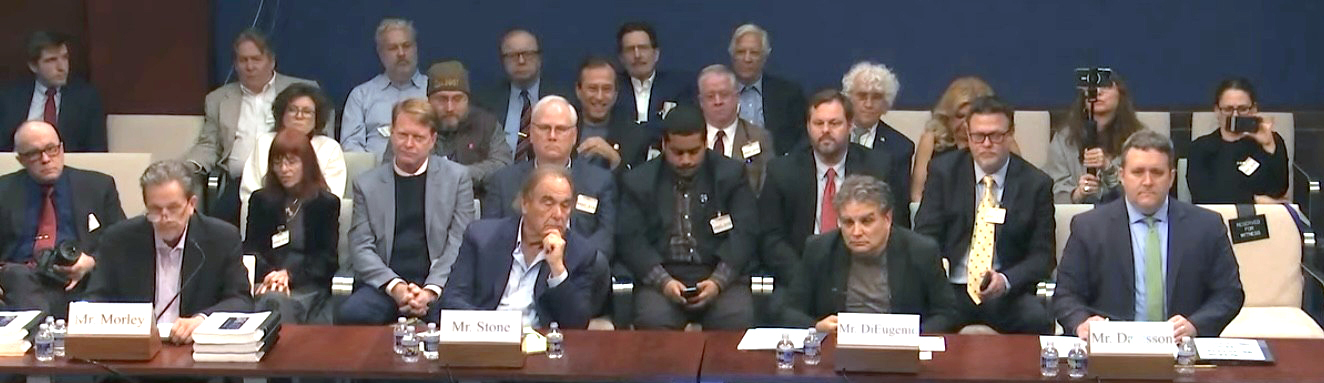
    This piece from Warren Commission apologist David Von Pein assumes that all Dallas Police could be trusted.

    “But do people like Jim DiEugenio actually want to believe that the Dallas Police Department, after having found a wallet on 10th Street that some conspiracists think was planted there by either the DPD or somebody else, would have NOT SAID A WORD about finding Oswald’s wallet in any of their police reports?”

    Unfortunately, the answer to this question is yes.

    There’s a very good reason why a wallet planted prematurely might disappear and be hushed up, i.e., if it messed up the planting of evidence at 1026 N. Beckley by a small clique within the DPD, which had then caused regular officers to search 1026 N. Beckley and find nothing in Oswald’s actual room.

    Once the Katzenbach Memorandum was acted upon as a political objective, the DPD, FBI, and all other agencies had not merely carte blanche to cover up but a command to do so. Hence, the post-event pressure on Earlene Roberts. As a result of pressure on FBI agents and the rest of the investigatory establishment.

    The Von Pein position is lacking in political context as well as evidence.

    Anyone who reads the evidence in the Warren Commission report properly will find discrepancies in timings, obscured events, Freudian slips, over-embellishment of accounts, and stories that lack basic credibility.

    Belin, in particular, had a habit of interrupting at the very point someone was saying something that would now be described as “off-message”.

    I set out in my Death of Tippit articles at Kennedys and King to show how muddled and full of fancy were the accounts of Sgt. Gerry Hill, Captain William Westbrook, and Reserve Sgt. Croy, as to how they got to the Tippit murder scene, and then the Texas Theater. I show the placing of a strip over an evidence report, which masked that Captain Westbrook had found a ‘gray’ jacket after 1:30 pm, which police radio reported as found around 1:20 pm as a white jacket. Also, Westbrook’s exhibit in monochrome appears gray, but a color version shows tan.

    I also set out on K&K to show that the police tapes were altered, including a fake call at 12:45 pm, which covered up the fact that Tippit had been at the Gloco filling station.

    Dallas County District Attorney Henry Wade stated this to the Commission, Volume V, regarding Captain Fritz, the head of homicide for the DPD.

    “I don’t know what the relations-the relations are better between Curry and Fritz than between Hanson and Fritz, who was his predecessor. But Fritz runs a kind of a one-man operation there where nobody else knows what he is doing. Even me, for instance, he is reluctant to tell me, either, but I don’t mean that disparagingly. I will say Captain Fritz is about as good a man at solving a crime as I ever saw, to find out who did it but he is poorest in the getting evidence that I know, and I am more interested in getting evidence, and there is where our major conflict comes in.”

    There’s another term for ‘solving’ crime without sufficient evidence. It’s called fitting people up. Particularly serious in a state with the death penalty.

    The searches, and full or not full

    Officers, at that stage, looking for someone on the run, having shot a police officer and discarding an Eisenhower jacket whilst running away would have information and incentive to search any room occupied by any young man who could fit that description, which is just what Arthur Johnson described (Vol. 10, p. 305).

    Mr. Belin. Well, let me backtrack a minute, now. How soon after you got home did the police come—approximately?

    Mr. Johnson. I’d say within 30 minutes.

    Mr. Belin. All right. 30 minutes after you got home, the police came. And what did the police say to you?

    Mr. Johnson. They asked if—uh—we had anyone by that name living there.

    Mr. Belin. By the name of Lee Harvey Oswald?

    Mr. Johnson. Yes.

    Mr. Belin. And what did you tell them?

    Mr. Johnson. We told them, “No.”

    Mr. Belin. All right. And then what did they say?

    Mr. Johnson. Well, they wanted to see the rooms. They had described his age, his build, and so forth, and we had two more boys rooming there. Uh—and my wife was going to let them see the rooms.

    Mr. Belin. Your wife was going to let them see the rooms that you had—and you had a total of 17 roomers, I believe you said?

    Mr. Johnson. Well, no. I don’t know just how many roomers we had. We have 17 bedrooms—but I don’t know just, at that time, how many roomers we had.

    But, anyway, we had a couple of boys around his age that had moved in just a few days before, and, so, she was going to let them see their rooms.

    There is clearly a sensitivity about his wife letting them see the rooms. Which I assume is provoked by the warrant issue. There was also another distraction and a leading question from Belin, stating, “You had 17 roomers”. That was misrepresenting what Arthur Johnson had earlier (page 302) stated: that they hadn’t been fully booked in the last six months.

    BELIN. About how many people do you have that room there?
    Mr. JOHNSON. Well, when it’s full, we have 17.
    Mr. BELIN. Has it been full within the past 6 months at all, or not?
    Mr. JOHNSON. No, no, it hasn’t
    Mr. BELIN. By the way, how long have you been married, Mr. Johnson?
    Mr. JOHNSON. Seventeen years.
    Mr. BELIN. You’ve been married 17 years
    ?

    Gladys Johnson said it hadn’t been full in October 1964. Arthur did with the above, emphatically. “No, no. It hasn’t”. Belin changed the subject by asking inanely how long the Johnsons had been married, as if he were a chat show host.

    But Belin also made a logical error regarding the math. If the official line was correct, for the place to be full, if “Room 0” was taken, then there would have been 18 roomers. That isn’t merely full, it’s overfull. Oswald would then come back when one had moved out, making it overfull again. Neither of the Johnsons testified fully, let alone overfully.

    Having said what he said above, Arthur Johnson then indicated the searches had already progressed.

    Mr. Belin. All right. And then what happened?

    Mr. Johnson. Well, I saw his picture on television and I hollered at them and told them. They were out in the back, started around the house to the—uh—basement where these boys room. The bedrooms are all in the basement. And they were going back there.

    And—uh—I just called them and told them, I said, “Why, it’s this fellow that lives in here.”

    Mr. Belin. You told them that you had seen the picture of this man on television?

    If I am correct in my assumption that the lack of a warrant was used as a lever to make up a story, then this exchange is evidence of it. Johnson seems to be describing a search of the rear annex as well as the basement. If officers in hot pursuit arrived even as late as 2:00 pm, then police arriving at 3:00 pm after the arrest of Oswald wouldn’t have hampered the search, which started over an hour earlier.

    Note, Belin also made yet another inane interjection, repeating what Johnson had said, rather than challenging what Johnson was saying.

    Earlene Roberts, in this exchange, revealed more irregularities in several ways.

    Mr. BALL. After he left the house and at sometime later in the afternoon, these police officers came out, did they?

    Mrs. ROBERTS. Well, yes.

    Mr. BALL. And they asked you if there was a man named Lee Oswald there?

    Mrs. ROBERTS. Yes.

    Mr. BALL. And you told them “No”?

    Mrs. ROBERTS. Yes.

    Mr. BALL. Then what happened after that?

    Mrs. ROBERTS. Well, he was trying to make us understand that—I had two new men and they told me-Mrs. Johnson told me, “Go get your keys and let them see in” I had gone to the back and they still had the TV on, and they was broadcasting about Kennedy.

    Just as I unlocked the doors Fritz’ men, two of them had walked in and she come running in and said, “Oh, Roberts, come here quick. This is this fellow Lee in this little room next to yours,” and they flashed him on television, is how come us to know. Mr. BALL. Then you knew it was the man?

    Mrs. ROBERTS. Yes; and I come in there and she said, “Wait,” and then again they flashed him back on and I said, “Yes, that’s him-that’s O. H. Lee right here in this room.” And it was just a little wall there between him and I.

    Mr. BALL. That was the first you knew who it was?

    Mrs. ROBERTS. Yes, because he was registered as O. H. Lee.

    Mr. BALL. Did you ever know he had a gun in his room?

    Mrs. ROBERTS. No; I sure did not.

    The line “Go get your keys and let them see in.” with “as I unlocked the doors”, goes entirely against the line Room 0 was only of interest only after Fritz’s officers arrived at 3:00 pm and only accessed with a warrant after 4:30 pm.

    But she also revealed there were the officers who first arrived, asking for Lee Oswald, then ‘two new men’ with the unlocking of doors, and then the Fritz men, who were Potts and Senkel, arriving at 3:00 pm.

    But if the police did turn up looking for Lee Harvey Oswald and she really did have a current guest called Mr. OH Lee, and there was already a description of a young man who looked like him it wouldn’t take a TV appearance much later for “oh it’s O.H. Lee”, to trigger the connection with Room 0, the small room next to hers without a lock.

    But that is just what Potts described.

    Mr. POTTS. 1026 North Beckley.
    Mr. BALL. What happened when you got there?
    Mr. POTTS. We got there and we talked to this Mrs.–I believe her name was Johnson.
    Mr. BALL Mrs. A. C. Johnson?
    Mr. POTTS. Mrs. Johnson and Mrs. Roberts.
    Mr. BALL. Earlene Roberts?
    Mr. POTTS. Yes; and they didn’t know a Lee Harvey Oswald or an Alex Hidell either one and they couldn’t–they just didn’t have any idea who we were talking about, so the television–it is a rooming house, and there was a television—-
    Mr. BALL. Did you check their registration books?
    Mr. POTTS. Yes, sir; we looked at the registration book–Senkel, I think, or Cunningham–well, we all looked through the registration book and there wasn’t anyone by that name, and the television was on in the living room. There’s an area there where the roomers sit, I guess it’s the living quarters–it flashed Oswald’s picture on there and one of the women, either Mrs. Roberts or Mrs. Johnson said, “That’s the man that lives here. That’s Mr. Lee—O.H. Lee.” She said, “His room is right here right off of the living room.”
    Senkel or Cunningham, one of them, called the office and they said that Turner was en route with a search warrant and we waited there until 4:30 or 5 that afternoon. We got out there about 3.
    Mr. BALL. You waited there in the home?
    Mr. POTTS. We waited there in the living quarters.
    Mr. BALL. You did not go into the small room that had been rented by Lee?
    Mr. POTTS. No; we didn’t–we didn’t search the room at all until we got the warrant.
    Mr. BALL. Who brought the warrant out?
    Mr. POTTS. Judge David Johnston.

    It’s one thing for one detective not to spot “Lee” if he was in the register, as OH Lee, or Lee Harvey Oswald, but for all three detectives to miss it as well? It doesn’t end there.

    Arthur Johnson testified he’d spotted Oswald on TV.  But Potts testified he was there when “one of the women” spotted Oswald on TV.  Roberts testified “she” (Mrs. Johnson) saw Oswald on TV whilst Roberts was “unlocking doors” with police officers. 

    There is a pattern of indicating doors were almost unlocked and almost opened. Any belief in the story that they were watching TV at 1026 N. Beckley for the “oh, it’s OH Lee” moment also has to contend with this memo from Hubert and Griffin of March 6, 1964, to Rankin. 

    “Her [Earlene Roberts’] failure to notify the police of Oswald’s residence at the N. Beckley address. (Mrs. Johnson apparently called the police from a different address immediately upon seeing Oswald’s picture on TV but Roberts who was watching TV at the N. Beckley address, did not).”

    With that, the TV part of the story collapses as well.

    When was the OH Lee name made up? If so, when?

    None of the attending parties on 22 November 1963, with the warrant at 4:30 pm, referred to OH Lee.

    The testimony of Fay Turner, Vol VII, taken at 2:30 pm on April 3, 1964, made no mention of OH Lee. He actually referred, as did Earlene Roberts in her 5 December 1963 affidavit, to Lee Oswald.

    Mr. TURNER. Well, Detective Moore was in the office. He and I got a car and drove down by the, back down to the sheriff’s office, and when we got there, Judge Johnston and one of the assistant district attorneys, Bill Alexander, was standing on the front steps waiting for us, because someone got ahold of him by phone and told them I was on the way.
    Mr. BELIN. Was that Detective H.M. Moore?
    Mr. TURNER. Yes, sir.
    Me r. BELIN. Then what did you do?
    Mr. TURNER. We went on over, the four of us–me, Detective Moore, Judge Johnston, and Mr. Alexander–went over to 1026 North Beckley where this Lee Oswald had a room in it.
    Mr. BELIN. You went over there on November 22?
    Mr. TURNER. Yes, sir.

    Turner not only failed to refer to OH Lee, but he also used the emphasis “this Lee Oswald”. By 3 April 1964, Oswald was known globally as Lee Harvey Oswald.

    Belin seems to have picked up on that slip and responded with yet another irrelevant change of the subject. It’s plainly obvious Turner is talking about the day of the assassination. Furthermore, Fay Turner was accompanied to 1026 by Officer Henry Moore; his testimony, Vol. VII, taken at 11:00 a.m. on April 3, 1964, again made no mention of OH Lee.

    The same goes for the Judge, David L Johnson, who arrived at 1026 with Turner, Moore and Deputy DA Bill Alexander. He made no mention of OH Lee when he testified on 26 June 1964, Volume XV. It would be a highly relevant point of law to search the room of someone registered under a different name from that on the warrant. Alexander did not testify.

    Earlene Roberts didn’t use the term OH Lee in her December 5, 1963, FBI affidavit. The comprehensive index of names which appear in FBI statements has hundreds of references, but the only reference to ‘OH’ Lee is for her statement. But in that affidavit, she said she took the reservation. In her Commission testimony, she had said Roberts did it. The affidavit makes no reference to any of the events at 1026 on 22 November.

    Arthur Johnson is listed in the Earlene Roberts file, in a memorandum from Norman Redlich as making an FBI report to Agent “Gamberling” (Gemberling) on 30 November 1963, which refers to OH Lee., But that record seems to be missing. The Redlich memorandum refers to Arthur Johnson telling the FBI on seeing Oswald on TV, which runs counter to Warren Commission testimonies and the reports of police officers Potts and Senkel–which omit the FBI–only referring to Johnson telling the police at 1026.

    So, by Monday, 25 November 1963, the name OH Lee had only appeared in the incident reports of Potts and Senkel and the FBI statement of Gladys Johnson.

    The Potts and Senkel statements are far from contemporaneous. They are undated, are typed as one document and refer to Ruby shooting Oswald. That dates them to late 24 November at the earliest.

    The Dallas Morning News made no mention of OH Lee on November 22, 23, or 24. Things stayed that way until April 1, 1964, when parties came to testify. By which time Roberts and Arthur Johnson had used it, and Gladys Johnson brought the slip but not the register, having changed her story about who had taken the booking.

    Was Oswald even using an alias at 1026?

    There are two possibilities. Oswald was registered at 1026 in his real name, or he was not.

    To me, the best indication that he did use his own name is the fact that the name in the planted wallet was Lee Harvey Oswald. Then there is what I have set out above, which includes the phone call to Gladys Johnson from her daughter as Oswald was being arrested.

    The only other evidence for an alias is Ruth Paine saying she called 1026 and asked for Lee Harvey Oswald, and they didn’t know who he was. But why give her the phone number if he was there under a false name? His daughter was born on 20 October 1963 whilst he was living there. A good reason to be contactable.

    Why would the name OH Lee be made up? That’s simple, it would create a cover story for why those officers who first attended had not looked in the right place the first time around.

    A benefit of pretending Oswald was using the name OH Lee is that it also creates smog, given that there was an unconnected Herbert Lee who had moved out. It seems to have confused Gladys Johnson when she testified. In short, there are no consistent accounts of who saw what and when, and who said what to whom. The only consistency is the irregularity.

    Why did Earlene Roberts leave overnight?

    The Warren Commission file makes clear that Griffin and Hubert not only didn’t believe Roberts but saw her as a potential conspirator. The result of the March 6, 1964, memorandum was that her testimony was delayed. It was meant to be April 1, 1964, the same day as the Johnsons.

    Roberts disappeared from her employment at 1026 in the middle of the night, according to the testimony of Gladys Johnson. She put that departure as Saturday, 6 March, which is interestingly the same day as the Griffin and Hubert meeting and memorandum. That delay seems to have been covered by a pretext – in Gladys Johnson’s testimony – that she didn’t reply to the Commission request to attend as the Johnsons didn’t know where to send it.

    To set Oswald up, with a visit by an imposter whilst he was already at or on the way to the Texas Theater by Rambler, and to enable evidence planting would need minor complicity from one person at 1026. Two extra keys. Is that what Earlene Roberts did for her sister, Bertha Cheek, as a favor for Jack Ruby? Neither woman would need to know what it was for.

    For all the pressure put on Earlene Roberts, one fact seems to relieve her of any guilt. She revealed, by 29 November 1963 (Friday), what appears in this DPD note: she saw car 207 and heard it toot at the time the man she thought was Oswald was in the house. She said she was certain, as she knew the officers who used car 170 and wanted to check whether it was them. She had been a PBX telephone operator, a job that requires fast acting and a facility with numbers.

    Who were the officers who first attended and searched Oswald’s room?

    By exclusion, from my prior articles, it couldn’t have been any of the parties at the Texas Theater for the arrest of Oswald. That rules out Hutson and Baggett, who I believe were clean, plus Hawkins, McDonald, CT Walker, Westbrook or Hill. It would rationally be officers at the Tippit murder scene.

    According to my prior articles, corrupted officers from the Tippit murder scene, bar Croy, are accounted for in the group at the Texas Theater, and corrupt officers would know that searching the room pre-emptively was a problem. Croy’s behavior cannot be explained from 12:30 pm to 2:00 pm. He said he drove one block from the Texas Theater at the time of Oswald’s arrest there. Was it his job to plant evidence in Oswald’s room, only to find that other police had already searched it?

    According to Bill Simpich, Croy got the wallet from an unknown person, gave it to Sgt. Owens, gave it to Westbrook, who showed it to Agent Barrett. After the wallet was videotaped, it went back to Westbrook’s custody.

    Officer Poe, who appears entirely regular in his behavior and statements, not least as he is relevant to the proof that Jerry Hill was lying (below), also said he was at the Texas Theater.

    That leaves Officer Jez, his partner. This article on K&K by Jack Myers states.

    “Before his death, Dallas Police Sergeant Leonard Jez was asked to comment on the presence of Oswald’s wallet at 10th & Patton. Jez had been one of several officers officially present at 10th & Patton, and whom Lt. Croy could not recall. Jez verified the existence of the wallet at the murder scene, he had seen it with his own eyes.

    “Don’t let anybody bamboozle you,” stated Jez flatly. “That was Oswald’s wallet.” “

    I note Warren Commission apologist Dale Myers has said he did not believe Jez. But I am more concerned with Myers not commenting that it is Sgt. Hill, Captain Westbrook and Sgt. Croy, who are not believable.

    By DPD patrol radio, Jez and Poe arrived first at the Tippit murder scene. Then, inside a minute of that, Officer Owens arrived, who said he carried Westbrook and Deputy DA Bill Alexander. But Jerry Hill said he arrived with Owens and was talking to witnesses when he saw Poe’s car pull up. An impossibility if Hill had arrived with Owens.

    I note Dale Myers was given access to particular DPD officers in his work to prove Oswald killed Tippit. But I find considerable overlap between those Officers with gross inconsistencies in their accounts and those he interviewed. Thus, Myers seems to dismiss other officers’ accounts, whilst not dealing with the many problems with those he was given access to.

    My personal conclusion is that Hill arrived in the same car 207 he’d left City Hall in to arrive at the Tippit murder scene, having delivered a decoy for the ambush of Tippit, via 1026 N Beckley. Thus, it was the decoy Roberts saw at 1:00 pm, not Oswald. Westbrook took car 207 back to the depository and then arrived again with Stringer and reporter Jim Ewell. Westbrook then made pointless patrol radio calls around 1:30 pm, which served to indicate he’d only then arrived. However that is betrayed by the fact – which he went to great lengths to cover up – that Westbrook discovered the fugitive’s jacket just before 1:20pm, called out on the radio by another officer.

    Further, this DPD record of June 1964 states “his records further indicated that Patrolman JM Valentine was the sole occupant of car Number 207 on November 22, 1963”. But that’s demonstrably false. By the account of reporter Jim Ewell, he arrived at the Depository building with Valentine and Hill. TV footage shows Hill getting out of that car with “207” on its door.

    A small clique of Officers, perhaps complicit in the impromptu murder of Tippit, would obviously have a position to protect. Officer Jez would not.
    Click here to read part 1.

  • Oswald, Beckley and the Tippit Wallet, Part 1

    Oswald, Beckley and the Tippit Wallet, Part 1

    John Washburn explores the evidence that the authorities knew who Oswald was and that he was at the Beckley Street rooming house way before the official story says they knew it. In addition, they were there much earlier also.

    Oswald, Beckley and the Tippit Wallet, Part 1

    By John Washburn

    Some researchers have suggested Lee Harvey Oswald did not live at 1026 N Beckley, the rooming house owned by Arthur and Gladys Johnson, with a live-in housekeeper, Earlene Roberts. Roberts is the sister of Bertha Cheek, a business associate of Jack Ruby.

    I have enumerated a quantity of false testimony and falsified documents in my prior articles for this site. And with no presentation to the Warren Commission of the guest register for 1026, I find that not an unreasonable position. The only paper evidence presented of his residing there is this slip of paper presented as an Exhibit with the name “OH Lee” and the words “OUT” and “Room 0”. However, I set out here why I believe Oswald was living at 1026 N Beckley, but not in Room 0.

    In doing that, I set out the necessity for a story being manufactured, whilst the components of that story do not match the facts. Something which recurs in the Kennedy and Tippit cases. All that is needed to establish that the official line was untrue is a careful read of Warren Commission testimonies and affidavits.

    “Room 0”

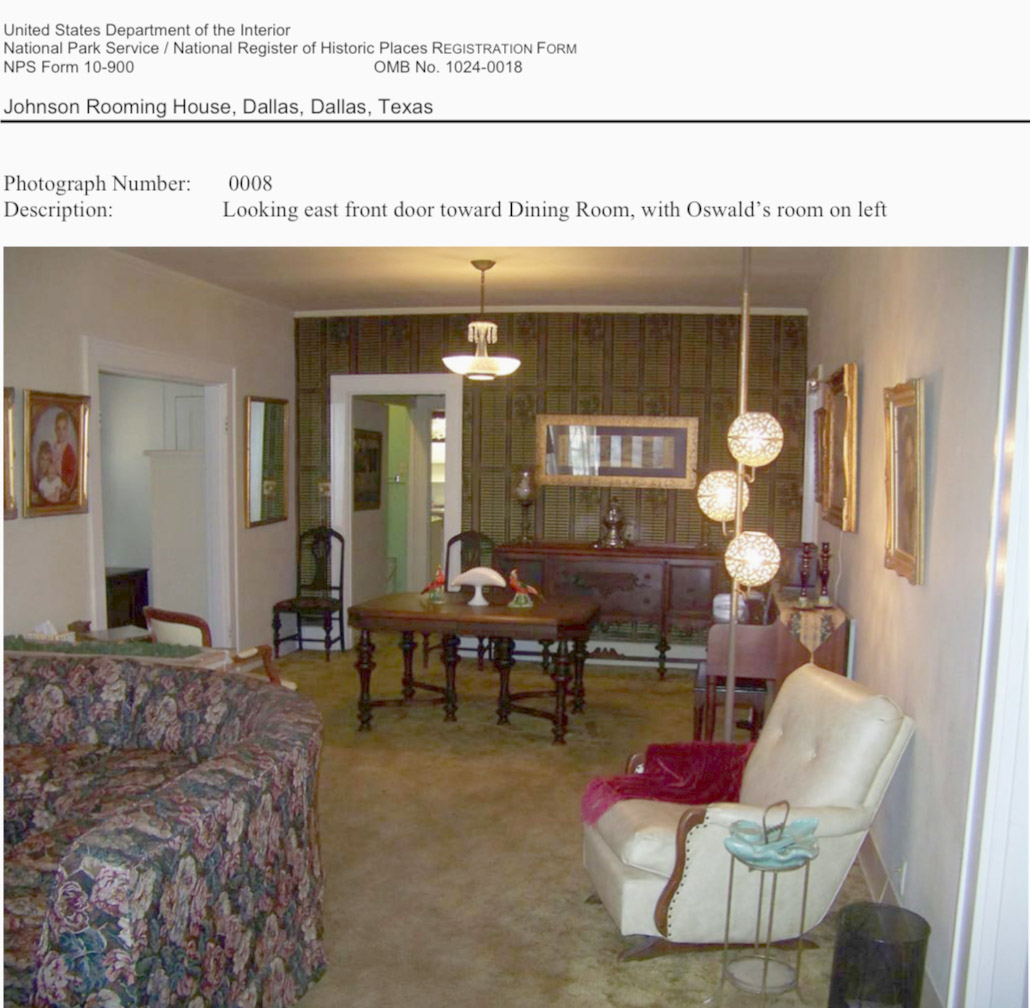
    Room 0 was a minuscule room off the TV room of 1026 N. Beckley. Designed to be a closet-library with sliding doors and no locks. It had a bed in it because the housekeeper used it for her grandchildren if they came to stay.

    The normal rooms at 1026, numbered 1-17, were located in an annex over a garage, two on the first floor by the living quarters, and the rest in a basement. The place is now a registered monument.

    The official line was that Oswald:

    • was staying in “Room 0” from 14 October 1963 until 22 November because the place had been full when he was looking for a room.
    • was using the name “OH Lee”

    And the police said they:

    • didn’t arrive at 1026 until 3:00 pm, 22 November, after Oswald was arrested and held at City Hall
    • needed a picture of Oswald to appear on TV after 3:00 pm for the connection with “OH Lee” to be made, and thence Room 0
    • didn’t search any rooms in 1026 other than Room 0

    The search is the only part of the account that is true. Room 0 wasn’t searched until after 4:30, as a warrant was obtained, which was attended by a judge, the deputy DA Bill Alexander, and Detectives Turner and Moore.

    The “OH Lee” paper slip – no register – and not full

    There was a guest register for 1026, as owner Gladys Johnson said so in testifying on 1 April 1964. Volume X.

    Mr. BALL. How many tenants did you have in October last year? 
    Mrs. JOHNSON. You know, I’m sorry I didn’t bring my register. I couldn’t tell you exactly; I imagine I had about 10 or 12. 
    Mr. BALL. Was it full
    Mrs. JOHNSON. No; I don’t–I most always have vacancies. 
    Mr. BALL. You do? 
    Mrs. JOHNSON. I have had more even since this happened.

    With that, she destroyed the line that Oswald had to take the room he took because all of the 17 normal rooms were taken.

    This is the exchange from the point she handed over the slip with OH Lee on it.

    Mr. Ball. We will make a picture of this and give it back to you.

    Mrs. Johnson. May I have something to erase this November 13, 15—I got that wrong, anyway. I was looking at the calendar and this, I was thinking it was November 13 that he left—he left my place on a Wednesday before this assassination on Friday.

    Mr. Ball. That was the last time you saw him?

    Mrs. Johnson. Yeah; the last time I saw him was on a Wednesday but my housekeeper seen him on a Friday morning right after this assassination, he came by the house hurriedly.

    Something else is amiss. She said, “he left – he left my place”, but Ball in his follow-up replaces the definite proposition that he’d checked out, with the possibility she merely didn’t see him.

    Gladys had another document with her, which she first offered to erase, and she then referred to dates that don’t appear anywhere on the O H Lee slip. Or anywhere else in her testimony.

    She appears to be backtracking, having let another cat out of the bag. She was referring to someone who checked out on Wednesday, 13 November 1963, not someone she last saw on Wednesday, 20 November. The only thing keeping her testimony on track is Ball helping it along.

    On the Education Forum, Bill Simpich has adduced evidence that there was a guest, Mr Herbert Leon Lee. That is supported by the FBI tracing calls made from the payphone at the gas station opposite 1026 to the Lee household in Shreveport. He appears to have been a genuine person (b 1941, d 2009). The FBI records show calls were made before Oswald moved in.

    Different room – searched too soon?

    I propose that Oswald did live at 1026 N Beckley, and Herbert Lee was an unconnected person who moved out on November 13, 1963. However, I propose that neither Oswald, Herbert Lee, nor anyone else was using Room 0.

    I conclude the story of Room 0 had to be made up because Oswald’s actual room had been searched by regular officers very soon after Officer Tippit was shot, but nothing was found in it. Because the evidence intended to be planted in Oswald’s room – communist literature and a gun holster – hadn’t been planted by then. If all guest rooms were already searched, there would only be one solution: to pretend he’d been in the only place not searched.

    That may seem a bizarre thing to say 60 years on. But no more bizarre than proposing that an ex-Marine, in his early 20’s was living in a minuscule room (1/3 of the size of the ones for rent), with sliding doors and no locks, opening into communal areas, with a connecting door to the bedroom of the 58 year old housekeeper Earlene Roberts. Now hidden by a curtain.

    As for Oswald: He was supposed to be of low intelligence on the one hand, whilst on the other had managed to learn fluent Russian from a Russian guide. It’s that account that is preposterous.

    That story gets worse with the additional excuse that when normal rooms did become available, he decided to stay in it regardless.

    timbush1 1

    In CE2830, Floyd DeGraffenreid – a resident at 1026 – said he only saw Oswald no more than 4-5 times and mainly in the TV room. But if Oswald was in that small room, he would be conspicuous every time he was in and out. The small room is little more than a closet of the TV room.

    The time problem – masking the first searches

    The official line was that the register was examined for the name Lee Harvey Oswald, but the room was not searched until after 4:30 pm. And only then because Oswald’s face had appeared on TV, because he was using the false name OH Lee. But OH Lee is merely the converse of LeeHO. It wouldn’t be difficult to make the connection with only 10 or so guests: Face on TV or no face on TV.

    Any police turning up with 1) a description of the person of interest running from the Tippit murder scene, and 2) the name Lee Harvey Oswald, would have at least two rooms of immediate interest, Oswald’s as well as recent guest Herbert Lee. But it is clear from various testimonies that the first round of police arrived much earlier than 3:00 pm, closer to 1:45 pm. That was before Oswald was arrested at the Texas Theater at 1:50 pm, arriving at City Hall after 2:00 pm.

    The earlier police came as a result of the shooting of Officer Tippit. This is from the testimony of Arthur Carl Johnson, Gladys Johnson’s husband, taken on 1 April 1964:

    Mr. BELIN. Could you describe how you came to find out that this man had another name other than O. H. Lee?
    Mr. JOHNSON. Well, it was when the officers came looking for him.
    Mr. BELIN. When was this?
    Mr. JOHNSON. Uh–after Tippit was shot, the police—-
    Mr. BELIN. This would have been on November 22, 1963.
    Mr. JOHNSON. Yes.

    Belin–with that interruption by stating the obvious–was changing the subject, stopping what else was going to come out.

    But the time of day does emerge from what followed. Note the CBS radio announcement at approximately 1:25 pm of Kennedy’s death was earlier than the television announcement of approximately 1:35 pm (CST). The earlier radio time can be verified because BBC TV London was ahead of US television, getting the news out live at 7:27 pm GMT (1:27 pm CST) as it monitored live radio transmissions globally.

    Mr. BELIN. He [a person Downtown] had heard over the radio that the President had been shot?
    Mr. JOHNSON. Yes.
    Mr. BELIN. And then, did you turn on your radio?
    Mr. JOHNSON. Yes. We don’t have one there in the place, so we went out in the car and sat there in the car and listened.
    Mr. BELIN. All right. And was it while you were sitting in the car that you heard that the President had died?
    Mr. JOHNSON. Yes; we didn’t leave until we–it was announced that he was dead.
    Mr. BELIN. How soon after that announcement did you leave?
    Mr. JOHNSON. I’d say 5 minutes.
    Mr. BELIN. All right. Then, how long did it take you to get to 1026 North Beckley?
    Mr. JOHNSON. It takes us about 5 minutes.
    Mr. BELIN. So that about 10 minutes after you heard on the radio that the President had been shot, you arrived with your wife at 1026 North Beckley?

    And Gladys Johnson said:

    “So I came from the restaurant, I guess 1 or 1:30, and these officers were there 1:30 or 2, something like that, anyway, it was after this assassination, and as I drove in, well, the officers were there and they told me that they was looking for this character and I told them I didn’t think I had anyone by that name there but we went through the register carefully two or three times and there was no Oswald there and I had two new tenants, rather new tenants, so we had carried them around the house to show them and we was going to start in the new tenants’ rooms and my husband was sitting in the living room and seen this picture flash on the television and he said, “Please go around that house and tell him it was this guy that lived in this room here” and it was O. H. Lee.

    Earlene Roberts, in her 5 December 1963 affidavit for the FBI, said this:

    “Oswald went out the front door. A moment later I looked out the window. I saw Lee Oswald standing on the curb at the bus stop just to the right, and on the same side of the street as our house. I just glanced out the window that once.

    “I don’t know how long Lee Oswald stood at the curb nor did I see which direction he went when he left there.

    About thirty minutes later three Dallas policemen came to the house looking for Lee Harvey Oswald. We didn’t know who Lee Harvey Oswald was until sometime later his picture was flashed on television. I then let the Dallas policemen in the room occupied by Lee Oswald. While the Dallas police were searching the room two FBI agents came in.”

    By that, the Dallas police arrived around 1:35 pm, and were asking for Lee Harvey Oswald, a person she refers to as “Lee Oswald”. She made no mention of OH Lee. The room was searched, and the FBI was there too. There is no mention of the judge or the DA with the warrant (which occurred around three hours later), and warrants are not needed in cases of hot pursuit.

    There is then her Warren Commission testimony, Vol. VI.

    Mr. BALL. Can you tell me what time it was approximately that Oswald came in?
    Mrs. ROBERTS. Now, it must have been around 1 o’clock, or maybe a little after, because it was after President Kennedy had been shot-what time I wouldn’t want to say because…
    Mr. BALL. How long did he stay in the room?
    Mr. ROBERTS. Oh, maybe not over 3 or 4 minutes-just long enough, I guess, to go in there and get a jacket and put it on and he went out zipping it.
    Mr. BALL. You recall he went out zipping it-was he running or walking?
    Mrs. ROBERTS. He was walking fast-he was making tracks pretty fast.
    Mr. BALL. Did he say anything to you as he went out?
    Mrs. ROBERTS. No, sir.
    Mr. BALL. Did you say anything to him?
    Mrs. ROBERTS. Probably wouldn’t have gotten no answer.

    Johnson again:

    BELIN. Had this man, O. H. Lee, was he there when you got there?
    Mr. JOHNSON. No; he had been there–just–uh–before we got home.
    Mr. BELIN. Did Mrs. Roberts tell you that he had?
    Mr. JOHNSON. She told us that he come in and got a–uh–little coat or something and just walked in his room and right back out the door.

    All of that is a significant departure from the official line that the police arrived at 3:00 pm.

    The disappearing wallet at the Tippit murder scene

    The thing that needs to be factored in, which can explain these anomalies, is the discovery of a wallet that can be seen in WFAA footage of the Tippit murder scene. This footage, the “Reiland film”, shows the wallet being examined with Sgt. Croy and Captain Westbrook present.

    The Reiland footage was shot between 1:30 pm and 1:45 pm at the latest. In my Death of Tippit article, I put the coverage of the wallet as shown in the film as around 1:35 pm. Since it was before Westbrook headed to the Texas Theatre for the arrest of Oswald, but after the TV crew had been filming searches on East Jefferson just before 1:30 pm.

    The drive from the Tippit murder scene to 1026 would be around 3 minutes.

    If that wallet contained the 1026 Beckley address, and the name “Lee Harvey Oswald”, then conscientious officers could and should have headed there in less than 5 minutes of it being ‘found’.

    The police at the Tippit murder scene not only had the description of someone who looked like Oswald running from that scene, but a person similar to that had been seen by Earlene Roberts entering and leaving 1026 around 1:00 pm. Added to which, the person running from the Tippit murder scene ditched a jacket, and Roberts had seen the man she described as Lee Oswald putting one on.

    It wouldn’t need a photograph on television at some point after 3:00 pm to hone in on possible people of interest at 1026. There were 17 rooms and only 10 or so guests.

    The wallet disappeared from the police record and only reappeared publicly when people spotted it in the Reiland footage in the 1990s.

    What went wrong

    I believe the wallet is essential to understanding what really went on at 1026 in the afternoon of 22 November 1963.

    If that wallet was planted prematurely – meaning it was planted in an improvised rush to set Oswald up for the impromptu killing of Tippit at 410 E. 10th – then the disastrous consequences of that would then require unpicking.

    That disaster was a search of Oswald’s actual room, by regular police officers in hot pursuit from 410 E 10th, where nothing unusual was found. Likewise, other rooms.

    By that scenario, conspirators and complicit elements of the Dallas Police would be so far down the road of setting up Oswald as a patsy that they had to have him living there with the incriminating evidence.

    That would require a clean-up operation,

    • covering up that regular officers had been there,
    • the control of 1026 by ‘irregular’ officers so that items could appear in Room 0, the only room not searched,
    • creating a fictional reason why Oswald was in Room 0,
    • creating a reason why it took so long to identify Oswald being in Room 0 (the OH Lee false name invention),
    • delaying the search of Room 0 until it could be searched with something to find,
    • creating a story/pretext to coerce Earlene Roberts and the Johnsons into an alternative account.

    False lead

    Warren Commission Counsels Leon Hubert and Burt Griffin did not believe the Dallas Police sent by Captain Fritz (see incident reports of attending officers W.E. Potts and B. L. Senkel) could have arrived at 1026 at 3:00 pm, having been sent from City Hall at 2:40 pm, after Oswald’s arrest, without some form of prior knowledge.

    That was because the official story was that the lead to 1026 N Beckley did not come from Oswald. It occurred after the Dallas City police and Dallas County Sheriff (jurisdiction over the County of Dallas as well as the City of Dallas) had arrived at the Oswalds’ lodgings at Ruth Paine’s house in Irving after 3:30 pm. Ruth Paine said she only had a telephone number for Oswald.

    The police and sheriffs then used the telephone company to trace the address.

    Ruth Paine also made the odd statement, “I was expecting you,” when the police and sheriffs arrived. When asked why she expected them, she said that Lee Oswald had worked at the scene of the shooting. (Testimony of Officer Guy Rose (8 April 1964).

    But his name hadn’t been released, nor had a photograph. She had been watching TV. It is unlikely that Oswald’s face had appeared on her TV by then. What the Commission missed–and unfortunately, Hubert and Griffin did not interview Roberts and the Johnsons–is that the doubtful reason for Potts and Senkel arriving at 3:00 was not the only irregularity. And in fact, Gladys Johnson had told her daughter prior to 2:00 PM that the FBI and Dallas Police had already been at Beckley looking for Oswald. (Sara Peterson and K. W. Zachry, The Lone Star Speaks, p. 175)

    Warrants

    Oswald was still alive until Sunday, November 24th. From the perspective of the Johnsons and Roberts on late Friday, 22 November, he would face trial. And they all would believe Oswald did it.

    I propose that complicit police officers could use a technical argument to get those people to go along with the fiction that Oswald was in Room 0. Because it was the only one that hadn’t been searched without a warrant.

    Warrants are not required when police are in hot pursuit. Warrants are required for searches after a suspect is arrested. That distinction wouldn’t be known by many members of the public.

    This – invented by me – phrase might work as simple pressure with a bit of guilt, too.

    “We have a problem. Mrs Johnson and Mrs Roberts in giving access without a search warrant have prejudiced the evidence we did find in Mr.Oswald’s room. We therefore need to say we found it in the small room, which wasn’t searched, until after we had obtained a proper warrant. A minor technicality. We will also need to say we didn’t look in that room because he was using the name OH Lee. By the way we must not mention we searched any other rooms as we didn’t have a warrant.”

    There was clearly something wrong with what the Johnsons and Roberts were saying. They weren’t very good at lying. Understandable if they were being fed a story to tell without all of the reasoning behind it.

    Roberts was clearly getting pressure from all directions.

    Mr. BALL. Why to your sorrows?

    Mrs. ROBERTS. Well, he was registered as O. H. Lee and I come to find out he was Oswald and I wish I had never known it.

    Mr. BALL. Why?

    Mrs. ROBERTS. Well, they put me through the third degree.

    Mr. BALL. Who did?

    Mrs. ROBERTS. The FBI, Secret Service, Mr. Will Fritz’ men [Dallas Homicide] and Bill Decker’s [County Sheriff].

    As well as pressure on her from at least four agencies, her answer seems to have a Freudian slip.

    Wish she’d not known what? Everyone knew Kennedy and Tippit were killed. Worrying about what name Oswald used when he registered in the overall scheme of things is trivial.

    Surely the sorrow and hassle were from him being there for six weeks, having supposedly murdered the President and a police officer.

    Unless there wasn’t a false name, but she was pressured to go along with it as an invention.

    But in her 5 December 1963 affidavit for the FBI, she didn’t show any anxiety about the name OH Lee, as she didn’t even refer to it. She indicated she knew him as Lee Oswald, but refers to the police looking for Lee Harvey Oswald. Not using one’s middle name is not using a false name.

    Why was the guest register never presented as evidence? I suggest that it is obvious. Not only would it show that 1026 hadn’t been full. It would show Lee Oswald registered in his own name.

    From examination of testimonies, there are so many areas of sensitivity, time inconsistency, over-embellishment, non-sequiturs and Freudian slips in the testimonies of Roberts, Arthur and Gladys Johnson, that everything about the official story falls over.

    The “OH Lee” alias is now an established part of the Oswald as a lone shooter narrative. But the Dallas Morning News of 23, 24, and 25 November 1963 makes no mention of it.

    That suggests that the story didn’t need to exist publicly until after the Katzenbach Memorandum of 25 November 1963, which gave the covert objective of the Warren Commission as,

    “The public must be satisfied that Oswald was the assassin; that he did not have confederates who are still at large; and that evidence was such that he would have been convicted at trial.”

    The rest of this article examines, in the light of the above, just how badly the official line plays out in testimonies taken by Counsel Belin and Ball.

    A particular issue is whether rooms were opened or not with keys – relevant to the warrant matter. But alas, Room 0 doesn’t have a lock. The library it was designed to be didn’t need one.

    (Part 2 coming soon)

    Click here to read part 2.

  • An Open Letter to Fredrik Logevall

    Jim DiEugenio takes Fredrik Logevall to task for his role in both the current Turning Point series on Vietnam and his prior role in the Ken Burns/Lynn Novick series on the subject.

    An Open Letter to Fredrik Logevall

    Dear Dr. Logevall:

    I have just watched all five segments of Turning Point: The Vietnam War. My review appears at the website Kennedys and King.com. I would venture to say it is the longest and most detailed examination of that disappointing series you will find.

    I have written or contributed to five books on the JFK case. And I was the screenwriter for Oliver Stone for his two most recent documentaries on that case, JFK Revisited and JFK: Destiny Betrayed. One of the things that puzzled me about Turning Point is that I could not find a writing credit for the series. Because if one is going to do an over six-hour series on such a controversial, multi-faceted, complex subject, it is not wise to just wing it and hope the chips fall into place. And, as we will see, that is not what I think happened here. Let me explain why.

    As you must know by now, the series begins with the John Kennedy administration. Which is odd in and of itself. Because America was involved in Vietnam two administrations prior: under Truman and Eisenhower. In other words, for about ten years before JFK was inaugurated. Kennedy inherited the war from those two men.

    What this series does is something that is inexplicable. It leads with Kennedy, and spends the whole first segment on him. It then, in Part 2, tells us about what happened in the fifties. In other words, it flashes backwards, referring to something that should have been the lead in. And at that, it is an abbreviated treatment of those ten years. The key development, what actually got this country into Vietnam, was America’s breaking of the Geneva Accords and its installation of the Nhu family as the leaders of the manufactured country of South Vietnam. This was done by President Dwight Eisenhower, Secretary of State John Foster Dulles and Vice President Richard Nixon. It had been presaged by Dulles’s planning of Operation Vulture to prevent the French collapse at Dien Bien Phu.

    There are simply no questions about any of this. America backed the French until the bitter end, and Dulles was willing to use atomic weapons to save the French empire. Dulles then broke his oral agreement at Geneva, i.e., to hold elections and then unify the country. He installed Ngo Dinh Diem as the leader of South Vietnam and kept him in power with rigged elections. This is what started the war under America and caused the rise of the Viet Minh.

    To say the film skimps over all this is being much too kind. But it cannot be skimped over, because this was all a monumental miscalculation. Vietnam was never worth using atomic bombs over, and it was not worth creating a new country, led by a man who turned out to be a tyrant. A leader who spoke English, wore Brooks Brothers suits, and had an American styled haircut. This was the true origin of American involvement. And you know this. Because you wrote a book about it called Embers of War.

    But as poor as that aspect was, it was not the worst part of Turning Point. Because the film jumped from the fifties to 1965. Let me repeat that: from the fifties to 1965. In other words it skipped over 1964! I could hardly believe what I was witnessing. Why? Because unlike what the film tried to depict, there was no mystery as to how all those American combat troops got into South Vietnam. They arrived there on President Johnson’s orders. And Johnson was planning this expansion of the war and its Americanization throughout 1964. But there was one problem. He had to get elected. So he lied about his planning for America’s direct entry. Some of the people who he had planning for that entry were William Sullivan and Bill Bundy. As Joseph Goulden wrote in his book, Truth is the First Casualty, Sullivan’s first paper on this for LBJ said that this American involvement was necessary in order to halt the advance of the Viet Cong. (p. 88)

    But we don’t need Mr. Goulden in order to certify that 1964 was a sea change do we? Because again, you wrote a book on this very subject. It was appropriately titled Choosing War. In other words unlike Kennedy, who stated it was Saigon’s war to win or lose, Johnson was making it America’s war. As you note in your book, two milestones in 1964 made it that way. The first was NSAM 288 which mapped out an air war against the north. The second was planning for a casus belli to get America into the war. This was achieved through the Tonkin Gulf Resolution, which was written before the infamous incident happened, and which Johnson carried around in his suit coat. That was the equivalent of a declaration of war against the north. From there the first American combat troops landed at Da Nang in early 1965, as planned for by Johnson.

    When Kennedy was killed there was not one more combat troop in Vietnam than when he took office. Which means there were none. As everyone who has studied the war understands, and as Maxwell Taylor and McGeorge Bundy were explicit about, Kennedy was determined not to commit combat troops into Vietnam. And he did not. Even though, as Gordon Goldstein has shown in his book about Bundy, he was confronted with this proposition nine times. Yet he refused each overture. Johnson did not need to be so encouraged.

    You would have been an excellent interview subject for what Johnson did in 1964. Instead you uttered the phrase that Vietnam was not Kennedy’s shining moment. Oh really? Compared to who? Compared to Lyndon Johnson, who started Rolling Thunder and committed a half million ground troops into theater? Or compared to Richard Nixon? Who invaded both Laos and Cambodia; the latter bringing a holocaust to that country. President Nixon also dropped more bomb tonnage over Indochina than Johnson did. Or shall he be compared to Eisenhower; who was going to use atomic weapons at Dien Bien Phu, but he could not get the British to back him on that. Ike also told Kennedy that Laos was worth going to the brink over in Indochina. Thankfully, Kennedy rejected that advice.

    I first encountered you and your work through the book Virtual JFK. In the transcripts that make up that volume I thought you were a well informed and objective scholar. You then got involved with Ken Burns and Lynn Novick. They had you do the reply to people like John Newman and David Kaiser and Jamie Galbraith on Kennedy’s withdrawal in the book that accompanied their bloated and utterly mediocre series. Galbraith replied to you on that issue quite strongly and appropriately. Yet you have now repeated that performance. Again, you are part of a film that ignores NSAM 263, the McNamara/Taylor Report, and Johnson’s conscious reversal of Kennedy’s policy. Maybe you did not know what this film was going to be like. After all there does not seem to have been a script. But you sure do know now.

    I’d wish you well on your relatively new high profile. But it’s not the profile I had imagined for you.

    ( This letter will be sent directly to the director and one of the producers of Turning Point.)

  • Turning Point: The Vietnam War, Part 5

    Luminat Media finishes their disappointing series on the Vietnam War by underplaying the evil done by Nixon and Kissinger in Cambodia and Laos, and in dragging on a conflict that could have ended in 1969. All because of the figurehead of Thieu.

    Turning Point, Part 5

    The peace talks on ending the war began under Lyndon Johnson. As we have seen, Richard Nixon covertly sandbagged Johnson’s negotiations through the Chennault Affair. So the talks continued under Nixon’s presidency. As with Johnson, there were two sets of talks, one open and observed, the other secret. Under Johnson, the secret negotiator was Averill Harriman. (No Peace, No Honor by Larry Berman, p. 25) Under Nixon, it was Henry Kissinger.

    I

    As many have commented, North Vietnam handled these negotiations adroitly. And it was all in keeping with their strategy that the long run was important. In other words, the longer they could delay any kind of truce or ceasefire, the more time they would have to attack and infiltrate their men into the south. I could not find anywhere in Turning Point, Parts 4 or 5, where this important issue was delineated. To me it is crucial to understanding how the war was decided. Hanoi also understood that the longer the war dragged on, the more that both Congress and the public would grow simply sick of all the violence. These tactics turned out to be effective.

    On the other hand, Richard Nixon had told the Russian ambassador, Anatoly Dobrynin, “I will not be the first president to lose a war.” (Berman, p. 48). But, as we also have seen, Nixon understood that the war itself was lost. Therefore, with a war that was becoming more unpopular as it proceeded, Nixon decided to turn over the actual fighting of the war to Saigon. And he would incrementally withdraw American combat troops. Nixon’s term for this was Vietnamization. By expanding the war into Laos and Cambodia, and dropping much bomb tonnage, Nixon hoped to make Hanoi understand that he would drive a hard bargain. What he first proposed was a mutual withdrawal of forces and no coalition government in the south. (ibid, p. 53)

    The first meant that all American military forces and PAVN forces would leave the south. The second meant that President Thieu would stay on until there were free elections there. In the opening rounds of the 1969 negotiations, it became clear that Hanoi was dead set against the first request and was almost as firm against Thieu staying. It was also clear that they understood that public and political opinion would provide pressure on Nixon. (Berman, p. 66)

    Let us explain–which the film does not–why the North would not agree to the first request. Hanoi was well aware that they had defeated the French on the battlefield in 1954. Dien Bien Phu was a terrible blow to not just France, but the concept of European colonialism. But they also realized that they lost the treaty at Geneva. They never should have agreed to an artificial separation of the country at the 17th parallel, and then reunification under free elections two years later. American Secretary of State John Foster Dulles had committed hundreds of millions in aid to the French struggle, and he even offered the use of atomic weapons to Paris. With that kind of investment, America was not going to go away easily. Or as he said, it was “best to let the French get out of Indochina entirely and then to try to rebuild from the foundation” ourselves. (Michael Swanson, Why the Vietnam War?, p. 114) Dulles thus subverted the Geneva Accords, and through a series of covert and overt actions, he exchanged French colonialism for American imperialism. (William Blum, The CIA: A Forgotten History, pp. 137-39)

    Ho Chi Minh, and later Hanoi leader Le Duan and his chief negotiator Le Duc Tho, were not going to let that happen again. They were not going to settle for less than they had won on the battlefield. So they were not going to agree to remove their soldiers in the south. In fact, they were going to present Nixon and Kissinger with a surprise in that regard.

    II

    The Easter Offensive took place in March of 1972. Turning Point glances over it and ignores the real importance of the action. The three-pronged attack ended up being a military failure. But it only failed because Nixon had to use an extensive amount of both Air Force bombing and Navy shelling to stop it. In just six months, Operation Linebacker dropped over 155,000 tons of explosives on North Vietnam. This was the first instance of the usage of laser-guided missiles. (Berman, p. 132)

    There are two points to be made about this attack. Without American air power, in all probability, it would have succeeded in winning the war. Which meant that Vietnamization was not going to work. Secondly, Kissinger told the Russians that Nixon would now accept a cease-fire in place, and this included leaving PAVN troops in the south–even those from the Easter Offensive. (Berman, p. 125) The film does note the second point; I could not find the first.

    There is also an outright clear deception that the film should have noted by Nixon. It is important not just because of the lie, but because it reveals how worried he was that the war was about to be lost. In his pathetic apologia of a book, titled No More Vietnams, he said that he never seriously contemplated either bombing the dikes or using atomic weapons in Vietnam. This was false. As Jeffrey Kimball discovered, Nixon considered doing both at the same meeting with Henry Kissinger. This was during the Easter Offensive when General Giap’s attack was threatening to take Saigon. (Jeffrey Kimball, The Vietnam War Files, pp. 214-19; Oliver Stone and Peter Kuznick, The Untold History of the United States, p. 386) All of this because Kissinger refused “to believe that a little fourth rate power like North Vietnam does not have a breaking point.” (Stone and Kuznick, p. 363)

    I could not detect that crucial quote in the film. But Kissinger turned out to be wrong about it. What happened of course was that the USA had a breaking point. It was the same breaking point that Edmund Gullion warned JFK about back in 1951 in Saigon. And like Gullion warned about France, America could not win a war of attrition in Indochina since the home front would not support it.

    After the Easter Offensive, Congress was much opposed to extending more funding for the war. Nixon and Kissinger were very aware of this issue. Because soon, about two months after it was over, the Democratic caucuses were to vote overwhelmingly against more funding. (Berman, p. 221) After the near success of the Easter Offensive, the writing was on the wall. The Saigon regime could not survive without massive and indefinite American intervention. And the Democrats were not going to go along with the continued financing of an endless and futile war.

    III

    Nixon’s admission to leaving PAVN troops in the south was a tell-tale sign about what he and Kissinger had really planned.

    Nixon and Kissinger now began to design their infamous “decent interval”. Knowing that Nixon’s Vietnamization plan would never defeat Giap’s PAVN and the Viet Cong, they began to plan the withdrawal of all United States forces–leaving only a bare bones maintenance mission behind. They only wanted assurances from China that the fall of Saigon would take place at what they termed a “decent interval”, after a peace treaty had been signed–they suggested something like two years. (Kimball, The Vietnam War Files, p. 187) To show how complete Nixon’s abandonment of Saigon and President Thieu was, the South was not represented at the secret Paris Peace talks. President Thieu was not told about them in advance, but only given brief summaries after the fact. (Larry Berman, No Peace, No Honor, pp. 43-44, 69) Nixon’s abandonment was so inclusive that, at the end, he allowed over approximately 150,000 PAVN troops to stay in the south. Combined with the Viet Cong, there were well over 200,000 total enemy troops there after the peace treaty was signed. Many of these were in places Hanoi had secured during the Easter Offensive. This whole “decent interval” strategy is not at all adequately dealt with in the film. Even though Frank Snepp, a former Saigon CIA officer who wrote a book with that title, is in the film.

    How badly did Nixon throw over Thieu? As we have seen, in 1968 Nixon had conveyed to President Thieu that if he would boycott Johnson’s peace talks, he would get a better deal from him than he would from LBJ. Nixon gave him many pledges of support. For instance, he gave him his personal assurances that the USA would react very strongly and rapidly to any Hanoi violation of the peace agreement—which he did not. (Berman, p. 187) At Midway Island in 1969, Nixon promised Thieu he would provide 8 more years of support, four as military and four more as economic aid. (Jerrold Schecter, The Palace File, p. 34)

    It did not take long for all that to go up in smoke. In fact, when Kissinger handed him a copy of the final agreement, Thieu noted the fact that it did not even mention a separate country of South Vietnam. There were only three countries in Indochina: Laos, Cambodia and Vietnam. To rub salt in the wounds, when Thieu was handed the agreement, it was in English. (Berman, p. 163) Quite naturally, he did not want to sign the treaty. In fact, he actually began to speak out in public against it. (Ibid, p. 148) Nixon threatened to enact the agreement without his signature, but he was bluffing.

    Thieu had over 60 objections to the proposed ceasefire. Nixon and Kissinger decided to be as fair as they could with him so he would sign. So they actually presented these to Hanoi in Paris. (Berman, 189) Thus began the notorious Christmas Bombing of late 1972. It was due to the demands made by Thieu. When Hanoi’s chief negotiator, Le Duc Tho, said he had to journey back home to get approval, the bombing began. Contrary to conventional wisdom, this did not bring Le Duc Tho back; Nixon had to ask him to return. (Kimball, The Vietnam War Files, pp. 279-80) But even then, he was reluctant to do so. The Chinese convinced him to return. They told him that Nixon had spent his last dollar on this bombing, and his political problems with Watergate were not going to disappear. They told Tho to return, sign the agreement, and they would get everything they wanted in the long run. (Berman, p. 221) The agreement was signed on January 27, 1973; and the Chinese were correct about the long run.

    IV

    Nixon hailed the signed agreement as one which would determine the future of South Vietnam without outside interference. Secondly, that it was a peace with honor for America. And third, that it had the full support of President Thieu. These were all either extreme hyperbole or knowingly false.

    Like President Diem, President Thieu never had any real legitimacy in Vietnam. In fact, Ellsworth Bunker, the next-to-last ambassador in South Vietnam, admitted that his re-election was rigged. (Berman, p. 145) One of the problems he had was the literally tens of thousands of political and military prisoners he held in indefinite detention. How could America be supporting democracy if we were rigging elections and holding that many people in prisons?

    Nixon kept Thieu for two reasons. First, he owed him something for the cooperation Thieu rendered in the October Surprise of 1968, the Chennault Affair. Without that subterfuge, it is highly likely that Hubert Humphrey would have won the 1968 election. (Kimball, Nixon’s Vietnam War, p. 60) Secondly, he also understood that Thieu would allow him to apply air power if need be to enforce the peace. Because Thieu had no legitimacy, the two men needed each other. This problem was made even worse because Le Duc Tho was fully cognizant of it—which is another very notable fact that Turning Point severely discounts. Le Duc Tho quite candidly said to Kissinger that Vietnamization was not working; that Nixon’s assault in Laos had been forlorn; that Rolling Thunder had not achieved its objective. He concluded, correctly, that America had failed in Vietnam.

    He then delivered his left hook about Vietnamization:

    Before, there were over a million US and puppet troops and you failed. How can you succeed when you let the puppet troops do the fighting? Now, with only US support how can you win? (Kimball, The Vietnam War Files, p. 127)

    This, of course, was an accurate observation. And Kissinger knew it was so. It is why he and Nixon decided on the decent interval strategy as an endgame. But the absolute necessity was that Saigon had to fall after the 1972 election. In fact, Kissinger had said this to Nixon in August of 1972. All they needed was a way to keep the country together for a year or two beyond the agreement. He then added that afterwards, “Mr. President Vietnam will be a backwater, no one will give a damn.” (Ken Hughes, Fatal Politics, pp. 84-85). In fact, Kissinger had made this agenda clear with the Chinese. (Kimball, The Vietnam War Files, p. 187) It is notable that Ken Hughes is a commentator, but I did not hear him use that rather pungent quote in the film. Hughes also could have stated that both Nixon and Kissinger denied the decent interval strategy in their books, No More Vietnams and The White House Years. But yet it is proven out by the declassified record.

    Years later, Alexander Haig, who worked directly with Kissinger on the agreement, explicitly stated that it was all a sham peace. It was designed to deceive the public with the hollow motto that Nixon had gained a peace with honor. Which he had not. As Kissinger wanted, Saigon fell in 1975, two years after the agreement had been signed. The final American evacuation was a disaster, symbolic of the whole experience there. Kissinger had performed poorly at planning the whole exodus, and his ambassador, Graham Martin, was utterly hapless in executing it. The film uses a lot of screen time depicting this debacle and trying to explain Martin’s incomprehensible actions. But I don’t think anyone will ever chronicle this better than Rory Kennedy did in her fine film, Last Days in Vietnam.

    V

    Although Nixon always used Watergate as his excuse for not enforcing the peace treaty, that was not really the case. Both Congress and the American public had turned against the war by 1973. (Berman, p. 265) For example, the Case-Church amendment effectively cut off funding for combat activities in Indochina in 1973. Thieu was so hapless toward the end that the CIA actually tried to start a coup against him in order to set up a coalition government. Even Martin favored a coup. It was scheduled for April 23, 1975, but Thieu resigned two days before. Like everything else about Vietnam, it came too late since Saigon fell on April 30th. Martin had to be ordered to leave. As the last helicopter departed, about 420 Vietnamese were in the courtyard of the embassy looking skyward. Someone had scrawled on the wall, “Turn off the light at the end of the tunnel when you leave.” (ibid)

    This segment gave short shrift to the Holocaust that happened in Cambodia as a result of the Nixon/Kissinger decision to invade that country with a combined USA/ARVN force in mid-1970. This was allowed to occur because Prince Sihanouk had been deposed by General Lon Nol in an overthrow just previously, which incidentally, Le Duc Tho accused Kissinger and Nixon of orchestrating. (Berman, p. 73) In fact there is some evidence that the CIA at least encouraged the overthrow. (William Blum, The CIA: A Forgotten History, pp. 152-53)

    Lon Nol allowed the invasion, something Sihanouk would not have done. (William Shawcross, Sideshow, p. 390) In their almost mad objective of weakening Hanoi by going after strongholds in Cambodia, Nixon and Kissinger actually added to the chaos in that country and strengthened Pol Pot and the Khmer Rouge. The chaos began in 1969 with something called Operation Menu. This was the Nixon/Kissinger secret bombing of Cambodia to disrupt the movement of supplies, arms and men through the Ho Chi Minh Trail, which cut through both Laos and Cambodia. Nixon decided that this mission should be utterly secret and disguised in every way. The pilots were not to talk about it; there would be a second set of papers to disguise what they were doing as missions over Vietnam, and there would only be one raid in order to knock out a North Vietnamese headquarters that was allegedly commandeering the entire war effort. (Shawcross, pp. 22-26)

    The one raid, in March of 1969, turned into a 14-month air campaign that included 3,630 sorties by B-52 bombers. The idea was to pulverize all of Hanoi’s troops and bases along the border between Cambodia and South Vietnam. Collectively known as Menu, the differing campaigns were called Breakfast, Lunch, Dinner and Dessert, among other meal titles. (Shawcross, p. 28) As noted, this was then supplemented by a land invasion. That air/land invasion reduced villages to rubble, killed hundreds of innocent civilians, and the refugees now began a long march away from the B-52s into the countryside. The Cambodian economy had been all but destroyed. (Blum, p. 154)

    In 1973, the air war was increased into an operation called Freedom Deal. (Shawcross, p. 215) The Pentagon ended up dropping 500,000 tons of explosives on Cambodia from 1969-73. Due to this, many Cambodians grew disillusioned with Lon Nol and joined the Khmer Rouge. The membership rose from about 4,000 to 60,000 by 1973. (Shawcross, p. 296) Two years later, the Khmer Rouge took Phnom Penh.

    I won’t go into the horrors that now befell Cambodia under Pol Pot and his Khmer Rouge machine. Once the city was secured, the mad tyrant ordered everyone out and a march to the countryside. It did not matter if you were in the hospital or a woman who was pregnant. If you stopped, you were shot. The latest estimates from judicial hearings place the total number killed at about 1.7 to 2 million. The killing fields in Cambodia were mass graves, sometimes consisting of 20,00 dead bodies. Sihanouk later stated that “There are only two men responsible for the tragedy in Cambodia today, Mr. Nixon and Mr. Kissinger.” He then added that those two spent 4 billion on the Cambodian campaign, and they achieved the opposite of what they tried to do, including losing all of Indochina. He then added, “…and they created the Khmer Rouge.” (Shawcross, p. 391)

    Richard Nixon did all he could to keep his tapes and papers secret until he died. We now fully understand why. Nixon was a very bad president, and what he did in Indochina was even worse than what Johnson did. Johnson did not invade and destabilize two neighboring countries, thus killing over 2 million people.

    The Turning Point series is actually worse than mediocre. Any program that is going to comment at length on what Richard Nixon did in Vietnam should feature the work of the foremost scholar on that topic, namely Jeff Kimball. Bill Moyers would have been a very good commentator about LBJ and Vietnam. He is quite old, but there are many tapes of him on this subject. Gordon Goldstein interviewed McGeorge Bundy at length before he passed on, and he would have been good on Johnson also. The two best commentators on Kennedy and Vietnam would have been John Newman and Jamie Galbraith.

    But this was not going to be. Luminant Media and director Brian Knappenberger seem to have an agenda from the start. It was first to skimp and to blur how America got into Vietnam in the fifties, which was through Nixon, Eisenhower and John Foster Dulles. Second, to smear Kennedy by blaming him for the war and to eliminate all the evidence of his withdrawal. Third, to then skip over 1964 and how Johnson reversed Kennedy and got the combat troops into Indochina. Finally, if anything, to be kind of soft on Nixon and Kissinger.

    With all we know today about Vietnam, there is really no excuse for this. There is almost no doubt today that if Kennedy had lived, Johnson and Nixon would never have been able to do the incredibly evil things they accomplished in Indochina. Even the Pentagon Papers admitted this. In the Gravel edition, there is a chapter entitled Phased Withdrawal 1962-64. One of the aims of that withdrawal was “ to avoid an open-ended Asian mainland land war.” (Part 4 B-4, p. ii) For any program to avoid that historical fact today is rather incomprehensible.

    Click here to read part 1.

  • Turning Point: The Vietnam War, Part 4

    Richard Nixon’s honorable peace includes invading two other countries, dropping more bomb tonnage on Indochina than Johnson, condoning My Lai, and prosecuting Daniel Ellsberg for releasing the Pentagon Papers.

    Turning Point: The Vietnam War, Part 4

    Part 4 of Turning Point begins with the Nixon Administration. It will end with the huge controversy over the release of the Pentagon Papers. As we shall see, the program is not inclusive or completely accurate about the latter issue.

    As Defense Secretary Robert McNamara tried to tell President Johnson, Rolling Thunder—the bombing campaign over Vietnam—was not working. But Johnson thought it could be used as a bargaining chip to begin talks with Hanoi. During the 1968 campaign, GOP candidate Richard Nixon said that he would find an honorable way to end the war in Indochina–although he was not specific about how he would do it. In October, Nixon had a comfortable lead of about 15 points. Mainly because Vice President Hubert Humphrey was reluctant to separate himself from LBJ on Vietnam, an issue the film does not articulate. But when Johnson announced a bombing halt over the north, the peace talks—which began in May—would gain traction. And, as the film shows, Humphrey began to cut into Nixon’s lead significantly.

    To thwart this, the Nixon campaign now set out to start the original October Surprise scheme. This maneuver worked mainly through GOP power broker Anna Chennault. The object was to subvert the cease fire negotiations before one could be announced. The Nixon campaign, through intelligence passed to it from Henry Kissinger, conveyed to the government of Saigon that if they held out, they would get better terms from Nixon. (The Nation, story by Greg Grandin, 11/02/16)

    It is important to recall that, by this point, there were 500,000 combat troops in Vietnam, over a million Vietnamese had been killed, and about 30,000 Americans had died. (Robert Parry, Consortium News, 3/3/12; 1/18/13). The original tip about the Chennault sabotage came into the White House from a Wall Street financier to National Security Advisor Walt Rostow. At this same time, Ambassador Ellsworth Bunker relayed the message that Saigon’s President Thieu was now balking at a cease-fire. On November 2, 1968, Thieu made a highly publicized speech boycotting his government from the peace talks.

    Smelling a rat, Johnson ordered FBI, CIA, and NSA investigations. The inquiry discovered the roles of Chennault and Washington’s Saigon ambassador Bui Diem, who acted as a middleman. The president complained about it to GOP Senator Everett Dirksen: “They oughtn’t be doing this. This is treason.” On a phone call, Johnson confronted Nixon and threatened to go public. Nixon lied to him about it.

    But Beverly Deepe, from the Saigon office of the Christian Science Monitor, had heard of the subterfuge through local sources. She handed her story to her editor, Saville Davis, in Washington. Ambassador Bui Diem denied it all, and after a conference with his top advisors, Johnson decided not to confirm the story for Davis—even though the president knew it was true. (ibid, Parry) Thus Nixon’s subterfuge remained hidden. And he lied about it until the end. In his interviews with David Frost, he said 1.) He did nothing to undercut Johnson’s negotiations, and 2.) He did not authorize Chennault’s attempts at subterfuge.

    I have gone into more detail about this than the film does, but Turning Point misses the true denouement to Nixon’s interference. Many MSM writers have attributed the origins of Nixon’s Plumbers Unit, and therefore Watergate, to the leaking of the Pentagon Papers by Daniel Ellsberg. Robert Parry discovered that such was not really the case. The new president was told by J. Edgar Hoover about Johnson’s surveillance of the Chennault affair. As revealed on the Watergate tapes, Nixon thought Johnson and Walt Rostow had stored their evidence on his subversion at the Brookings Institute. Nixon instructed Chief of Staff H. R. Haldeman to break into Brookings and even advised him to use someone like E. Howard Hunt to do so.

    Nixon was wrong about the location. Walt Rostow sealed the materials and sent them to the LBJ Library. In an accompanying note, he labeled the papers as Top Secret, not to be opened until June of 2023. We are lucky that the late Bob Parry found out about them much earlier. (ibid)

    II

    In addition to the above, it is important to know that, as historian Jeffrey Kimball wrote, Nixon knew about the Wise Men meeting I discussed in Part 3. In March of 1968, he told three of his speechwriters:

    I’ve come to the conclusion that there’s no way to win the war. But we can’t say that, of course. In fact, we have to seem to say the opposite, just to keep some degree of bargaining leverage. (Jeffrey Kimball, Nixon’s Vietnam War, p. 52)

    In other words, before he took office, Nixon knew that the war could not be won by Saigon. But he decided to continue the conflict for political reasons. It is important to recall that Nixon was instrumental in getting America directly involved in Vietnam, and he was the first politician to ever recommend the use of American combat troops. This was during the siege of Dien Bien Phu. At that time, he also pushed for the use of atomic weapons. (John Prados, Operation Vulture, Chapter 9, JFK Revisited, by James DiEugenio, p. 131). Anyone who knows anything about Nixon understands that he was tutored in foreign policy by John Foster Dulles. It was Dulles who so memorably said after the collapse of the French empire, “We have a clean slate there now, without a taint of colonialism. Dien Bien Phu was a blessing in disguise.” (William Blum, The CIA: A Forgotten History, p. 139)

    As I noted earlier, one of the many problems with the series is that it skimps over the origins of the American involvement in the fifties. Because of that, one cannot really understand Nixon’s near schizophrenic mania about the war. And if you do not delineate his role at the start, it is not possible to explain the fruity extremes he went to– knowing Saigon could not win.

    For example, Nixon ended up dropping more bomb tonnage over Indochina than Johnson did. This is because he greatly expanded the air war over Laos and Cambodia. (Kimball, The Vietnam War Files, p. 21; William Shawcross, Sideshow, pp. 70-71) Again, in my view, the series seriously underplays this aspect; it is a significant expansion from what Johnson did. And Nixon ordered the secret bombing of Cambodia the first week he was in office. (Shawcross, p. 91) It began in March of 1969 and continued for 14 months, entailing 3,630 B-52 sorties. This campaign had horrific political effects. It began to undermine the neutralist government of Prince Sihanouk and allowed the beginning of the growth of the Khmer Rouge. To protect himself, Sihanouk appointed General Lon Nol as prime minister. Lon Nol then deposed Sihanouk, and he allowed Nixon and National Security Advisor Henry Kissinger to supplement the air war with a land invasion of Cambodia—by American and ARVN troops– in the spring of 1970. For all intents and purposes, this was the beginning of the end of Cambodia.

    In 1971, Nixon authorized an invasion of Laos by the ARVN. By most objective accounts, this ended in failure; so much so that Nixon later relieved General Creighton Abrams, who supervised American support of the operation. Even though Operation Lam Son 719 was a failure, the bombing did not stop. This bombing was even more pointless in Laos, since that was even a more backward country than Vietnam or Cambodia. (Blum, p. 160) As one commentator noted, Laos was a fledgling society the USA was trying to make extinct, to strangle in its crib, so to speak. They were so senselessly desperate in this aim, they created phony invasions from North Vietnam, not once but twice—all in order to boost military aid to a country that was landlocked and poor. (Blum, p. 159) But with the announcement of a ceasefire in Vietnam in 1973, another coalition government was announced. It would last until 1975. Up until then, due to the bombing and the incursion, “Laos had become a land of nomads without villages, without farms, a generation of refugees, hundreds of thousands dead, many more maimed.” It might not have been as bad as Cambodia, or what was to happen in Cambodia, but it was pretty much inexcusable. Eisenhower was simply wrong when he told Kennedy that Laos was worth going to the mat over. Khrushchev also wondered why Washington even bothered so much about the country, since it bored him. (Blum p. 159). But Nixon thought it was worth invading.

    III

    The expansion of the war through the invasions—Nixon called them incursions—into Cambodia and Laos brought the peace protests to a pinnacle of scope and fury. And these created tragedy at Kent State and Jackson State. At Kent State, four were killed and nine wounded by the National Guard. Chic Canfora, one of the program’s commentators, was at Kent State with her brother—who was wounded—and she does a helpful commentary on how it happened. She states in the film that the ROTC building, which was set on fire, had been scheduled to be taken down already. But further, a presidential commission concluded that the blaze was not started by Kent State students. (Commission on Campus Unrest, p. 251)

    There can be little doubt that Nixon and Governor James Rhodes despised the demonstrators and egged on the reaction to them. On the day the campus protests began, May 1, 1970, Nixon called the students bums who were burning up books and blowing up campuses. And he contrasted them with the bravery of the troops in the field abroad. (New York Times, May 2, 1970, story by Juan de Onis) Reporter Bob Woodward later stated that a year later, Nixon compared the Kent State demonstrators to the prison rioters at Attica and said Kent State might have been beneficial to his administration. On the tape, Woodward said Nixon tells Bob Haldeman, “You know what stops them? Stops them? Kill a few. Remember Kent State….” (WCBE Radio, Ohio Public Radio, May 6, 2019)

    The day before the shooting, Rhodes held a press conference in the town of Kent, and he called the demonstrators un-American revolutionaries who were trying to destroy higher education in Ohio. He said he would use law enforcement “to drive them out of Kent. We are going to eradicate the problem.” Rhodes compared the students to Hitler’s paramilitary Brownshirts who helped bring him to power. (Cleveland.com, May 3, 2020, story by Thomas Suddes; Kent State/May 4, edited by Scott Bills, p. 13)

    At Jackson State in Mississippi, two students were killed and 12 wounded. The shootings were by the Mississippi Highway and Safety Patrol and the Jackson police force. As more than one commentator has stated, unlike Kent State, there was an element of racism in this shooting. (Nancy Bristow, The Nation, May 4, 2020) All told, the demonstrations against the Cambodian attack generated protests at more than 700 college campuses. More than 200 Foreign Service employees issued a petition against the expansion of the war. Four of National Security Advisor Henry Kissinger’s aides registered their disagreement with their resignations. (Stone and Kuznick, p. 370)

    In his half-mad pursuit of a war he knew could not be won, Nixon had brought forth submerged demonic forces amid the American populace. He was intent on polarizing the country over Vietnam. In his April 30, 1970 speech revealing the Cambodian action, he said that in the USA ”‘great universities are being systematically destroyed.” Previously, he had appealed to what he called the great Silent Majority that could not abide by America looking “like a pitiful helpless giant” in Vietnam, as opposed to the bums who wanted to burn books and try to impose their will on the country by demonstrations in the streets. RMN was consciously pitting idealistic students against lunchpail factory workers and trying to split the Democratic party on cultural grounds. With Malcolm, both Kennedys and King gone, it worked.

    IV

    Even this does not show just how unhinged Nixon was on Vietnam and how effective and heroic the anti-war movement was. In 1969, Nixon designed an above top-secret plan code-named Operation Duck Hook. It included direct American infantry attacks on the north, air strikes on bridges along the Chinese border, and the mining of three seaports. (Jeffrey Kimball, The Vietnam War Files, p. 101. Other sources say that it included saturation bombing of Hanoi and Haiphong and possible use of atomic weapons–see Stone and Kuznick, The Untold History of the United States, pp. 362-64) Nixon held it so close to his vest that even his Defense Secretary, Melvin Laird, was ignorant of it. The president called it off when he saw the immense scope and intensity of the October/November Moratorium. (ibid, Kimball, p. 105; Stone and Kuznick, p. 362) It was then that he decided to give his Silent Majority speech, facing off the demonstrators against his perceived constituency.

    I could not detect Duck Hook in this series.

    At the Nixon Library in 2014, there was discovered—or some say rediscovered– evidence that Nixon and Chief of Staff H. R. Haldeman intervened in the court-martial of Lt. William Calley over the My Lai Massacre. (CBS News, March 23, 2014, story by Evie Salomon) The notes made by Haldeman indicate there was a task force for My Lai, and they should employ dirty tricks that did not go to a high level. They should also use the atrocity at Hue for countering purposes, “discredit one witness”, “use a senator or two”, and to “keep working on the problem.” According to author Trent Angers, Nixon and Haldeman were going to target Hugh Thompson and Larry Colburn, who actively tried to halt the massacre. In fact, two congressmen working with Nixon managed to seal Thompson’s testimony, hurting the cases against others who were accused. When Calley was convicted, almost immediately, Nixon had his prison sentence turned into house arrest. (NY Times, 4/2/71, story by Linda Charlton) He was paroled after a bit more than three years.

    I mentioned in the last section that the film does an above-average job on the My Lai Massacre through Ron Haeberle, the military photographer. But I could not detect any examination of Nixon’s role in the Calley trial and aftermath.

    V

    As a result of My Lai and the following cover-up, people like Jane Fonda, Mark Lane and Vietnam veteran Donald Duncan originally helped organize a public tribunal on other atrocities that had taken place in Vietnam. Eventually, this went on for three days in Detroit, January 31-February 2, 1971. It was called the Winter Soldier Investigation. The film briefly shows some of the hearings but does not go into Nixon’s reaction to them, which was to try to discredit the proceedings. (Washington Post, 12/17/17, story by Michael Dobbs) Nixon and Haldeman tried to smear the organizers as being “Kennedy supporters.” They also tried to mobilize veterans of Vietnam who were still for the war against the group Vietnam Veterans Against the War. (Andrew Hunt, The Turning, p. 73, p. 84) Nixon’s ploys worked to a degree. The film made from the hearings was not successful. Only when it was re-released in 2005 did it meet with acclaim. (Click here for a segment https://www.youtube.com/watch?v=m9KI0BUzr70)

    John Kerry became a national figure at this time when he began speaking out against the futility of the Vietnam War. His testimony before the Fulbright Committee is not included. In fact, I did not see any of those hearings on the war in the series. Yet these lasted until 1971. They were well reported on, some were even broadcast, and they were effective in ultimately cutting off funds for the conflict. Ken Hughes, one of the interview subjects, understands all this, as he wrote about it in his book, Fatal Politics.

    This segment ends with the leakage and publication of the Pentagon Papers to the New York Times in 1971. There have been several books written about that whole, long, celebrated episode, and how it rocked the MSM and Washington. I have read up on it, and interviewed some of the principals involved, e.g., the late Daniel Ellsberg, and attorney James Goodale of the New York Times. Some background is in order.

    Ellsberg was working at the Rand Corporation offices in Santa Monica when Defense Secretary Robert McNamara commissioned a study on the entire expanse of the Vietnam War, from its beginnings to the end of the Johnson administration. In other words, it did not include what Nixon had done in that regard. But Nixon decided to take action due to the (poor) advice of two people: Henry Kissinger and Attorney General John Mitchell. (Steve Sheinkin, Most Dangerous, p. 221; James Goodale, Fighting for the Press, p. 73).

    When the Times and then the Washington Post published the classified material, a legal battle broke out on three fronts. One was in court in Washington to stop publication. The administration lost 6-3 on a decision that went up to the Supreme Court. They then tried to convict Ellsberg and his friend Anthony Russo in California. That case was dismissed when the judge found out that, among other things, the White House had burglarized the offices of Ellsberg’s psychiatrist. (Daniel Ellsberg, Secrets, pp. 444-49) Third, the White House opened grand jury proceedings in Massachusetts against Beacon Press for their efforts to publish a more complete version of the Pentagon Papers than the Times did. That did not succeed because Beacon’s version was based on the papers given to Senator Mike Gravel, and he recited them into the congressional record and then submitted the rest. One should add that it was that version of the papers which included a subject called Phased Withdrawal 1962-64. For whatever reason, the Times version did not.

    Nixon had begun the so-called Plumbers Unit over his fear of being caught for his sabotage of the 1968 election. He wanted a break-in at the Brookings Institution, where he (mistakenly) thought those papers were. Both acts, the subterfuge and the break-in, were illegal. But as the reader can see from the above, that was just the beginning of a record of perfidy on Indochina that is both incredulous and horrifying. This film is too kind to the criminal.

    Click here to read part 5.

  • Turning Point: The Vietnam War, Part 3

    LBJ’s reversal of Kennedy’s policy leads to a rudderless war effort by General William Westmoreland.  As the war becomes hopeless, dissent begins to mushroom.  LBJ gives up, MLK and RFK are killed, and this leads to Nixon.

    Turning Point: The Vietnam War, Pt. 3

    In Vietnam, after the 1963 overthrow of Diem, there was a period of instability and power struggle—five governments rose and fell. One of the leading figures at that time was Nguyen Cao Ky, who came up through the Air Force and was prime minister from 1965-67. One of the problems with Ky was that he was part of a drug ring carrying opium from Laotian refineries into South Vietnam. (The Great Heroin Coup, by Henrik Kruger, pp. 134-35; Alfred McCoy, The Politics of Heroin, pp. 209-222). The other problem with Ky was his flashiness and outspoken nature. He once said, “People ask me who my heroes are. I have only one: Hitler.” But he also admitted that the communists were closer to the people’s yearning for social justice and an independent life than his government was. (Oliver Stone and Peter Kuznick, The Untold History of the United States, p. 332)

    I

    All this made him unpalatable for presidential leadership. Lyndon Johnson decided to hold an election in 1967 with Nguyen Van Thieu as president and Ky as Vice President. The pair won in another rigged election. Soldiers showed voters how to mark their ballots, and they encircled the legislature while it recorded the electoral tally. (Stanley Karnow, Vietnam: A History, p. 466; Washington Post, article by Richard Pearson,10/1/2001)

    Lyndon Johnson wanted the illusion of a democratic state, which South Vietnam was not. Accompanying this illusory aspect were various pronouncements by both Johnson and military officers about the progress of the war. General Westmoreland even taunted Hanoi to begin an attack since the Americans were ready. (Karnow, p. 514) Joseph Alsop, a well-connected and powerful columnist, wrote that Thieu and Ky predicted the war would be over by the end of 1967. (The Myths of Tet by Edwin Moise, p. 15) At the end of July 1967, Walt Rostow told Dan Ellsberg “The other side is near collapse…victory is very near.” (ibid, p. 18). In November of 1967, President Johnson brought Westmoreland to Washington, and he said the enemy was “running out of men” and “trying desperately to win a victory.” (ibid, p. 95) At the National Press Club, he then said the communists were certainly losing the war and had not been able to win a major battle in over a year. General Bruce Palmer said the Viet Cong had been defeated from Da Nang all the way down to the populated areas. (ibid, pp. 98-99)

    The film does a decent enough job in showing this political, military and press optimism, which will be shocked by the size and scope of the Tet Offensive. But it does not show the tactical maneuvering that made Tet so surprising in its effectiveness. General Giap decided to create two diversions to draw out the Americans and the ARVN to the north and west. These were at Khe Sanh, and then Loc Ninh and Dak To. (Moise, pp. 113,114) The first became a major battle, which had both Westmoreland and Johnson so worried that they considered using atomic weapons. (Erik Villard, History.net, 3/2/2022)

    The second factor that the program underplays was the intelligence failure that made the attack such a surprise. To this day, there is a dispute about how many men Hanoi was sending south prior to Tet. Westmoreland’s initial claim was between 5,500 and 6,000 per month. Even he later said that was wrong. The most reliable tally today is that the number was probably about three times that or a bit more. There was an utterly massive influx in January of 1968, as high as 45,000. And this should have been a telltale indication that something was coming. (Moise, p. 121, p. 123)

    But Westmoreland was so taken by surprise that he actually stated in February of 1968 that, “The units committed to this campaign, we carry on our order of battle.” He later added, ”No previously unidentified unit showed up.” That was simply wrong, and he probably knew it was so when he said it. (Moise, p. 124). In fact, it was so wrong that Pentagon headquarters in Saigon, Military Assistance Command Vietnam, later revised their pre-Tet infiltration figures upwards.

    Also going unmentioned in the film is the other claim by the Army: that the Viet Cong had thrown everything they had into Tet. Or as one officer put it, the VC were scraping the bottom of the barrel for recruits. This was also not true. Many Viet Cong units were simply not in position to be active in the attack at the time it happened. The initial estimates were that about 84,000 Viet Cong and infiltrated Hanoi troops participated. But Hanoi later came out with their own study saying they had used over three times that many over the whole 45-day barrage of attacks, and still had some in reserve. (Moise, p. 128)

    The only man who realized how large the coming attack was going to he was the legendary CIA analyst Sam Adams, and he did not figure it out until a few days prior. Also, very late in the day, January 25th, some DIA analysts proffered the idea that Khe Sanh might be a diversion to pull American forces away, but as this got upwards in the hierarchy, it was ignored. (ibid, p. 130) Again on January 25th—five days before Tet—the National Security Agency warned that there might be some coordinated communist attacks coming. But the warning did not say they had targeted cities or that it would be so widespread. (Ibid)

    II

    It is important to elucidate the intelligence failure that made Tet possible, for the simple reason that the offensive could not have been so powerful if it had been in any way expected. But there were almost no preparations for it. The only officer who even tried to do something in advance was General Frederick Weyand. He cancelled some operations near Cambodia and moved forces closer to Saigon. This may have prevented the capture of Tan Son Nhut Airport. But the overall feeling afterwards was conveyed by General Creighton Abrams, who “wanted to fire every intelligence officer in Vietnam.” It was that bad. (p. 132)

    Needless to say, the hopeful line that the Army and the White House had been feeding the public made the impact even worse. During the entire expanse of the multi-phased operation, scores of towns and cities were attacked, and it unfolded for weeks on end.

    If anything, the film underplays the impact the assault had in the press and in Washington. As Clark Clifford, the designated Secretary of Defense, said, “Tet, to me, was the roof falling in.” Lyndon Johnson later said that it was a shock–he did not expect an attack that was so large and so coordinated. White House Press Secretary George Christian said it was a huge surprise. He thought the Viet Cong were under control, and it was not possible for them to rise to the offensive heights they did. (Moise, p. 152)

    Because of the continuing battles at Hue and Khe Sanh, Westmoreland asked for more troops, over 200,000. This notice ended up being leaked to the press, and it created a firestorm of controversy. A New York Times editorial called it “Suicidal Escalation”. (March 11, 1968) The editorial then ridiculed the notion of a light at the end of the tunnel, which it now characterized as a bottomless pit headed nowhere: “The American people have been pushed beyond the limits of gullibility.”

    The film leaves out two rather important events that occurred as a result of this request. One was a meeting of the so-called Wise Men at the White House. This included people like Robert Lovett, Averill Harriman, and Dean Acheson. The military was giving their reasons for the call-up, and Johnson followed with a speech supporting it. In the middle of the speech, Acheson got up and walked out. When he was phoned after and asked why he left, he said, “You can shove Vietnam up your ass.” Johnson got on the line, and Acheson explained that the Pentagon was giving canned briefings and he would not stand for it anymore. He would only listen to people on the ground in Vietnam and read the raw data. This is how the group turned against the war. (The Wise Men, by Walter Isaacson and Evan Thomas, p. 687)

    Shortly after this event, Clark Clifford was sent over to the Pentagon. President Johnson wanted him to get the raw data and find out how the Joint Chiefs planned on winning the war after Tet. Clifford went there day after day for over a week. He asked many pointed questions, e.g., if we sent in more troops, would not Hanoi counter by sending more of their men? The remarkable thing about these interviews is that Clifford had been on the President’s Intelligence Advisory Board prior to his appointment as Secretary of Defense. At that time, he had been a hawk. He found the answers he got so unsatisfactory that it caused him to change his mind on the subject. He advised Johnson to begin to get out. (Isaacson and Thomas, pp. 683-89)

    The film does show the famous editorial comments on the war by Walter Cronkite, who labeled the conflict as a stalemate. LBJ reportedly said that if he had lost Cronkite he had lost Middle America, (https://www.youtube.com/watch?v=Dn2RjahTi3M) The program states that CBS president Dick Salant allowed Cronkite to do this editorial and backed the newsman after. It does not mention how, four months later, Salant allowed Warren Commissioner John McCloy to secretly have approval over the CBS four-night special endorsing the Warren Commission–and then would not admit to what he had done. (Click here for more on that https://www.kennedysandking.com/john-f-kennedy-articles/why-cbs-covered-up-the-jfk-assassination)

    III

    The film deals extensively with the battle at Hue during Tet, and it describes the massacre that took place there. Oddly, it does not go into any similar depth about Khe Sanh, which was a massive siege that lasted 77 days, beginning about a week before Tet. It resulted in 35 downed helicopters, 23 aircraft lost, and 2700 American casualties. When it was all over and the siege was lifted, the entire base was abandoned and then destroyed, rather than risk another such siege.

    The film uses Ron Haeberle to tell the story of the My Lai massacre. Haeberle was a combat photographer who took many photos of My Lai. These made it simply impossible to deny what had happened. They were published in the Cleveland Plain Dealer. He also wrote a personal account of the episode for that newspaper. The photos were then sold to Life magazine and were published in its December 5, 1969, issue. They created an immediate sensation. As did his testimony before Congress, where he described simply wanton slaughter of everyone, including women and children. The film also relates the story of Hugh Thompson, the helicopter pilot who did the most to halt the operation in real time and escorted many civilians away from the scene. Thompson was probably the most heroic person involved in the atrocity. (Click here for the film Four Hours in My Lai https://www.youtube.com/watch?v=FYzb9DH7YAE&list=PL_i8Q5O9tfujtnIlaV4vmZ9lUpLcb_mtH) )

    Although Turning Point does deal with some of the trials that happened after the atrocity, like those of Captain Ernest Medina and Lt. William Calley, it does not interview author Doug Valentine. In his fine book, The Phoenix Program, he made the argument that My Lai was really a CIA operation meant to eliminate Viet Cong sympathizers, and the Agency passed on lists to the military. William Peers, a former CIA officer who had served previously in the OSS, was appointed by Westmoreland to do the military inquiry into the massacre. During the Vietnam War, Peers began in special operations and then became a special assistant for counterinsurgency under the Joint Chiefs. Peers and journalist Sy Hersh—who wrote two books on the subject—more or less localized the affair. The latter largely chalked it up to incompetence and ambition. Hersh specifically wrote in his second book, “There was no conspiracy to destroy the village of My Lai 4….”(The Assassinations, edited by James DiEugenio and Lisa Pease, p. 367)

    IV

    The Tet Offensive was enough for Johnson to recall Westmoreland. The general was now made Chief of Staff of the US Army. Creighton Abrams became the commander in Vietnam.

    Johnson’s betrayal of Kennedy’s Vietnam policy had dealt him a lethal political body blow. Allard Lowenstein and Curtis Gans organized a Dump Johnson movement. In the autumn of 1967, Senator Eugene McCarthy had agreed to be their candidate. In November of 1967, he announced his candidacy. He entered the Democratic primaries running as an anti-war candidate. At first, no one believed he really had a chance to defeat the incumbent Democratic president. But on March 12, 1968, in the Democratic primary in New Hampshire, Johnson was held to 49% of the vote.

    McCarthy had galvanized American youth against the war. They journeyed to New Hampshire to work as volunteers. On the other hand, Johnson was so confident he had not filed, and was therefore not on the ballot. McCarthy was so well organized that he captured the majority of the delegates. The political impact was shocking. As revealed in the book 85 Days, Bobby Kennedy had decided to enter the race prior to the primary. But since he had made the decision so late, he did not announce until after the results were in. Johnson was now faced with not one but two strong opponents.

    The film does little with Bobby Kennedy’s criticism of Johnson about the Vietnam War. But yet, as many have observed, Bobby’s attacks really disturbed Johnson. Daniel Ellsberg worked for Bobby in 1968, and he knew that RFK understood there was no victory for America in Vietnam. We could not bomb our way to peace. (Lisa Pease, A Lie Too Big to Fail, p. 477) The last thing Johnson wanted to contemplate was losing to Bobby Kennedy in the primaries. But the word was out that the president’s campaign in Wisconsin was collapsing. The film depicts Johnson on the phone, realizing that he had now been labeled a war president, and it was a highly unpopular war. Using then-Johnson employee Polly Baca as a witness, the film reveals the almost tangible antipathy between Kennedy and Johnson. With one defeat barely avoided and another staring him in the face, on March 31, 1968, Johnson went on television and made a shocking declaration: He was not going to run.

    This was a political earthquake. But then, just four days later, another tremor was felt: Martin Luther King was assassinated in Memphis. The film shows Bobby Kennedy’s famous speech that night in Indianapolis, where he announced to the crowd that King had been killed. He urged the assembly not to strike out in fury and violence. Unnoted is the fact that that was the only major city that did not erupt in rioting.

    After Tet, after Johnson’s abdication, after King’s murder, what could now happen? Two months later, Bobby Kennedy was killed in Los Angeles. The film interviews Baca and Chic Canfora, who both worked for the RFK campaign. Canfora cannot speak; the memory of RFK’s death is too painful. With those two men dead, there was no one to represent the anti-war youth at the Chicago Democratic convention. Baca talks about being in a crowd when the police began striking the demonstrators with batons, and blood began to flow. Canfora observes that the powers that be wanted the war to continue and were willing to silence any voices that were opposed to it. (And that is as far as the film goes with that concept.)

    Canfora then observes that this process eventually led to someone who was even worse than Lyndon Johnson. That was the man JFK defeated in 1960: Richard Nixon.

    Click here to read part 4.

  • Turning Point: The Vietnam War, Part 2

    Turning Point continues with one of the most startling omissions ever in a documentary on the Vietnam War.  By jumping from 1956 to 1965, the film misses the monumental events of 1964, when Johnson broke from JFK and decided America would go to war with North Vietnam. Evidently, the filmmakers did not think this was important.

    Turning Point: The Vietnam War, Part 2

    All you need to know about the quality of this series is that director Brian Knappenberger gives the last word on Kennedy’s Vietnam policy to Dan Rather. This is the man who perhaps has done more to obfuscate how Kennedy was killed than any living person. (Click for one aspect https://consortiumnews.com/2016/04/22/how-cbs-news-aided-the-jfk-cover-up/) And since the program does not reveal any of Kennedy’s early talks in 1951 with people like Seymour Topping, let alone his withdrawal program, Rather can give that notion the back of his hand. (Seymour Topping, On the Front Lines of the Cold War, pp. 152-56)

    I

    In Part 2, the series finally gets to the origins of the war. We get a brief biography of Ho Chi Minh and his letters to President Truman for support in his attempt not to be recolonized by France after World War II. I could detect nothing about how Secretary of State Dean Acheson advised Truman to begin supporting the French effort to take back Indochina. Or the unwillingness of Paris to grant any true independence through their stand in Bao Dai. Even at this early date, there were analysts in the State Department who felt that Ho’s resistance would eventually lead to a war between his followers, the Viet Minh, and France. (Pentagon Papers, Volume I, p. A-5) These same analysts found there was no proof that the Soviets had a strong influence on Ho Chi Minh as late as 1948, when the imperial war had begun in 1946. (ibid, p. A-6)

    By 1950, Dean Acheson had altered the American policy of chilly neutralism. This was due to the recognition of Hanoi as a state by Moscow. That was enough for Acheson to declare Ho Chi Minh a communist, not a nationalist. (ibid, p. A-7) By the summer of 1950, Acheson and Truman were extending aid to the French puppet Bao Dai. From here on in, the USA became more and more involved in the war. Later in 1950, they initiated a Military Assistance Advisory Group in Saigon to aid Paris.

    Truman and Acheson had reversed Franklin Roosevelt’s aims in Indochina. FDR was clear on this to Secretary of State Cordell Hull:

    Indochina should not go back to France. France has had the country…for nearly one hundred years, and the people are worse off than they were at the beginning….The people of Indochina are entitled to something better than that. (Oliver Stone and Peter Kuznick, The Untold History of the United States, p. 112)

    In other words, Kennedy was aligned with Roosevelt in that he valued nationalism in the European colonial empires over the American alliance with France. Acheson valued his alliance with France more than he did the decolonization dictates of Roosevelt. All of this crucial history is just about absent in Turning Point, even though this in itself is a clear turning point in the conflict. But then comes something even worse, as the film literally leaps to the siege of Dien Bien Phu.

    How is it possible to jump to that fateful siege without mentioning that Secretary of State John Foster Dulles and President Eisenhower had ratcheted up the aid to France exponentially when the general took office? By 1954, America was supplying almost 80% of the funding for the war. This was because Foster Dulles was even more of a dyed-in-the-wool Cold Warrior than Acheson. In 1953, twelve shiploads of arms were coming in per month, and by 1954, it totaled about a billion dollars per year. (Operation Vulture by John Prados, see Chapter One of the e-book version.)

    II

    But despite all this, the French strategy to lure Hanoi’s commander, General Vo Nguyen Giap, into a trap in the northwest area of the country did not work. In fact, Dien Bien Phu, which cost the Americans 300 million dollars, backfired. (Seth Jacobs, Cold War Mandarin, p. 33) About a month into the 55-day siege, it became apparent that Giap had outsmarted French General Henri Navarre. Foster Dulles and Vice President Richard Nixon could not accept this impending loss. So Nixon developed an alternative scheme: sending American ground troops. (Prados, Chapter 9)

    Then came something even wilder: the use of atomic weapons, code-named Operation Vulture. (Stone and Kuznick, p. 267) Incredibly, Dulles thought the use of these bombs would be simply an extension of conventional warfare. Recall, this is just nine years after Hiroshima. Nixon became the floor manager in Congress for Vulture. In keeping with his anti-colonial views, the chief outspoken opponent of this fruity scheme was Senator John Kennedy. (Stone and Kuznick, p. 268) One reason I think the film leaves out Vulture is because this Kennedy opposition would have undermined the false portrait of Part One.

    Eisenhower would not approve of Vulture without British backing. But England would not go along with the project. British clearance was refused even when Foster Dulles himself went to London to lobby for it. (Prados, Chapters 6 and 8) When Eisenhower would not let it proceed unilaterally, Foster Dulles used his last card. He offered the bombs to the French foreign minister. Georges Bidault pointed out something that, in his messianic zeal, Dulles had overlooked: “If those bombs are dropped near Dien Bien Phu, our side will suffer as much as the enemy.” (David Talbot, The Devil’s Chessboard, p. 245)

    Dien Bien Phu fell in early May of 1954. In a stunning lacunae, almost all of the above concerning the attempts by Nixon and Foster Dulles, and their schemes about ground troops and Vulture is absent. Yet it is essential. Once one realizes the lengths that Foster Dulles and Nixon were willing to go to in order to save France’s Indochina empire, then, and only then, can one understand what they did next. After the defeat at Dien Bien Phu, the Eisenhower administration never intended to abide by the strictures of the peace conference, labeled the Geneva Accords.

    Those Accords allowed for a division of the country between the north and south, in preparation for elections to provide for one leader under unification in 1956. The problem for Foster Dulles was that both he, Eisenhower and Nixon knew that Ho Chi Minh would win any popular election in a landslide. (William Blum, The CIA: A Forgotten History, p. 139) So Dulles had his representative make an oral pledge to abide by the accords, but instructed him not to sign them. (Stone and Kuznick, p. 268)

    Now, one of the Geneva guidelines was that “the military demarcation line is provisional and should not in any way be interpreted as constituting a political or territorial boundary.” (Trapped by Success, David L. Anderson, p. 62). The area in the south was under the temporary supervision of France, which pledged not to interfere, to the point of keeping Bao Dai’s team out of the final negotiations. (ibid, p. 63) Since Foster Dulles controlled the allied side, one can conclude this is what he wanted. Dulles violated this territorial stricture fairly early.

    III

    As Seth Jacobs outlines in his biography of Ngo Dinh Diem, the CIA had been alerted to Diem’s anti-communist and anti-French qualities in the early fifties. Diem understood that the USA played the major role in the French imperial war by that time, and would likely take over if Paris lost. So he spent years in the USA after leaving Vietnam in order to publicize himself as being able to take over for the puppet Bao Dai if France left. He managed to attract the attention of powerful people, like Congressman John McCormack, Secretary of State Dean Acheson and Supreme Court Justice William Douglas. (Seth Jacobs, Cold War Mandarin, pp. 29-32) Diem ended up meeting with Robert Amory of the CIA in the spring of 1953 and shortly after with Senator Mike Mansfield. Mansfield sponsored a luncheon for him, which included Senator Kennedy, Cardinal Spellman and Congressman Clement Zablocki. (Jacobs, p. 31) At this luncheon, Diem criticized both the French and Ho Chi Minh, and he said he could fill the area between them and rally the population to fight for him. (ibid, p. 32) This was a sales pitch, of course. As we shall see, Diem could never balance Ho’s popularity or rally a force to defeat the Viet Cong, let alone the army of North Vietnam.

    Diem then went to France, where he did not do well at all. (Jacobs, p. 32). But this did not really matter since France would be out of the equation soon. Bao Dai knew that Diem had the backing of powerful people, like Acheson, whom he had met in 1951. Bao Dai, therefore, did what Foster Dulles wanted and appointed Diem as the new leader in the south. Diem requested full powers over the state, and he got them. (Jacobs, p. 139). But when he arrived in Saigon, Colonel Edward Lansdale noticed a problem. His enclosed limousine sped by, and he did not mingle with the crowd Bao Dai had paid to greet him. Diem was never, and would never become, a man of the people. He wore Brooks Brothers suits, spoke good English, was a Catholic in a Buddhist nation, and had his hair styled like an American. In that regard, he was no match for Ho Chi Minh. The CIA and Lansdale had made a big mistake.

    On top of this, Diem never planned on being a democratic leader in the south. He did not believe in civil liberties: freedom of speech, freedom of the press, or assembly. He certainly never bought into free and fair elections, which Lansdale rigged for him. (Jacobs, p. 95) Viet Minh suspects at times were beaten, had their bones broken and some females were raped. Diem even authorized the use of the guillotine by mobile courts in the countryside. (Gordon Goldstein, Lessons in Disaster, p. 51) If Lansdale ever firmly protested to Washington about these abuses, they are hard to locate. But inevitably, this helped the Viet Minh.

    America had broken the Geneva Accords by installing military help for what was now a new country, not just a provisional one. (William Blum, The CIA: A Forgotten History, p. 139) They had constructed a new dictatorial government led by a man who was, in reality, a fascist. Therefore, Diem now broke the Accords again by announcing he would cancel the 1956 elections. (Blum, p. 139)

    To say Turning Point skimps over this crucial history gives it too much credit. For example, it says words to the effect that two states emerged out of Geneva. South Vietnam did not emerge. It was created by the USA in order to avoid the unification of the country under Ho. North Vietnam arose as a reaction to this violation of Geneva. When the film talks about the migration of the Catholics south from the north, I could not find any reference to Lansdale. But this was largely his propaganda operation to bolster Diem. (Jacobs, pp. 52-54). So the following civil war was not really such. It was an imperial war caused by the interference of the USA–through the Dulles brothers, Nixon and Eisenhower. And they had placed a man in charge of their fabricated country who was perhaps one of the worst choices they could have made. (Jacobs, pp. 38-39)

    IV

    From here, the film jumps to 1965. I didn’t understand why at first. But by doing that, it first leaves out a large segment of the Eisenhower administration and its propping up of Diem. For instance, Michigan State University faculty acted as consultants in police and public administration. (Anderson, p. 76) There were five CIA agents infiltrated into the program, but carried on the university payroll. They devised a policy for Diem to have anyone over the age of 15 carry an ID in South Vietnam. If you did not have such, you were considered a Viet Cong suspect and could be thrown into the infamous tiger cages. (Blum, p. 140) At the time of registration, fingerprints were recorded and information about political beliefs was taken.

    Lansdale was virtually Allen Dulles’ representative in Saigon, working out of something called the Saigon Military Mission, which operated independently from the regular CIA station. It was from there that he ran “Passage to Freedom,” his great propaganda triumph of scaring the Catholics of the north into fleeing south during the two-year transfer window. (Anderson, p. 77) Lansdale also headed off an early coup attempt by sending the plotters on an all-expenses-paid vacation to Manila. (ibid, p. 62)

    John Foster Dulles created the SEATO group in 1954. This was his way of establishing what he called a “no trespassing sign” against the Soviets and Chinese in Southeast Asia. Although the alliance did not include South Vietnam directly, Dulles formed an extended protocol, which Diem accepted. This was used by President Johnson when he passed the Gulf of Tonkin Resolution, which was basically a declaration of war against Hanoi. (Jacobs, p. 63) Again, I detected no mention of this crucial linkage in the over six-hour series.

    When I could not find this link, I began to pore over my notes. I then began to uncover something that I did not want to believe. But it explained the chopped-up chronology of the series. By skipping from 1956 to 1965, you don’t just minimize what Foster Dulles and Nixon did. You also eliminate Johnson’s actions in 1964, i.e., the Gulf of Tonkin Resolution: the declaration of war against Hanoi, partly based on SEATO. This is how agenda-driven the film is against JFK. They dropped the real declaration of war by Johnson in August of 1964–and everything leading up to it and following from it. Which is a huge part of the story.

    At the beginning of Part 2, the program has a Viet Cong member say that many more Americans were in Vietnam in 1965. If you skip what LBJ did both after Kennedy’s death and then during 1964, you can characterize that as some kind of mystery, or even a continuation of Kennedy’s policy. It was neither. It was not a mystery because Johnson had been planning on it for months on end. And one of the film’s talking heads, Frederick Logevall, wrote a book about that very subject, called Choosing War. Before him, Joseph Goulden wrote a similar book, called Truth is the First Casualty. Both authors prove, without any doubt, that as Johnson was saying one thing—that he was not going to send American boys to do a job Asian boys should do—he was planning to do just that. The key point was to keep that goal hidden until he got elected in 1964.

    This is critical information. It is startling for the series to dismiss it. It is perhaps the most crucial part of the story since the creation of South Vietnam itself. It was under Johnson that the war reached a scope and intensity not seen before, e.g., the air war Rolling Thunder, and 540,000 combat troops in the theater. Under Kennedy, there had been no combat troops. And he was getting out.

    Johnson first thwarted the intent of Kennedy’s NSAM 263, JFK’s order to begin the withdrawal at the end of 1963. It did not happen. Johnson then altered certain parts of NSAM 273, an order Kennedy had not seen but National Security Advisor McGeorge Bundy had prepared for him. This alteration allowed for direct involvement by US forces in the war in naval operations. Again, this was not allowed under Kennedy. (John Newman, JFK and Vietnam, pp. 447-58)

    But beyond that, in December of 1963, Johnson had appointed William Sullivan–a foreign service officer who had opposed Kennedy’s withdrawal plan–to head a multi-agency task force. It was called the Vietnam Working Group. (Joseph Goulden, Truth is the First Casualty, p. 88) Sullivan understood that his job was to plan for an all-out war against Hanoi. He came back with a paper that might as well have been written by Walt Rostow, who Kennedy had kicked out of the White House because he was too hawkish.

    Sullivan concluded that if the war was to be won, it needed direct American intervention. The Viet Cong were a formidable force, and it was necessary to bring the war to Hanoi in order to put pressure on them to lessen their support. That pressure would include American naval ships off the coast of North Vietnam to blockade Haiphong and use force if necessary to block shipping. Sullivan recommended 100,000 American troops in the first call-up. (Goulden, p. 90)

    Remember, this is December of 1963 – February of 1964. By January 22nd, Johnson had already let the Joint Chiefs in on advice and planning, and they recommended aerial war against critical targets in North Vietnam and the use of American ground troops. (Gordon Goldstein, Lessons in Disaster, p. 108) By March, the Pentagon was advising air and naval bombardment of targets in the north, mining of harbors, a naval blockade, and, in case of Chinese intervention, the use of atomic weapons. (Ibid) This planning continued under various personalities, including William Bundy. And it was decided that they would go to Congress for a resolution upon the occurrence of a casus belli. Any trace of any reference to withdrawal or neutralization had been buried with John Kennedy. In fact, the Chiefs had now recommended a list of 94 air targets in the north. (Goldstein, p. 108)

    The casus belli, of course, was the–at least partly ersatz–Gulf of Tonkin incident in August 1964. Johnson had the war resolution already composed and in his suit jacket. (Eugene Windchy, Tonkin Gulf, p. 319) Once it happened, the administration went to the senate and got their resolution through by what many later termed—including Senator William Fulbright — a false presentation. On August 4th, Johnson ordered air raids in retaliation against Hanoi, and he immediately decided to go to the Senate for his declaration. (Goldstein, p. 126). It passed overwhelmingly, and it even included allowances for American troops to enter Laos and Cambodia. (Goulden, p. 13)

    These events, the exaggerated Tonkin incident, the misrepresentation of it—for example, the speedboat raids by the Vietnamese were connected to the destroyers off the coast, the passage of the war resolution—these all allowed Johnson to do what Kennedy would not do. That was to Americanize and militarize the war.

    To not deal with any of this, and to not detail the rupture of policy that led to the landing of combat troops at Da Nang in March of 1965–this is both inexplicable and inexcusable. Unlike what the film tries to imply, Johnson knew what he was doing from the beginning.

    From here, the film deals with the failure of the Strategic Hamlet program and General William Westmoreland’s unsuccessful attempt at what he called ‘counterinsurgency’. It also details the failed concepts of Westmoreland’s “search and destroy” missions and free fire zones. These were all parts of his attempt to win a war of attrition. It therefore became a war by body count. Except, as the film shows, the body counts were fudged, and therefore, Westmoreland was not getting or giving out the correct numbers. Meanwhile, Westmoreland asked for more and more troops, which Johnson gave him. All the way until a total of over half a million were in theater by 1968.

    This troop build-up was coupled with Rolling Thunder, the largest bombing campaign since World War II. Except, in Germany and Japan, one had a surfeit of industrial and arms-building targets. You did not have anywhere near that many in Vietnam. When it was all over, as the film demonstrates, 5 million tons of bombs had been dropped over all of Vietnam. Nixon and Kissinger then dropped about 2 million more over Laos and Cambodia.

    Johnson was perturbed by the war coverage, especially by CBS reporter Morley Safer showing a village being burned live on camera, then asking: How will this win the hearts and minds of the Vietnamese? Johnson was also much disturbed by Martin Luther King coming out against Vietnam in April of 1967, with his famous speech in New York.

    By 1967, the CIA had issued a study questioning the body count thesis and whether it was valid. McNamara had shown signs of his disaffection for the war and his disagreement with Rolling Thunder. He ordered the monumental Pentagon Papers study without telling Johnson—this was a devastating secret history of the war made up from classified documents. While it was being written, he decided it was time to get out of Vietnam. Johnson disagreed. He more or less retired McNamara. Johnson then made a speech about how the enemy had never defeated our forces in battle. This was after bringing back Westmoreland, who said there was light at the end of the tunnel.

    The Tet Offensive was right around the corner. Johnson was about to pay a huge price for his break from Kennedy.

    Click here to read part 3.

  • Turning Point: The Vietnam War, Part 1

    Netflix is now showing a five part series on the Vietnam War that is just as poor as the PBS series by Ken Burns and Lynn Novick of 8 years ago. If we are to understand history, this  kind of programming is precisely what is not needed at this time.

    Turning Point: The Vietnam War, Part One

    Almost eight years ago, I wrote a lengthy four-part review of the Ken Burns/Lynn Novick 18-hour PBS series The Vietnam War. I concluded it was a bloated mediocrity that was, in some instances, not candid with its viewers. What it left out, especially concerning the origins of that conflict, made for a dubious presentation of history. That pretentious and bloated program tried to tell the story of American involvement in Vietnam without mentioning the names of Dean Acheson, Bao Dai, the Dulles brothers or Edward Lansdale. It was not possible to present that tragic event in such a manner. (Click here for my review https://www.kennedysandking.com/reviews/ken-burns-lynn-novick-the-vietnam-war-part-one)

    I

    I really did not think that anyone could make another series about Vietnam that was as intellectually shabby as what Burns and Novick produced. I was wrong. The new five-part series on Netflix, Turning Point: The Vietnam War, is just as bad. As we shall see, in some respects, it is even worse.

    This show was put together by a company called Luminant, which operates out of LA, and it was directed by one Brian Knappenberger. He also served as an executive producer. There are four producers; the one who has been interviewed in the press is Doan Hoang Curtis. In going through the film credits, I could not find anyone billed as a writer, either in the front or end credits. This is a key point with this production since they bill everyone, even their “families, friends and strangers who supported us”. But no screenwriter? As we shall see, that is revealing.

    The usual entry point for any Vietnam series is the French attempt to take back their colony of Indochina after World War II. (The Novick/Burns pastiche took it back further with the original attack on Indochina by France in the 19th century.). Surprisingly, this series did not do that.

    Turning Point starts with the Kennedy administration, when, in fact, the United States had been involved for almost ten years when Kennedy took office. I soon began to see that there was a methodology behind this mangling of the record. The idea was to set up the Vietnam War as a battle within the Cold War of communism vs capitalism and to deliberately begin with Kennedy. The objective being to present two things as fact which are utterly wrong: 1.) Somehow Kennedy was a Cold Warrior and 2.) It was he who started the war.

    What this film does to fit those square pegs into round holes is nothing less than what I would term a hatchet job on John Kennedy. For example, there is no mention of Kennedy’s visit to Saigon in 1951 and his consultations with reporter Seymour Topping and diplomat Edmund Gullion, who both told him that France would not win the war. This is an important elision since those discussions had a large impact on how Kennedy looked at conflicts in the Third World and at Indochina afterwards. (Richard Mahoney, JFK: Ordeal in Africa, pp. 14-15) As a result, Kennedy made speeches on this subject, specifically saying these conflicts were not about communism vs free enterprise; they were about nationalism and independence vs colonialism and imperialism. (Betting on the Africans, by Philip Muehlenbeck, p. 35) Which is why, for example, he took out an ad in the New York Times for the novel The Ugly American. Because the message in that book was that if all the USA had to offer in the Third World was anti-communism, we might as well fold up our tables and go home. (New York Times, article by Michael Meyer, 6/10/09)

    By 1957 and his great anti-colonial Algeria speech, these declarations eventually made him the Democrats’ alternative foreign policy leader. Because he was opposed to John Foster Dulles’ view of the world as a Manichean good vs. evil, USSR vs USA constant confrontation. (John T. Shaw, JFK in the Senate, p. 110) But before that, Senator Kennedy specifically criticized the Eisenhower/Dulles American effort to back France in its futile effort to hold onto its empire in Indochina. (Mahoney, p. 16). He even addressed a letter to Foster Dulles, asking him what his goal was in backing the French effort there. (Click here for James Norwood’s overview of Kennedy’s views about this https://www.kennedysandking.com/john-f-kennedy-articles/edmund-gullion-jfk-and-the-shaping-of-a-foreign-policy-in-vietnam)

    II

    In what I think are meant to be backgrounders for their questionable portrayal, the film brings up the Bay of Pigs episode and the death of Patrice Lumumba in Congo. First, as far as Congo goes, Kennedy was going to support Lumumba, and the CIA knew that. There is evidence that the Agency sped up its assassination plots in order to get rid of Lumumba before the inauguration of Kennedy. (John Morton Blum, Years of Discord, pp. 23-24) Kennedy was not alerted to Lumumba’s death until almost a month later. There is a famous picture of his reaction to this belated knowledge, which reveals the pain he felt at that moment.

    As per the Bay of Pigs invasion, anyone who knows anything about that subject, which apparently Curtis and Knappenberger do not, understands that this was a CIA operation. It began under Eisenhower and was pushed on the new president. Kennedy had no inherent inclination to go through with it. When Arthur Schlesinger asked him what he thought about the project, JFK replied that he thought about it as little as possible. CIA Director Allen Dulles also admitted this when he said that, with Kennedy, the project was a kind of an orphan child that he had no real attachment to. (Trumbull Higgins, The Perfect Failure, pp. 102-03) JFK ended up passing on the decision to a meeting of his advisors. There were about 20 people present, and 19 voted for it. (Robert McNamara, In Retrospect, pp. 25-26)

    When the operation was failing, Kennedy refused to send in American Marines and Naval forces, even though Admiral Arleigh Burke strongly pushed escalation with direct American involvement on him. (David Talbot, Brothers, p. 47). It later turned out that the proponents of the operation—Allen Dulles and Dick Bissell–were banking on him acceding to this all along, because they knew the operation as planned would fail. (ibid).

    We know that Richard Nixon and Dwight Eisenhower would have done what Burke requested. (Arthur Schlesinger, A Thousand Days, p. 288; New York Times, story by Thomas Ronan, 10/14/65). And that is an important historical distinction to make in regards to the subject at hand. Curtis and Knappenberger do not come close to making it. They also leave out the fact that Kennedy terminated the top level of the CIA—Dulles, Bissell and Deputy Director Charles Cabell—when he discovered their treachery.

    Another parallel issue that Curtis and Knappenberger leave out is Kennedy’s decision on Laos. This was a country that Eisenhower advised Kennedy he should take great interest in, because it was the key to all of Southeast Asia. The president told Kennedy that if the communists took Laos, they would bring “unbelievable pressure” on Cambodia, Thailand and South Vietnam. He went so far as to say that Laos was so crucial that the USA should be willing “as a last desperate hope, to intervene unilaterally.” Further, the General said that America should not permit the communists any role in a new Laotian coalition. (Schlesinger, p. 163)

    Kennedy did not heed this advice. He simply did not think that Laos was worth turning into a “pro-western redoubt.” He thought that was a bit exaggerated for a small land-locked country that had only been independent for 12 years. Kennedy wanted to achieve the neutralist solution that Eisenhower had vetoed six months previously. (Schlesinger, p. 329-30). He added that he did not think that America should fight for a people who would not fight for themselves. Which, as we shall see, is another parallel with his view of Vietnam. Kennedy was opposed on this by the Pentagon, which wanted to pour in 60,000 ground troops, air assaults and, if needed, atomic weapons. (ibid, p. 332)

    Kennedy decided to forcefully make Moscow understand that he wanted a neutralist solution by bluffing on military intervention. He sailed the Seventh Fleet into the South China Sea and moved 500 Marines into Thailand. After consulting with SEATO, he got pledges from England and India to support a ceasefire. This brought Moscow around, and a neutralist solution was now agreed to with a conference later in Geneva to map out its details.

    I could not find any reference to this important precedent in this over six-hour series.

    III

    Let us now go to the actual depiction of the Kennedy years in Vietnam. There is little discussion of the conferences centering on the first major decision in the Kennedy White House on the subject. These were the November 1961 meetings that resulted in the issuance of NSAM 111. That order stated that America would allow for more advisors, air lift and equipment– but there would be no combat troops entered into the conflict. During these meetings, Robert Kennedy made it clear to the president’s all too hawkish advisors, e.g., Walt Rostow and McGeorge Bundy, that there would be no American combat troops in Vietnam. (David Kaiser, American Tragedy, p. 113, p. 116).

    As historian David Kaiser notes, the constant barrage from those asking for intervention based on a need to save South Vietnam from communism, “had not moved the president at all.” Kennedy was fundamentally opposed to direct involvement because the basis of it would not be clear, since, unlike in Korea, Vietnam was a guerrilla war with Saigon fighting against the Viet Cong. Therefore, the nature of the conflict was less flagrant and more obscure. Consequently, direct American intervention invited both domestic criticism, as well as from nations abroad. Kennedy then noted that prior to the present, millions had been spent by the French and the Eisenhower administration “for years and with no success.” (Kaiser, p. 116)

    There is no way to understand what Kennedy did in the next two years if these discussions are not elucidated. And they are not. The program then tries to thwart the import of Kennedy’s opposition by using one of the most desperate, insulting arguments I have ever heard: helicopter pilots were the equivalent of combat troops. Which is just silly. Units of combat troops are made up of squads, platoons, companies, battalions etc. One can also divide them around functions, like infantry, armor and artillery. They are designed to either protect territory or to conquer and hold enemy territory on the ground. The first American combat troops arrived in the form of the 3rd Marine Division in Da Nang on March 8, 1965, 14 months after Kennedy’s assassination.

    This is all bad enough, but the program also leaves out the looming figure of John Kenneth Galbraith. Galbraith was sent to Saigon after NSAM 111 was issued because Kennedy wanted to get a report that countered what people like Rostow and the Pentagon were saying. He knew that his former Harvard tutor would do just that—which he did. (John Newman, JFK and Vietnam, second edition, pp. 234-35)

    Galbraith was in town in April, and Kennedy directed him to meet with McNamara. He designated McNamara because, after the November conferences over NSAM 111, Kennedy called a meeting. He arrived late and waited for the small talk to die down. He then began with this: “When policy is decided on, people on the spot must support it or get out.” He then asked who would be implementing his policy for Vietnam. McNamara said it would be him and General Lyman Lemnitzer. Since everyone knew Lemnitzer would be leaving shortly, it would be McNamara. (Newman, p. 146) This is why Kennedy sent Galbraith to meet with him. Galbraith wrote to Kennedy that he was sure McNamara got the message. In that memo, Galbraith states that America should resist any temptation to use combat troops in Vietnam. (Virtual JFK, by James Blight, p. 370) McNamara’s Deputy Roswell Gilpatric later stated that McNamara had told him that the withdrawal program was something Kennedy wanted him to devise in order “to unwind this whole thing.” (ibid, p. 371)

    Less than one month later, at the 5th SECDEF Conference on Vietnam, McNamara ended the meeting and waited for the door to shut. He then addressed the commanding general in Vietnam, Paul Harkins, and his assistant, George Allen. He told them it was not the job of America to fight the war for Saigon. America’s job should be to develop the capability of South Vietnam to do so. He then asked Harkins when that capability could be attained. Harkins said they had not thought yet about a way to dismantle the American advisory structure. McNamara now gave the order to do just that. (Newman, p. 264)

    Because he was so surprised, Harkins dragged his feet about McNamara’s order. But at the May 1963 SECDEF meeting, McNamara collected the withdrawal schedules from members of the CIA, Defense Department and State assembled at the meeting in Hawaii. After he collected them, he looked up and said the schedules were too slow. (Blight, pp. 105-06)

    At this point, McNamara began to talk about a termination date for all American advisors to be out of Vietnam by 1965. That decision was then discussed in meetings at the White House in October of 1963, and then certified by the Taylor/McNamara Report and the approval of NSAM 263 on October 11, 1963. That memorandum ordered the first batch of 1,000 advisors to be out by the end of 1963. Kennedy had sent General Max Taylor and McNamara to Vietnam and wanted them to write a report that would formalize a schedule of withdrawal. (Blight, p. 295, p. 302) They did, and there is evidence the report was actually written in Washington and delivered to those two men. (Howard Jones, Death of a Generation, p. 370) Upon their return to the White House, William Sullivan tried to take out the withdrawal part of that report. Kennedy had it placed back inside. (Newman, p. 411)

    The above is all historical fact. Watch the film’s Part One and tell me how much of this crucial information is in those opening 72 minutes.

    IV

    The capper for the first section was predictable. The film tries to somehow blame Kennedy for both the overthrow of the Nhus—Ngo Dinh Diem and his brother Ngo Dinh Nhu–and their deaths. As I have stated on more than one occasion, there are two excellent descriptions of the cause of the overthrow and the ultimate demise of the Nhus. The sending of the so-called ‘coup cable’ is dealt with in objective detail in John Newman’s JFK and Vietnam. How the brothers met their bloody end is rendered honestly in JFK and the Unspeakable.

    Certain persons in the State Department, like Joseph Mendenhall, who had served as Political Counsel at the American Embassy in Saigon, understood that by the summer of 1962, the war was not going well. He asked the rhetorical question, “Why are we losing?” He blamed it on the Nhu brothers, who would not change their dictatorial rule no matter what pressure was brought. His rhetorical solution was that they had to get rid of Diem, and Mr. and Mrs. Nhu. (Newman, p. 298)

    This foreboding was exacerbated by the Buddhist crisis, which started in the city of Hue in early May of 1963. What began as a local demonstration against religious discrimination was so mishandled by Nhu, chief of security forces, that it turned into a national crisis. And it gradually spread south into Saigon. Madame Nhu smeared it as being communist inspired. And as the public immolations of monks began, she referred to them as “barbecues”, adding that she would supply the gasoline for the next one. (Newman, p. 343) It was this crumbling and chaos that gave the doubters in the State Department the opening for their scheme to rid themselves of Diem and Nhu.

    The cabal consisted of Averill Harriman, Roger Hilsman and Michael Forrestal. They waited for a late August ’63 weekend when the major players were out of the DC area—JFK, Secretary of State Dean Rusk, Defense Secretary McNamara, his deputy Roswell Gilpatric, and CIA Director John McCone. Cables began coming in from the new Saigon ambassador, Henry Cabot Lodge, and the temporary CIA station leader, Lucien Conein, who was in contact with Diem’s opponents in the military. (Newman, p. 354) The generals said that if Washington agreed, they would willingly participate in an overthrow of Diem. Hilsman then prepared a memo instructing Lodge to request Diem to strip Nhu of his powers, and if he did not, then we could no longer support him. If the government broke down, Lodge should tell the generals that we would support them in the interim.

    When Kennedy was contacted in Hyannis Port, he asked why this could not wait until Monday. Forrestal said it was because Harriman and Hilsman wanted to meet the problem right then and there. The president then asked that the cable be cleared by all the principals, especially John McCone. (Newman, p. 355). To make a long story short, Forrestal lied to Kennedy about McCone approving the cable, and Lodge did not go to Diem in advance; he went directly to the generals. When Kennedy got back from Hyannis Port, he was enraged, and Forrestal offered to resign. Kennedy said, “You’re not worth firing. You owe me something, so you stick around.” (Newman, p. 361)

    V

    As Lodge said in a TV interview, when Kennedy discovered the subterfuge, he called the ambassador and asked him to cancel the cable, which he says he did. But the cat was out of the bag. As the Buddhist crisis got worse, the Nhus realized their isolation and began tentative, indirect contacts with Hanoi; but the north demanded that Diem ask the Americans to depart. (James Douglass, JFK and the Unspeakable, p. 191)

    Lodge publicized these contacts in the press, knowing this made the generals even more suspect about Diem. Lodge understood that once he did this, it would, in all probability, prompt a coup attempt. Kennedy tried to get Lodge to talk to Diem, but that did not work. Hilsman encouraged Lodge to continue his policy of silence with Saigon’s leader. (Douglass, p. 192) When Kennedy learned that the CIA had cut off the Commodity Import Program to Saigon without informing him, he shook his head and said, “My God, do you know what you have done?” (Ibid)

    Realizing he was losing control and that Lodge was the wrong man for the job, Kennedy decided that he would try to get Diem out himself, since the writing was on the wall for his inevitable fall. He tried doing this by sending his friend Torby Macdonald to Saigon to plead with him to leave. Diem would not. (Douglass, p. 211).

    The overthrow began on November 1, 1963. Diem and Nhu made a bad mistake by consulting with Lodge as it began and continuing to do so, thus relaying locations as they tried to escape. Lodge was in close communications with Conein, who was, in large part, supervising the generals. Thus, the Nhu brothers’ attempts to escape were playing right into the coup plotters’ hands. (Douglass, pp. 208-10)

    When they learned of the church where they were, General Minh sent a team of five in a personnel carrier to pick them up. The brothers thought that Lodge had arranged an escort to the airport to provide them safe passage out of Saigon. Not suspecting what was planned, they entered the carrier and both were shot in the nape of the neck. Nhu was also shot in the chest and stabbed many times. (Douglass, p. 210) Lodge wrote out the report two days after the killings. He likely got the details from Conein.

    When Kennedy got the news, he recalled Lodge to Washington for the purpose of firing him. (Ibid, p. 375) The Dallas assassination intervened, and Lyndon Johnson kept him as ambassador. Which tells us something about what was going to occur under LBJ. As we shall see, the series is about as poor on that subject as it is on Kennedy.

    Click here to read part 2.

  • Why Are We Still Declassifying JFK Records? Critical ARRB Final Determinations Buried and Ignored

    Why Are We Still Declassifying JFK Records? Critical ARRB Final Determinations Buried and Ignored

    The declassification process should have been concluded years ago. The Luna Committee should call John Tunheim and David Marwell to testify about its Final Determinations immediately.

    Why Are We Still Declassifying JFK Records?

    Critical ARRB Final Determinations Buried and Ignored.

    by Andrew A. Iler

    iler declassify 01

    House Task Force on the Declassification of Federal Secrets Hearing – April 1, 2025

    PART ONE

    Overview

    Part One of this two-part series will initially outline a wider sketch of the circumstances that have perpetuated the controversy around the Kennedy assassination and particularly the continuing refusal on the part of the government to release all of the records related to the assassination. Sharper focus and attention will then be drawn to the subjects of the legal framework created by the John F. Kennedy Assassination Records Collection Act of 1992, and the work of the Assassination Records Review Board (ARRB), an independent federal agency with unprecedented authority to issue binding determinations to release or postpone release of assassination records. Part Two of the series, which will be released soon after, will follow the story of what happened to tens of thousands of agency final orders created by the ARRB and how the (mis)handling of these records resulted in decades long and potentially unlawful delays in the disclosure of assassination records as was required by the law.

    This lengthy article will hopefully act as a primer for those wanting to understand better how it is that the American public has continued to be denied transparency and the full truth in respect to government-held records regarding one of the most consequential and traumatic events in the history of the nation.

    Why are JFK Assassination Records Still an Issue in 2025?

    On April 1, 2025, the House Committee on Oversight and Reform’s Task Force on the Declassification of Federal Secrets (“The Luna Task Force”) met for its first public hearing on the JFK assassination and in part to fulfill President Trump’s commitment to release all of the withheld JFK assassination records. This is the first public hearing in respect to the assassination of President Kennedy in more than thirty (30) years. The last time Congress took up the subject of the assassination was in 1992 when it enacted the John F. Kennedy Assassination Records Collection Act in the wake of Oliver Stone’s blockbuster Academy Award-winning film “JFK”.

    In recent weeks and months the public’s attention has once again shifted into high gear in regard to the secret JFK assassination records….. but why are we still here asking how it is that the records are still being withheld from the public, when a law unanimously passed by Congress in 1992 mandated that all assassination records were to be released no later than by October 26, 2017?

    With Congress re-examining the Kennedy assassination and especially focusing on the issue of government secrecy, the question of exactly how and why JFK assassination records are still being held in secret regarding the murder of President Kennedy should be front and center for the Task Force.

    This article will shed light on a mostly unknown, but profoundly important group of legal documents created by the ARRB in the late 1990s that have been buried and ignored at the National Archives for almost 30 years…resulting in potentially thousands of assassination records being withheld from public disclosure, some for almost twenty (20) years beyond their mandated release dates, despite the existence of legal orders being issued specifically requiring their release.

    This is the story of the Assassination Records Review Board FINAL DETERMINATIONS.

    Introduction

    From even the first hours after gunshots rang out across Dealey Plaza on November 22, 1963, one of the dominant and consistent aspects of the investigations of the assassination of President John F. Kennedy, has been the suppression of evidence, witnesses, critical media, and the hordes of records originated by the investigative agencies, commissions and by ordinary citizens. From the dozens of eye and ear witnesses of a Grassy Knoll shooter who were never called to testify; to the medical evidence arising out of the treatment of the President at Parkland Hospital and the subsequent sham autopsy at Bethesda Naval Hospital; to the Zapruder film that was kept under ironclad wraps by Time/Life for over 12 years; to the fact that Clay Shaw was a highly paid asset of the CIA, to senior CIA officer George Joannides’ connections to CIA operations related to Oswald, and Joannides’ later efforts to obstruct the House Select Committee’s investigation into those same operations in the late 1970s; to the suppression of the FBI’s contacts with Jack Ruby as an informant; to the destruction of assassination records by the secret service; the recent revelations that the CIA had a thick file on Lee Harvey Oswald dating back from 1959 and going right up to November 1963; and finally to the tens of thousands of assassination records collected and reviewed by the ARRB that have remained withheld from public disclosure at the National Archives for more than 30 years despite a law passed in 1992 that said all records were to be released by October 26, 2017.

    It is the last acts of suppression and obstruction that this article will explore: the poorly understood black hole of non-compliance related to the statutorily mandated periodic review and release of assassination records after the ARRB ceased its operations on September 30, 1998. Thousands of assassination records were ordered released by the ARRB, but have remained withheld by the National Archives.

    For over six decades, historians, lawyers, researchers, and the American public have been perplexed by the stubborn refusal on the part of the CIA and other executive agencies to release tens of thousands of records regarding the 1963 assassination of President John F. Kennedy. Which, to this day, have remained hidden in secret files and kept from public disclosure.

    The controversy over the JFK records heightened in October 2017, when President Trump issued the first of a series of en masse postponements that have now spanned three presidential administrations. I wrote a previous article for Kennedys and King on the Trump and Biden postponements in July 2023. A link to that article is here.

    Through an examination of the legal underpinnings of the work of the ARRB and an unfortunately obscured legal document called an Assassination Records Review Board Final Determination Notification, it should become clear exactly how, when and why tens of thousands of assassination records remained secretly withheld at the National Archives and Records Administration for now over 63 years.

    The Assassination Records Review Board

    The John F. Kennedy Assassination Records Collection Act, 1992 (“JFK Records Act”), passed unanimously by Congress, created the Assassination Records Review Board. This was an independent federal agency mandated with the unprecedented authority to collect, review and release Kennedy assassination records that had been classified and withheld by both Congress and by executive agencies and departments, such as the CIA, FBI, Secret Service, National Security Agency, Department of Defense, and even the U.S. Postal Service.

    The ARRB’s declassification authority was unprecedented because, for the first time, an independent federal agency had the authority to review and release assassination records, with a presumption of immediate disclosure. In the words of Congress in 1992: “most of the records related to the assassination of President John F. Kennedy are almost 30 years old, and only in the rarest cases is there any legitimate need for continued protection of such records.” That was the mindset that Congress created for the ARRB, and the members of the ARRB adopted that mindset between 1994 and 1998 when they performed this historical function.

    The ARRB Creates the “Final Determination Notification”

    Sections 2 and 3 of the JFK Records Act lay bare the problems of secrecy and over-classification surrounding the JFK assassination records, which the legislation sought to cure. Of particular importance to the drafters of the JFK Records Act was that the statute needed the teeth of enforcement. Section 2(a)(3) of the Act enshrines this critical purpose and sets up the creation of a complete legal framework that mandates an independent federal agency (the ARRB) with the authority to issue enforceable Agency Final Orders.

    iler declassify 02

    Section 2(a)(3) of the JFK Records Act

    Senate Report 102-328, which attended the passage of the JFK Records Act in 1992, outlined the purposes of the legislation, stating, “The underlying principles guiding the legislation are independence, public confidence, efficiency and cost effectiveness, speed of records disclosure, and enforceability.” [S. Report 102-328, at page 16] The Report further provided that, “Finally, the determinations of the review board are reviewable and enforceable in a court of law.”

    During its four years of existence, between 1994 and 1998, the ARRB collected and reviewed several million pages of assassination records. The Board voted on the release or postponement of release of each separate record and/or parts of records when an agency justifiably sought continued postponement based on clear and convincing evidence on the strict criteria mandated by section 6 of the JFK Records Act. The Board met with the federal agencies that were seeking postponements and gave them every opportunity to prove their case of a compelling or legitimate need for postponement more than 30 years after the assassination. The review process was tedious, detailed and thorough.

    Section 9(c)(3) of the JFK Records Act required that the ARRB issue a “report” that became known as the “ARRB Final Determination Notification” for each record that it reviewed. Judge John Tunheim, the former Chair of the ARRB, confirmed in an email that, “All of the Board’s determinations were ‘Final Determinations.’ We did not make any determinations about records that did not fit into that category.”

    Further, pursuant to section 9(c)(3), each Final Determination was required to contain a description of the actions of the ARRB, including justification for the actions (i.e., postponing the release of a record) and a description of the proceedings of the ARRB relating to the specific record or action. In addition, each Final Determination required the ARRB to indicate a specified time or occurrence following which the associated record or postponement should be reviewed by the Archivist and the originating agency or the date or occurrence when the record or postponement is deemed appropriate for release to the public.

    The legal framework created by the JFK Records Act ensures that for each and every assassination record that the ARRB reviewed, an ARRB Final Determination was issued and that each ARRB Final Determination is an Agency Final Order.

    Agency Final Orders

    Agency final orders (more properly… final agency actions under the APA style) carry legal significance in administrative law. Namely, agency final orders are the final binding legal decisions made by a government agency, much like how a court order operates in the civil or criminal law systems. Agency final orders mark the end of the administrative process with respect to a matter. Once a final order is issued on a matter, a party cannot go back and attempt to re-litigate a dispute before the relevant agency, on the same issue, which has been finally decided. Agency final orders are essential to administrative law processes, because they are supposed to give agencies and affected parties some sense of finality over issues and to provide an enforceable conclusive decision at the end of the process.

    Only agency final orders can be appealed. The JFK Records Act recognized this through section 9(d)(1), which provides the originating agency with what amounts to an implicit “appeal” process to the President for any ARRB final decision to release an assassination record. More details on agency “appeals” pursuant to section 9(d)(1) will be discussed in later sections of this article.

    One further and very important legal consequence of an agency (such as the ARRB) issuing an Agency final order is that such orders can be enforced by an individual or entity who is seeking to hold a government official or agency to account for non-compliance with statutory and ministerial duties.

    In his 1995 analysis of the JFK Records Act [page 16], ARRB Chief Legal Counsel Jeremy Gunn wrote that,

    iler declassify 03

    To further complete the legal framework of JFK Records Act and to ensure the Act’s overarching purposes of creating an enforceable and accountable process for the public disclosure of assassination records, Congress made it absolutely clear in sections 11(b) and 11(c) of the JFK Records Act that ARRB Final Determinations were subject to Judicial Review under the Administrative Procedures Act.

    iler declassify 04

    Section 11(b)&(c) of the JFK Records Act

    Section 7(o)(3) of the JFK Records Act (below) mandates that once the ARRB’s operations come to an end, all of the ARRB’s records are to be transferred to the Archivist to be included in the Collection and that no ARRB record shall be destroyed.

    iler declassify 05

    It is indisputable that section 7(o)(3) covers ARRB Final Determinations. The ARRB Final Determination Notifications reflect the final decisions of the ARRB on each and every record reviewed by the Board. They are final agency orders that ensure the enforceable and accountable process intended by Congress. They are not classified or protected in any way by the JFK Records Act. The Archivist should have them organized and readily accessible for anyone wishing to review them through a records request.

    In an email dated October 26, 2024, ARRB Legal Counsel Jeremy Gunn confirmed, “… we planned that the wording of the forms be such that even if the record were postponed from release, the form should be subject to release even if the content of the record remained classified. I have a vague memory from an oral statement by Kermit Hall at a Board meeting that the wording on the forms should be preserved so that future scholars could better understand the thinking process that went into decisions to release or postpone. There was no dissent from that observation. Thus, from my understanding and recollection, 100% of the Final Determination forms should be housed at NARA and available for inspection, even if the associated document has not been released.”

    ARRB Final Determination Notifications – The Nuts and Bolts

    Below is a copy of the first page of the ARRB Final Determination for the assassination record catalogued as Record Identification Number (“RIF”) 104-10015-10385.

    iler declassify 06

    Key parts of the Final Determination Notification form are:

    1. The Record Identification Number, which associates the Determination with a specific assassination record in the Collection;
    2. The date on which the Final Determination was issued by the ARRB, which starts the clock ticking on the appeal period for any disputing agency;
    3. The specific section 6 criteria on which the Board has based its decision to postpone a part of a record; and
    4. The specific disposition Order of the ARRB, which had to be one of the following four options:
      1. Release In Full;
      2. Review on a specified date or occurrence;
      3. Postpone In Part; or
      4. Postpone in Full

    In the example provided above, the Final Determination for RIF# 104-10015-10385, shows that for Postponement #1, the ARRB ordered that the redacted information on the first page of the record was to be periodically reviewed in March 1996, and for Postponement #2, the ARRB ordered the redacted information also on page one of the assassination record to be released in January 2006. When cross-referenced with the actual corresponding assassination record linked here, you can fully appreciate how the ARRB Final Determinations operate. This distinction between orders by the Board for future periodic review versus future release is critical, as will become crystal clear in the rest of this article and in Part Two.

    The ARRB took its responsibility to issue Final Determinations quite seriously. The staff and Board Members worked tirelessly and diligently to collect tens of thousands of assassination records from dozens of government agencies and from private holdings. Each record was diligently scrutinized by the originating agencies and the ARRB. Disputes were hammered out between the ARRB and the originating agencies at tedious meetings over a four-year period. An entire computer and software system was created by the ARRB to track the review process to its culmination in an ARRB Final Determination Notification.

    Chet Rhodes was the computer specialist who was hired by the ARRB in its formative days, before the agency moved into its permanent secured office. Rhodes was responsible for creating the software and hardware architecture of the ARRB’s Fast Track and Review Track record tracking system, which was built on the Lotus Notes platform. Through this software, the ARRB was able to track critical data regarding the ARRB’s activities and actions on each record and generate reports, including ARRB Final Determination Notifications, which were physically printed and stapled to each assassination record once the Board issued its Final Determination on a record. The Final Determination Notifications were also stored on the system and could be reproduced in both digital and paper formats. Rhodes worked for the ARRB until the very last day of the ARRB’s operations on September 30, 1998. We will hear more about his work later in this article.

    The entire point of the computerized review and tracking system used by the ARRB was to culminate in the production of the ARRB Final Determination Notifications. The time and effort invested in this tracking system show the ultimate importance of the ARRB Final Determination Notifications in ensuring that the purposes of the JFK Records Act were fully carried out when the ARRB’s historical work was done.

    At page 38 of the ARRB Final Report, it states that,

    The Review Board’s most basic task was to review postponements claimed by federal agencies in their assassination records and to vote either to sustain or release the information at issue. The review of claimed postponements consumed more Review Board staff hours than any other task and was the primary focus of most of the Review Board’s interactions with the agencies. The Review Board voted on more than 27,000 documents in which the agencies had requested that the Review Board postpone information. Each of these documents required the attention of a Review Board analyst to shepherd the document through the process of: (1) evaluating the postponed information according to the Board’s guidelines; (2) presenting the document to the Review Board for a vote; (3) recording the Review Board’s vote on the postponed information; (4) notifying the agency of the Review Board’s decision; (5) publishing the decision in the Federal Register; and (6) preparing the document for transfer to the JFK Collection. The Review Board’s review process ensured that it scrutinized each piece of withheld information so that the American public could have confidence that it did not postpone any significant information.

    Delays and More Delays

    Although the JFK Records Act became law on October 26, 1992, it took until around April 1994 for the full Review Board to be appointed. The JFK Records Act included a sunset clause that ended the ARRB’s mandated term exactly two years after the date of the passage of the Act (which would have been October 26, 1994). Given this unacceptable situation, one of the Board’s first actions was to seek a “resetting of the clock” on its term. Congress passed a revision to the President John F. Kennedy Assassination Records Collection Extension Act of 1994, which established September 30, 1996, as the new termination date for the ARRB. Pursuant to section 7(o)(1) of the Act, the Board quickly authorized a further one-year extension of its term until September 30, 1997.

    Further delays due to securing its funding from Congress, and given that the ARRB was a new agency, with no staff, no security clearances, no secured office facilities, no computers or equipment, and no structure for its operations, including there being no statutory definition of an “assassination record”, caused much of the first year of the ARRB’s existence to be spent spinning up the new organization and putting in place the policies, processes and tools they needed to fulfill their mandate. As a result of these additional delays, the Board did not start reviewing records and issuing Final Determinations until June 1995, as is reflected in a June 20, 1995, letter from the ARRB to President Clinton.

    Presidential Authority to Override ARRB Final Determinations

    At page 9 of the ARRB’s Final Report, the ARRB explains its authority to issue ‘final and binding decisions.

    While the JFK Act authorized the Review Board to make final and binding determinations concerning the release or postponement of a record, it provided that the President could reconsider any Board determination: “After the Review Board has made a formal determination concerning the public disclosure or postponement of disclosure of an executive branch assassination record or information within such a record,…the President shall have the sole and non-delegable authority to require the disclosure or postponement of such record or information under the standards set forth in section 6 [of the JFK Act]….” Thus, if agencies disagreed with a Review Board determination to release information in a record, the affected agency could “appeal” to the President and request that he overturn the Review Board’s decision.

    Section 9(d)(1) of the JFK Records Act mandated that once the ARRB issued a Final Determination, the President had thirty (30) days to override the ARRB’s Final Order. This means that any agency that wished to dispute an ARRB decision to release a record had only 30 days in which to contest an ARRB release decision to the President.

    iler declassify 07

    To be clear, section 9(d)(1) recognizes the President’s sole and non-delegable authority over Executive Branch Records. And while the President had full discretion to order either the postponement or release of an assassination record, the only situation wherein the President would be called into play to exercise his authority under section 9(d)(1) was when/if an agency disputed an ARRB decision to release a record within the time period specified in section 9(d)(1).

    If an agency did dispute an ARRB Final Determination, the JFK Records Act imposed, what in law are called “ministerial duties” on the President to issue an unclassified written certification postponing the release of an assassination record, if it was the President’s decision to override the ARRB Final Determination.

    The use of the word “shall” in section 9(d)(1) indicates that the President’s duty to issue a written and unclassified certification within 30 days of the ARRB’s Final Determination was a mandatory and non-discretionary (ministerial) duty. If the President failed to issue his certification within the prescribed 30-day period, his authority to override the ARRB Final Determination would lapse.

    Also part of the mandatory ministerial or non-discretionary duties explicitly mandated under section 9(d)(1) was that the President’s unclassified written certification had to include both the grounds for postponement under section 6 of the Act and a copy of the Identification Aid form (RIF) for the specific record. Each of these requirements (i.e., the 30-day period, the section 6 grounds for postponement, and the inclusion of an Identification Aid) is an explicit ministerial duty.

    Again, to be clear, no one is suggesting that the JFK Records Act was attempting to impede or fetter the President’s discretion to either release or postpone the release of any record. The Act only imposed on the President mandatory non-discretionary ministerial duties that dictated how and when the President exercised his discretion.

    The JFK Records Act put the onus and burden on the President to take action within the 30 days prescribed in section 9(d)(1). Further, the JFK Records Act does not require that the ARRB take further steps to confirm the binding legal status of their Final Determinations should the President fail to issue an override certification pursuant to section 9(d)(1).

    Section 9(d)(1) was not created to be some kind of trap door for the President to indefinitely frustrate the release of assassination records without any justification or affirmative steps being taken.

    All of the above falls into complete alignment with the purposes of the JFK Records Act, which mandates its primary goal as the timely release of assassination records and the creation of an accountable and enforceable process for the release of assassination records, and the availability of judicial review to enforce Final Determinations to release the records in accordance with the Act. It would be an absurdity for Congress to have created a statutory scheme with such clear goals and purposes only to allow for presidential inaction to derail the entire process.

    In his Analysis of the JFK Records Act [page 18], ARRB Chief Legal Counsel, Jeremy Gunn, presaged that given the 30-day time period for the President to provide a written certification to release or postpone a record after the ARRB has issued a formal determination,

    … it would seem advisable for the Review Board to begin negotiations with the White House for the disposition of records once the Board has made its “formal determination.” It may be that the White House, which no doubt does not want to be distracted from its other duties by confronting the task of a document-by-document review, will be willing [to] adopt a procedure that effectively ratifies the Board’s decision within thirty days [after] an agency makes a particularized appeal. The Statute does not seem to require the President to make such an agreement, but it would seem to be consistent with the Statute, to be time and effort efficient, and to spare all parties needless confusion.

    In anticipation of reviewing and issuing tens of thousands of Final Determinations, the ARRB recognized that it would simply not be feasible for the President to certify such a potential deluge of records. In order to circumvent this problem, in early June 1995, the ARRB drafted a Memorandum of Understanding (“MOU”) between itself and the President. The recitals in the Memorandum of Understanding (MOU) provide an illuminating interpretation of the statutory requirements of the JFK Records Act with respect to the duties of both the ARRB and the President regarding the ARRB’s Final Determinations. The most important sections of the MOU are copied below.

    Whereas the Review Board will be reviewing tens of thousands of executive branch records; and Whereas a document-by-document review of assassination records by the President would be a time-consuming effort; and

    Whereas the JFK Act allows the President only “30 days after the Review Board’s determination and notice to the executive branch agency . . . stating the justification for the President’s decision” [Sec. 9(d)(1)], and;

    Whereas the JFK Act requires the President to provide a written “justification for the President’s decision, including the applicable grounds for postponement” [Sec. 9(d)(1)] and;

    Whereas there is a need to establish an efficient procedure for the review of executive branch assassination records to ensure that both the President and the Review Board properly comply with the letter and the spirit of the JFK Act;

    Therefore it is agreed between the President and the Review Board that a protocol should be established to provide for efficient procedures for the review and disposition of the records that the JFK Act presumes will be disclosed and made available to the public.

    The Protocol established by the MOU included the following:

    1. As provided by the JFK Act, the Review Board will promptly notify the President or his designee once a formal determination has been made to release immediately or to postpone release of information in executive branch assassination records and such notification shall in any event be made no later than 14 days after the decision has been made.
    2. The President or his designee shall be informed of all formal determinations by means of a Listing that shall be hand delivered to the White House or to any other location specified by the President or his designee. The Listing shall identify with specificity the documents on which a formal determination has been rendered and the basis for the formal determination.
    3. Unless the President, within 30 days of receiving the Listing, makes a specific finding rejecting a Review Board determination with respect to specific assassination records, the Review Board shall be authorized by the President to release assassination records to the National Archives consistent with the Review Board’s prior determinations as recorded on the Listing.
    4. For each specific assassination record where the President disagrees with the formal determination of the Review Board, the President shall notify the Review Board, in writing, within 30 days of the date that the Listing is provided to the President.
    5. For each specific assassination record where the President disagrees with the formal determination of the Review Board, the President shall explain with specificity the basis for his disagreement so that the explanation can be attached to the record identification form that is to be sent to the National Archives.
    6. The President or his designee(s) shall be granted full access to the assassination records at the Review Board’s office, 600 E Street, N.W., Washington, D.C.

    While no copy of the executed Memorandum of Understanding between the ARRB and the President has been made available by the National Archives or is accessible on any of the popular websites providing archives of assassination records, I was able to obtain copies of internal White House Memoranda regarding the ARRB MOU and the President’s approval of ARRB Final Determinations. These White House documents show that the Chair of the ARRB, John Tunheim, along with Executive Director David Marwell, and ARRB General Counsel Jeremy Gunn, met with Marvin Krislov and Bill Leary of the National Security Council on June 8, 1995, to discuss the ARRB MOU and to seek its approval by the President. The resulting June 17, 1995, memo, addressed to White House Counsel Abner Mikva and then White House Staff Secretary John Podesta, recommended that the White House approve the approach outlined in the ARRB MOU.

    A June 27, 1995, Memorandum for the President, authored by National Security Advisor Anthony Lake, Abner Mikva and John Podesta, all recommended that the President approve the ARRB MOU. This Memorandum to the President was stamped “THE PRESIDENT HAS SEEN 7-11-95” and a handwritten note indicates that “President approved 7/11/95”.

    The existence of these records showing that President Clinton approved the terms set out in the ARRB Memorandum of Understanding closes the circle tightly on ARRB Final Determinations becoming binding and enforceable legal orders, as will be discussed below.

    The ARRB Gets to Work

    Once the ARRB Board got down to the business of reviewing assassination records and issuing Final Determinations, it did not take long for disputes to arise between the ARRB and the originating agencies. The FBI, CIA and Secret Service all contested ARRB determinations to the President, with the FBI being the most aggressive agency in disputing ARRB decisions. Not a lot of information is available regarding the agencies’ appeal briefs in these disputes. But ARRB records show that the Board and staff were ready to do battle with the recalcitrant agencies, including fighting the FBI’s efforts to withhold its records pertaining to its pre-assassination files on Lee Harvey Oswald [ARRB Final Report, pp. 46-47]. According to Appendix 5 of the draft ARRB Annual Report for Year 1996 [at page 24], the multiple appeals filed by the FBI in 1995 alone accounted for a ten-month delay in establishing what type of evidence would support continued postponement.

    The CIA contested three decisions of the ARRB to the President. A draft letter from the ARRB to President Clinton opposing the CIA’s appeal sheds significant light on the ARRB’s interpretation of the law, particularly section 9(d)(1) of the JFK Records Act and the 30-day appeal period. The draft letter states,

    First, it should be noted that this appeal is untimely. The appeal deadline for each of the records at question has long since tolled, and this appeal falls outside any provision of the JFK Act. The CIA’s dire warnings of the serious harm that would follow the release of the information in question lacks credibility if one considers that each of the records could have been released to the public thirty days after the CIA was notified of the Board’s decision. If we are to believe the CIA’s claim of harm, then we must consider their delay in raising the appeal as reckless. [Emphasis added.]

    While the final draft of the letter that Judge Tunheim would send to President Clinton softens the language from the earlier draft letter, the message is very clear….. agencies only had thirty (30) days to contest Final Determinations of the ARRB after notice from the ARRB of its decision, and the President was required to issue a written certification of his decision within the same 30 days.

    The CIA ended up withdrawing all of its appeals, and so did the FBI and all other agencies.

    In the end, the President did not overturn or override any of the ARRB’s Final Determinations. Once the 30-day period passed without the President taking any steps to exercise his authority pursuant to section 9(d)(1), the ARRB Final Determination became the final and binding legal order governing the disposition of the subject assassination record.

    Therefore, all of the ARRB Final Determinations stand as binding Agency Final Orders, and by law, the Archivist and NARA were required to comply with those final agency orders without delay.

    THE ARRB’s FINAL DETERMINATIONS ARE THE LAW REGARDING THE RELEASE AND PUBLIC DISCLOSURE OF ASSASSINATION RECORDS.

    The Race to Issue Tens of Thousands of ARRB Final Determinations

    The JFK Records Act only initially provided for a two-year term for the ARRB to complete its work, although the Board had the option to extend its mandate by an extra year. However due to a year and a half delay in appointing the Board members (as discussed above), by the end of 1995, the ARRB had only issued a few hundred Final Determinations, most of these were “Consent Release” decisions.

    The ARRB Board exercised its option to extend its term by an additional year, which would allow it to continue its work until the fall of 1997.

    At the start of 1996, the clock was already quickly ticking down on the expiry of the ARRB’s temporary mandate, and the pressure was mounting to complete the job of reviewing and issuing Final Determinations for tens of thousands of assassination records.

    On January 29, 1996, ARRB Executive Director David Marwell sent the Board Members of the ARRB a Memorandum “The State of the Board,” in which he provided the Board Members with something of a reality check in regard to the status of their progress. He wrote:

    We will have to review at a rate that will exceed an average of 1100 records for each of the next eight months. As daunting as these numbers appear, they pale in comparison to the review rate that will need to be reached in the Board’s last year if we are to succeed in reviewing the remaining estimated 66,000 records from the CIA’s Sequestered Collection and the FBI’s HSCA Collection. One thing is absolutely certain: we cannot achieve these review rates and complete our mandate unless we make changes in the way we conduct our business.

    In June 1997, the ARRB circulated an internal memo to its staff titled the “ARRB Final Determination Form Project”. Dated June 16-18, 1997, this brief memo (below) demonstrates that the ARRB’s productivity in issuing Final Determinations was in full swing, and that staff were being actively tasked with physically attaching copies of the ARRB Final Determinations to each assassination record, before the records were transferred over to the National Archives to be entered into the JFK Assassination Records Collection. A copy of the full Memo is immediately below.

    iler declassify 08

    The Final Days of the ARRB

    On September 22, 1998, Peter Voth, who was an Analyst and Computer Specialist at the ARRB, wrote an email that was distributed to all staff at the ARRB (September 22, 1998, was only 8 days before the ARRB’s final day of operations). In his email, Voth stated the following:

    iler declassify 09

     This message indicates that with only a few days left in the ARRB’s mandate, it was discovered that the CIA had delayed printing out copies of 14,000 Final Determinations, so that these critical legal orders could be attached to the assassination records and transferred to the National Archives before the ARRB ceased to exist. This operation had to take place at the last minute in order to meet the ARRB’s mandated termination date.

    According to Chet Rhodes, the ARRB Board and staff worked feverishly reviewing records and issuing Final Determinations right to the very last hours on its final day of operations on September 30, 1998, before the Agency was shuttered and its lights turned off for good. This is supported by notes to the last meeting in the ARRB Federal Register Publication dated October 6, 1998. This was the final meeting of the Board, happening on September 28, 1998, with numerous Final Determinations having been issued that day. This Federal Register entry advises that individual document-by-document determinations can be obtained by contacting Eileen Sullivan at the ARRB.

    Rhodes further explained that it was largely his responsibility at the end of the ARRB’s operations to manage the winding up of the agency’s computer and records system so that core parts of it could be safely and securely transferred over to the National Archives, which was to assume responsibility for the management of the continuing periodic review and release of the records–in accordance with the ARRB Final Determinations mandated by section 5(g)(1) of the JFK Records Act.

    In fulfilling his responsibilities to wind up and transfer the ARRB computer system, Rhodes advised that he prepared 2-3 computers and the servers to contain all of the software and data from the ARRB’s system, including the full Lotus Notes tracking system which held all of the ARRB Final Determinations, along with all of the other records, communications, and materials created by the ARRB and stored electronically during its operations. He packaged up the entire system, along with back-up copies of the data, before it was transferred to the National Archives, along with a detailed memo that Rhodes had prepared for the Archives staff, so that they could continue to operate the tracking system and comply with the ARRB Final Determinations. The rest of the ARRB’s computers were decommissioned in keeping with government policies.

    Rhodes also ensured that the National Archives had his contact information so that he could continue to consult with them about using and maintaining the tracking system. Much to Rhodes’s surprise and disappointment, the National Archives never reached out to him.

    Conclusion of Part One

    The ARRB was clearly under extreme pressure to complete its mandate by its sunset date of September 30, 1998, and it was pushing records and determinations out the door right up to the last minute. The Final Determinations were the pinnacle of the ARRB’s work and the embodiment of the purpose of the JFK Records Act to create an accountable and enforceable process for the public disclosure of all Kennedy assassination records.

    The American public demanded accountability and transparency from its government with respect to the JFK assassination. Congress responded by passing the John F. Kennedy Assassination Records Collection Act in 1992. Congress further authorized significant funding for the Assassination Records Review Board to undertake and complete the gargantuan task of collecting and reviewing millions of pages of records, but more importantly…. Issuing tens of thousands of legal agency final orders dictating the final disposition and release of each of these records.

    Given the resources invested in the project, as outlined in the pages above, it would be reasonable to believe that the government ensured that the work of the Assassination Records Review Board would receive a high level of care and scrutiny by Congress, and also by the agency mandated with the duty to maintain the JFK Assassination Records Collection and implement the orders contained in each ARRB Final Determination.

    In Part Two of this story, we will learn what actually happened to the ARRB Final Determinations and how much of the ARRB’s work was thwarted once the National Archives gained full control over the periodic review and release processes mandated by the JFK Records Act. Part Two will conclude with legal recommendations on what current Congressional Oversight Committees and Task Forces can do to ensure that all ARRB Final Determination Forms are located, properly archived, and fully complied with in accordance with the ARRB’s final agency orders for release of assassination records.

    Click here to read part 2.

  • Oswald’s Flight to Finland: The Steenbarger Interview

    Oswald’s Flight to Finland: The Steenbarger Interview

    Scott Reid explores another possibility of how Oswald got to FInland during his defection, or was it a diversion?

    Oswald’s Flight to Finland: The Steenbarger Interview

    by Scott Reid

    ScottReidFinland 1

    Prestwick Airport is located on the West Coast of Scotland and is most famously known for being the only place where Elvis Presley stepped onto British soil during his life. This was in March 1960 when he was returning from American Army National Service in Germany. It was a brief visit of only a few hours. Prestwick Airport was used as a short refuelling stop in those days for military aircraft making their way back to the USA from Europe.

    Did Lee Harvey Oswald also make a stop at Prestwick Airport, but earlier, in October 1959? Documents released a few years ago provide details of an interesting story that has largely flown under the radar. Is it possible that the future alleged assassin of President Kennedy made such a stop along the way as he was defecting to the Soviet Union?

    The conventional account is that Oswald made his way to Europe, travelling for two weeks on a freighter that departed from New Orleans on 20th September 1959 and arrived in France on 5th October 1959. He then appeared in Helsinki, Finland, five days later before entering the Soviet Union on 15th October 1959.

    If not the real Oswald, could the alleged Prestwick Airport sighting just be a case of honest mistaken identity, a member of the public seeking fame and notoriety, or another Oswald imposter? This article will try to answer these questions. To this end, I’ll firstly outline the story and note my research findings – and then assess whether this is compatible with what we know about Lee Harvey Oswald and furthermore, how he entered the Soviet Union in October 1959.

    The Flight to Europe

    Maurice Steenbarger worked for the US Air Force, and in October 1959 was stationed in Phalsbourg, France as a civilian auditor with the Auditor General. Phalsbourg is in the north-east of France and close to the border of what would have been West Germany at the time. Major US military bases in RheinMain and Frankfurt were only a few hundred miles or so away from the French/West German border.

    Louise “Lola” Steenbarger decided to visit her husband in France in October 1959 and took their eight-year-old son, David, along with her. She told her story to the House Select Committee on Assassinations (HSCA) in September 1978.

    Travel from the US to Europe was arranged via the military. Lola and her son left from their home in Marion, Indiana and travelled to Bunker Hill Air Force Base (now called Grissom) in the same state. From there, they were flown to McGuire Air Force Base in New Jersey. This was the point of departure from the US for Military Air Transport Service (MATS) flights destined for Europe. MATS was an air transport service that would deploy troops and equipment to US military bases in Europe, Africa and other places across the world. Families and other military personnel could catch a “hop” on one of these flights.

    The following is taken directly from the HSCA report dated 26th September 1978 (HSCA: 180-10102-10267) of an interview conducted with Lola Steenbarger. She recalled that the flight to Prestwick Airport took place in mid-October 1959.

    On the airplane her son sat in the window seat and she sat in the middle. The man sitting in the aisle seat said his name was Lee Oswald; she doesn’t remember him using a middle name. He seemed tense and didn’t say much; he gripped the arms of the seat so tightly that his knuckles were white. She thought he was merely afraid of flying. He was quite taciturn and actually seemed hostile when she tried to talk to him.

    The young man relaxed after they had a meal. He seemed to her like he had a lot of pent-up emotion. He said he had served in Japan and the Philippines. He was wearing a Marine Corps uniform. He said he had fallen in love with a Japanese girl and had been imprisoned in either Japan or the Philippines because he wanted to marry her. He said he was being shipped to Germany by the military; the departure had been so hastily arranged that he had not even been able to see his mother.

    Mrs Steenbarger described the man as having light to sand hair, light eyes, with sharpshooter medals on his uniform, a name plate saying “Lee Oswald” and a slight Southern accent.

    He said his father was named Robert E. Lee Oswald. He talked about putting down the American system. He said he was being shipped to Germany because they needed him right away and that he had a skill he could use there, but she doesn’t recall if he specified what skill.

    The plane landed to Prestwick in Scotland. Mrs Steenbarger and her son deplaned to use the restroom. Oswald said he was ill. He stood at a distance and seemed to be watching her coldly and suspiciously. After that, he didn’t speak to her any more.

    When they got back on the plane the man named Oswald sat across the aisle from her and her son and a couple rows up. Another man in nice civilian clothes sat next to her. He let a cigarette dangle on the armrest but appeared distracted and did not smoke it. There may have been other civilians on the plane, but she is not sure.

    The man named Oswald told her that he was still under surveillance from his trouble with the military police. The man sitting next to her after Oswald moved behaved so oddly that she wondered if he was in fact the person who was watching Oswald.

    Their plane landed at either Rhine/Maine or Frankfurt. That was the last she saw of the man named Oswald. She did not notice how he left the airfield.

    Mrs Steenbarger offered that her travel arrangements and possibly a manifest of that flight could be gotten from the Air Force.

    The full HSCA statement can be found here (courtesy of John Armstrong’s digital archive at Baylor University).

    As someone who was born and has lived in Scotland all his life and been fascinated by the JFK assassination for many years, this story interested me very much. Prestwick Airport is around 50 miles from my home. Could it be true that the alleged assassin of President Kennedy stepped foot on Scottish soil on his way to the Soviet Union? I decided that I had to investigate further.

    However, I’m not the first to do so. Veteran JFK assassination researcher, Bill Kelly, had gotten wind of the story before me. He had written about it twice back in 2014 for his JFKcountercoup blog. My initial thinking was to check for flight manifests to find out if there was a record of a Louise Steenbarger and Lee Oswald being on a MATS flight from the US to Prestwick Airport and then on to Germany, but Bill had already checked this out. He had previously contacted McGuire Air Force Base and been informed that they did not keep passenger manifest records.

    No surprise there, I hear you say!

    Could such a flight be authentic?

    My next step was to visit The Mitchell Library in Glasgow. I went there because they held flight logs relating to Prestwick Airport for the period in question. I was particularly interested in finding out if records still existed of flights from McGuire Air Force Base to RheinMain or Frankfurt that stopped at Prestwick Airport.

    The library kindly provided me with the Aircraft Movement Logbooks from October 1959 in advance of my visit. The flight logs from that period were dusty old books with the pages completed in pencil – with inbound flights to Prestwick Airport on one side of the book and outbound flights on the other side.

    I discovered that there were plenty of inbound flights from the US during October 1959 that stopped off at Prestwick Airport and then departed for RheinMain (and also Frankfurt). They arrived almost daily and typically stayed at Prestwick for only around an hour or so. This information was encouraging as it substantiated that part of Lola Steenbarger’s claim. The problem was that the logs did not record these flights as originating from McGuire Air Force Base. They were arriving instead from a place called Harmon or Stephenville. This confused me. Where and what were Harmon and Stephenville?

    It didn’t take me too long to discover that Harmon was actually a reference to the Ernest Harmon Air Force Base in Stephenville, Newfoundland. This was a former base built by the US Air Force in 1941 until its closure in 1966. Whilst located in Canada, it essentially existed as an enclave of US territory during that period. A little bit more digging online revealed the existence of a map that detailed MATS flight routes from the US to Europe and Africa. This clearly showed that there were no direct flights from McGuire Air Force Base to Prestwick Airport. Instead, the flights left McGuire and stopped off at the Ernest Harmon Base first (presumably to refuel) before proceeding over the Atlantic Ocean to Prestwick Airport and then on to RheinMain.

    ScottReidFinland 2

    (Photo Credit: https://en.wikipedia.org/wiki/Military_Air_Transport_Service)

    This all meant that Lola’s story was at least plausible insofar as the credibility of the flights she took was concerned. But what can we make of the conversation and information she obtained from the man with the name plate, saying he was Lee Oswald? There are several obvious similarities between what she said she was told by this man and what we know of Lee Harvey Oswald.

    Coincidence, Consistency and Contradictions

    In addition to the name plate, Lola confirmed the following details in her HSCA interview that we can confidently state are consistent with information that has previously been reported about Lee Harvey Oswald:

    1. His father was indeed named Robert E. Lee Oswald – who died on 19th August 1939, two months before Lee was born.
    2. Lee did serve in the Marine Corps – from around October 1956 until September 1959.
    3. He did spend time in Japan whilst in the Marine Corps – from around September 1957, and was based at the Atsugi Naval Air Facility just outside Tokyo.
    4. There were several reports that he was involved with a Japanese lady – who worked at a bar called the Queen Bee near the Atsugi base or even in Tokyo (whether this relationship was genuine or part of some kind of intelligence gathering operation is open to question).
    5. Lee was imprisoned whilst in Japan – for picking a fight with a senior officer in a bar and pouring a drink over him.
    6. He also spent a few months in the Philippines – from around January 1958 to March 1958.
    7. Lola said the man had “sharpshooter medals on his uniform” – Lee did score just above the requirements for a sharpshooter, not long after he joined the Marine Corps (it is worth adding that he fell to the level of marksman in a further test in 1959).
    8. Lola said the man had “light to sand hair” – Lee had brown hair.
    9. She said the man had a “slight Southern accent” – Lee was born in New Orleans.
    10. The man had “light eyes” – Lee’s eyes were blue.
    11. Oswald was indeed generally known to be a quiet and taciturn individual.
    12. He had spoken previously about his discontent with the American political system – although was this genuine bitterness or part of his cover as an intelligence agent and future defector.

    These details would all seem to be extraordinary coincidences if Lola Steenbarger were not speaking to the real Lee Oswald. Is it realistic that a completely different person, but also called Lee Oswald, could share so many similarities?

    Of course, it is important to add that her interview also included details that would not be consistent with what we know about Oswald. For example, he had been discharged from the Marine Corps a month before this encounter took place. He also said that his departure from the USA had been “so hastily arranged that he had not even been able to see his mother.” But when Oswald was discharged from the Marine Corps in September 1959, he did in fact go to Fort Worth and saw his mother for around three days. He wasn’t imprisoned in Japan because he had fallen for a Japanese girl, and it is not known exactly what skill he had that necessitated such an immediate transfer to Germany.

    Freighters, Ferries and Finland

    It is worth reviewing at this moment the official narrative of how Lee Harvey Oswald is supposed to have travelled from the USA to Europe, before his eventual defection to the Soviet Union on 15th October 1959. And this journey does not involve a Military Air Transit Service flight to Prestwick Airport in Scotland.

    In early September 1959, Oswald applied for a passport in Los Angeles. His passport application indicated that the reason for applying was that he wanted to attend the Albert Schweitzer College in Switzerland and the University of Turku in Finland. He also planned to travel to Germany and France, among other countries mentioned. Oswald was issued with a passport on 10th September 1959. The next day, he was released from active duty with the Marine Corps. He then visited his mother and other family in Fort Worth. He only stayed for a few days. He told his mother that his plan was to find work on a ship in the export-import business, and there was money to be made in such employment.

    Oswald left his mother around $100 and then headed to New Orleans. On 17th September 1959, he paid $220.75 for passage to Europe on a freighter called the SS Marion Lykes. In addition to the ship’s crew, there were three other paid passengers on board. They were 18-year-old student Billy Joe Lord (who Oswald roomed with during the voyage), retired US Army Lieutenant Colonel George Church Jr, and his wife Beauford.

    ScottReidFinland 3

    (Photo Credit: www.shipsnostalgia.com)

    The SS Marion Lykes left New Orleans on the morning of 20th September 1959. The freighter spent just over two weeks at sea crossing the Atlantic Ocean – arriving in La Rochelle Pallice on the west coast of France on 5th October 1959. It was here that Billy Joe Lord disembarked to begin his studies in France. Lord and Oswald had just spent two weeks together.

    In an affidavit given on 26th June 1964, Lord provided some details of his interactions with Oswald. He said that Oswald told him that he had recently been discharged from the Marines and was bitter because his mother had to work in a drugstore in Fort Worth. Oswald gave Lord no indication that he was planning to defect to the Soviet Union, but mentioned about attending a school in Switzerland. This would likely be a reference to the Albert Schweitzer College that Oswald mentioned on his recent passport application form. They also discussed religion. Oswald did not show him his passport or any military identification.

    According to Lord, he never saw Oswald again after leaving the ship in La Rochelle. Billy Joe Lord is also an interesting individual. On 2nd February 1977, he wrote a letter to President Carter stating his belief that the CIA and FBI were suspect in the assassination of JFK and that it was a coup d’etat. He was a man with his own story to tell.

    ScottReidFinland 4

    (Photo Credit: courtesy of Linda Zambanini)

    On the evening of 6th October 1959, the SS Marion Lykes left La Rochelle and travelled around the north-west coast of France, arriving in Le Havre early on 8th October 1959. It is here that Oswald is said to have disembarked the ship, and his passport is stamped as entering and leaving Le Havre on this same day. It is thought that Oswald then boarded another ship and journeyed across the English Channel, arriving in Southampton, England, on 9th October 1959. His passport is stamped to indicate arrival in Southampton on that date. He then seems to have made the approximate 80-mile trip to London. Another stamp on his passport indicates that he left London Airport on 10th October 1959.

    ScottReidFinland 5

    (Photo Credit: Dallas (Tex.). Police Department. [Lee Harvey Oswald’s Passport], text, 1959~/1963~; (https://texashistory.unt.edu/ark:/67531/metapth338438/: accessed February 15, 2025), University of North Texas Libraries, The Portal to Texas History, https://texashistory.unt.edu; crediting Dallas Municipal Archives)

    It is widely believed that Oswald then flew directly from London to Helsinki, Finland, that evening. However, records indicate that the only flight from London to Helsinki on 10th October 1959 landed in the Finnish capital at around 11:33 pm. Oswald then checked into the city’s Hotel Torni. The reservation book of the hotel, though, said that Oswald checked in on 10th October 1959. How is it possible that he could have exited the plane, cleared officialdom and gotten from the airport to the hotel all in less than 27 minutes? Seems a rather unlikely scenario, unless the hotel check-in receptionist was rather careless in completing the necessary paperwork. This leg of Oswald’s journey in his defection to the Soviet Union has had many scratching their heads over the years, including the CIA.

    In 2023, the Finnish Secret Service (known as Supo) declassified and revealed its files on Lee Harvey Oswald. They were very skeptical that Oswald arrived in Helsinki via a late-night flight directly from London. According to Supo, Oswald’s name did not appear on any arrival lists. They felt it was more likely that he arrived in Helsinki via Stockholm, Sweden, either by plane or ferry. Flights from Stockholm to Helsinki on 10th October 1959 landed at 12:25 pm, 3 pm and 4:55 pm. A ferry from Stockholm to Turku arrived at 8:35 am. Turku is a city located on the southwest coast of Finland, approximately 100 miles west of Helsinki. Passengers would have made the rest of the journey by bus to the capital, arriving around noon. The reader will recall that Oswald also mentioned Turku in his passport application form. This all sounds like a more realistic travel itinerary than the mad dash from the airport at 11:33 pm. A Swedish newspaper reported shortly after the JFK assassination that they also felt Oswald had gone to Helsinki via Sweden. On 15th October 1959, and having successfully and very quickly obtained a visa, Oswald left Helsinki heading for the Soviet Union.

    Will we ever know for sure how Lee Harvey Oswald found his way into Finland? Are Supo and the Swedish newspaper correct when they speculate that he likely arrived there via Sweden? Or was the Hotel Torni receptionist just not too fussed about the check-in times he or she entered in the arrivals book? Or could Oswald’s journey perhaps have included another MATS flight or “hop” that was secret and remains undiscovered to this day?

    We know Oswald was in the Marine Corps, but how much would he have known about MATS flights? On 8th August 1961, he wrote to the American Embassy from his apartment in Minsk, Belarus, seeking to return to the USA. His letter stated that he could not “afford to fly direct from Moscow to New York” but that he believed he “could catch a military hop back to the States, from Berlin.” He went on to write that “Perhaps a letter from the Embassy explaining my position, which I could then show the military in Berlin, would assist me to get a hop.”

    Oswald was indeed aware of the existence of MATS flights and their purpose.

    The ubiquitous Lee Oswald

    Was the man that Lola Steenbarger spoke to perhaps another of the numerous Oswald imposters? If it was known that the “real” Lee Oswald was defecting to the Soviet Union via France/UK/Finland, was the purpose of the man on the MATS flight to Prestwick Airport to deflect, distract, confuse and muddy the waters – throwing potential investigators or adversaries off the scent from the get-go?

    On 3rd June 1960, FBI Director, J Edgar Hoover, wrote to the US State Department, as he was concerned that Oswald was being impersonated. He wrote that “Since there is a possibility that an imposter is using Oswald’s birth certificate, any current information the Department of State may have concerning subject will be appreciated.”

    There are several recorded incidents of Oswald being impersonated at the same time when he was supposed to be in the Soviet Union.

    The alleged encounters of Oswald took place in New Orleans. In January 1961, two men visited the Bolton Ford Dealership on Canal Street. They were interested in buying ten Ford Ecoline Trucks and spoke with the Assistant Manager, Oscar Deslatte. One of the buyers identified himself as Joseph Moore. The other man was unidentified at this time. They said they were representing the Free Democrats of Cuba. Oscar Deslatte went to speak to his boss, Fred Sewall, who told him to give the two men a bid that would make the business a profit of $75 over the purchase of each truck. When documentation was being completed for the sale of the trucks in the name of Joseph Moore, the other man began talking to Deslatte and Sewall. He said that the name of the group they represented should be corrected on the official paperwork to “Friends of Democratic Cuba,” as he was “the man handling the money.” Deslatte asked him his name, and the man replied, “Lee Oswald.” Deslatte retained a copy of the bid form for his own records, and the name “Oswald” can be seen on the top right-hand section of the form.

    ScottReidFinland 6

    (Photo credit: https://harveyandlee.net/Misc/Bolton.html)

    A similar incident was recalled by another car salesman, James Spencer. During the period from February to August 1961, James Spencer was employed by the Dumas and Milnes Chevrolet Company in New Orleans. Shortly after the assassination of President Kennedy, he saw a photograph of Lee Harvey Oswald on TV and felt sure that he had seen this man before, but could not place exactly when and where. He looked through his wallet and found a business card that he used when working for Dumas and Milnes. On the back of the business card in Spencer’s own handwriting were the words “LEE OSWALD, Magazine Street.” He recalled a man who had come into the car lot and was interested in a particular vehicle, maybe a 1958 Chevrolet. The man returned a second time, and Spencer dealt with him on both occasions. They went for a coffee to discuss a possible sale, and he obtained the name and address of the individual and wrote it down on the back of the business card. The man also spoke in favourable terms about Fidel Castro. Spencer also recalled that the man insisted on buying his own coffee and had made such an impression on him that he mentioned him to his wife, something he hardly ever did. Whilst Spencer did not personally see this man handing out pro-Castro leaflets on the streets of New Orleans, he did remember that others were involved in such activities at that time. We should note that when Oswald went to New Orleans in the summer of 1963, he both worked and lived on Magazine Street.

    All the above instances are interesting and important because at the time the New Orleans car salesmen said they saw their Oswald, the man we know as Lee Harvey Oswald was living in Minsk, over 5,000 miles away. There are so many examples of Oswald lookalikes and imposters that a whole Chapter is dedicated to the topic in the excellent book The JFK Assassination Chokeholds (Camp Street Press, 2023) by James DiEugenio, Paul Bleau, Matt Crumpton, Andrew Iler and Mark Adamczyk. However, the story of Lola Steenbarger did not feature in the chapter.

    Stepping into the light

    The thing that really makes Lola’s story unique in comparison to other similar Oswald incidents is the level of detail she was able to include that was consistent with facts generally known about Lee Harvey Oswald.

    One of the criticisms that is often levelled at witnesses who come forward and tell their story is that they are seeking the spotlight or some kind of notoriety in the public eye. I have often felt that kind of criticism to be unkind and a cliché. It is more reasonable to acknowledge that people’s recollections can perhaps become a bit hazy, especially if many years have intervened, rather than being eager to be on the front pages of the newspapers or to become overnight celebrities. We should take a moment to consider the context and time of when Lola Steenbarger gave her interview to the HSCA.

    Their report of her statement was dated 26th September 1978, following a call made by investigator Surrell Brady to Mrs Steenbarger. Lola had just recently contacted the HSCA to advise that she had something of interest to tell them. The HSCA was established in 1976 to look again at the assassinations of President Kennedy and Martin Luther King Jr. It was big news at the time. Over the next few years, they interviewed many high-profile witnesses, including Marina Oswald. What would motivate Lola to come forward and tell her story after all these years? It was well known that many witnesses to the murder of JFK had disappeared and died in mysterious circumstances in the years following the assassination. This continued into the period up to and around the HSCA investigation.

    Chicago mobster Sam Giancana was murdered in June 1975 during the time when the Church Committee was holding hearings and investigating the CIA, and their assassination attempts on Fidel Castro. The Agency had recruited the mob to assist in this endeavour. Another member of the Chicago Outfit was Johnny Roselli. He gave testimony to the Church Committee in 1975. The following year, they wanted to hear from him again, but Roselli had since disappeared. In August 1976, his decomposed body was found chopped up in an oil drum floating in a Florida bay. An acquaintance of Lee Oswald was George de Mohrenschildt. He had known Oswald in Dallas during 1962 and 1963. The HSCA was keen to hear from de Mohrenschildt as well. But before they could obtain information from him, he died from a shotgun wound to the head. This happened in March 1977 and was officially deemed a suicide. Some have suspected foul play was at work instead.

    It is not known if Lola Steenbarger personally knew about these violent deaths, but it would be surprising if she didn’t, given their high-profile nature and possible links to the Kennedy assassination. Despite this, she still came forward to tell her story. It would perhaps be fairer and more appropriate to thank people like Lola Steenbarger for having the bravery and integrity to come forward when it surely would have been easier to stay silent and not reveal what she knew. We owe her, and many others like her, a debt of gratitude for deciding not to stay in the shadows but instead courageously putting their experience on the record.

    ScottReidFinland 7

    (Photo Credit: www.findagrave.com)

    Louise “Lola” Steenbarger died on 29th August 2008. She was 85 years old. Her son David, who was on the MATS flight with her in October 1959, died eleven days after his mother. He was only 56 years old. Their deaths so close together are very sad, tragic and poignant.

    The author JRR Tolkien once wrote that, “courage is found in unlikely places.” Lola Steenbarger epitomises Tolkien’s words.

    I hope that this telling of her story helps to keep her memory alive.

    It also adds to the intrigue and mystery of the enigma that continues to be Lee Harvey Oswald.