Tag: JFK ASSASSINATION

  • The Missile Crisis Plot to Kill JFK

    The Missile Crisis Plot to Kill JFK

    Paul Bleau examines a phony trail of psy war Black Letters both before and after the JFK murder, linking the plot to Cuba.  It turns out that every credible examination, including Cuban G2, concluded they were phony, designed to produce a false trail.

    The Missile Crisis Plot to Kill JFK

    By Paul Bleau

    Introduction

    Comparative Case Analysis (‘CCA’), also known as ‘Similar Fact Analysis’, is a technique used in criminal intelligence analysis to identify similarities and support decision making (Dominik Sacha et al, 2017, originally published at The Eurographics Association).

    Cases can be linked in CCA through any of the following:

    a) Modus Operandi (or tactics, techniques, procedures)
    b) Signatures and patterns
    c) Forensic evidence
    d) Intelligence

    CCA is also a perpetrator profiling technique. By comparing seemingly similar cases, crime scenes, tactics, language, weapons, injuries, people of interest, and backdrops, templates can be defined and suspects identified.

    CCA was never performed for the JFK assassination.

    By comparing elements of what occurred in and around the murder of JFK and a November 1962 plot involving the use of incriminating letters purportedly sent from Havana by a Jose Pepe Menendez almost one year before the successful attempt, we will present compelling evidence of not only a conspiracy, but key parts of an m.o. and the identification of persons of interest.

    Ask yourself the question: If it can be established that there is a clear connection between two plots to kill JFK, the successful one and another that occurred a year earlier, can one solve the murder by solving the preliminary plot?

    Readers will be able to find all letters referred to by clicking here.

    Summary

    Near the end of November 1962, when the tensions around JFK’s handling of the Missile Crisis were at their highest and military hawks were opposed to their Commander in Chief, three letters from Cuba were intercepted. These letters, all bearing the signature Pepe, were fabrications designed to provide a paper trail that would frame potential patsies in the murder of JFK as leftists who were in league with Cuban agents.

    As we will see later, their interception was made easy by design: The intended recipients could easily be portrayed as pro-Castro and were not even connected to the addresses on the letters. Those who picked up the letters in their place were CIA-friendly and certain to pass the information on to their intelligence contacts who were part of the JMWAVE network, controlled by CIA officer William Harvey. The FBI and the Secret Service considered these letters to be serious. They suspected that their interception was intended, and called the alleged sender of the letter, Pxepe Menendez, a suspect. This case was never solved and was closed on November 21, 1963, one day before the assassination.

    In October 1963, Oswald and/or an imposter contacted Valeriy Kostikov, a KGB officer in the Russian Embassy in Mexico City, whom the CIA believed was in charge of executive action in the Western Hemisphere. After Kennedy was killed, at least three assets answering to CIA officer David Phillips offered false testimonies to link Oswald to Cuban agents.

    Between the Mexico City incident and the assassination six weeks later, Oswald was linked to Kostikov and the Cubans in six incriminatory letters that were strikingly similar to the Pepe Letters in terms of style, content, phrasing, and propaganda strategy.

    It is the similarity between the 1962 and 1963 false flag operation templates that renders the Pepe Letters affair so significant.

    The Pepe Letters

    In the process of reviewing the recent Latin American intel files at the Mary Ferrell Foundation, a series of them pertained to a prior plot that involved the use of incriminating letters to set up a patsy who would be blamed for the assassination of JFK and made to look as if he were a Cuban asset.

    The first letter I analyzed was very telling.

    1. It was sent from Cuba to “Bernardo Morales” at a post office box in Miami owned by an anti-Castro propaganda unit called Radio Libertad, La Voz Anti-Communista de America. The alleged sender was Jose Menendez, and the letter was signed Pepe. Morales was unknown to those who handled the letter and who eventually forwarded it to a CIA contact linked to the JMWAVE station in Miami.
    2. The sender’s full name is Jose Menendez Ramos. He was nicknamed Pepe. Menendez and his wife Carrie Hernandez had been described by an informant as members of the Tampa FPCC. Menendez got a “top Job” in the Cuban Government after his return. He and his wife were said to be extremely pro-Castro.
    3. Olga Duque de Heredia de Lopez and Aida Mayo Coetara, Miami Representatives for Radio Libertad (linked to anti-Castro DRE operatives), handled the mail. Lopez handed the letter to Cesar Gajate, whom she described as an anti-Communist fighter. Mayo is the wife of Humberto Lopez Perez, the director of Radio Libertad in Venezuela.
    4. Gajate was an AMOT contact. AMOT is a cryptonym for a network of Cubans trained by David Morales at JMWAVE during 1960-61. He passed on the information to his contact (likely CIA officer Tony Sforza or David Morales, who answered to William Harvey).
    5. This was an elaborate hoax to push the “Cubans plan to kill JFK” narrative. One of the people pushing it – CIA’s Bill Finch, worked with Bill Harvey.
    6. The information was sent to the Secret Service, the FBI, and the Department of State on Dec. 8, and later to the INS by Rufus Horn of Task Force W and is signed by him as Liaison and in lieu of William Harvey.
    7. The INS identified a Morales who entered the U.S. using a fake visa.
    8. Radio Libertad was CIA-sponsored (which was also the case for Voice of America) and operated out of Venezuela. It had an antenna office in Miami.
    9. The letter is postmarked November 29, 1962, a month after JFK’s peaceful resolution of the Missile Crisis.
    10. It reveals a network of conspirators based in Miami, Washington, and Cuba.
    11. It lamely suggests that by sending the letter to the right-wing Radio Libertad, it would not be intercepted.
    12. It crudely links “Fidel” to a plot to kill JFK.
    13. It does not mince words and is self-incriminating: “if we are able to kill President Kennedy,” “It would be a great success, super extraordinary, for Fidel,” “Marxist-Leninists 90 miles from the U.S.,” “paralyze imperialism completely,” “terrorize capitalism”, “get in contact with your Friends”, “You are an artist”: all very similar to the 1963 letters we will discuss later.

    The second letter, which was postmarked November 14, was sent to Antonio Rodriguez–a student at Georgetown’s foreign service school and the son of a Venezuelan diplomat–who was a chauffeur for Colonel Hugo Trejo. Trejo was a suspected intelligence contact from Venezuela and a Venezuelan military officer and politician who led the first attempt at a military rebellion against the president of Venezuela, Marcos Pérez Jiménez. Improperly addressed, Trejo advised the FBI about the letter.

    Trejo said that the letter arrived at a Venezuelan Delegation office in Washington. The Secret Service, tipped off by an informant suspecting an assassination plot involving Trejo, questioned members of the delegation, including Trejo, Rodriguez, and others, about the letter.

    “Antonio Rodriguez Jones’ address was crossed out in red ink and emerged from the Dead Letter Section with the address Antonio Rodriguez Gil, “2335 Ashmead Place NW, Washington, DC.   The Secret Service eventually found “this was in error”. 

    This address was the base for the office of the Venezuelan delegation of the Inter-American Defense Board, an OAS institution, where Antonio Rodriguez Gil was a chauffeur.  

    The ostensible reason for the operation against foreign service student Antonio Rodriguez Jones was because his father was Antonio Rodriguez Echazabal, also a diplomat by trade.   He was Cuba’s ambassador to Haiti as recently as 1959 before he defected in place in Haiti.   He identified as anti-Communist but was not involved with any anti-Castro opposition group. In November 1962, Echazabal was living in Washington, DC and planning to defect to the United States.   Echazabal was believed to secretly be a communist.   When Echazabal was arrested and deported in August 1963, the “Cuban plot against the President” file was ostensibly closed, but new files kept going inside it.” (Bill Simpich email to Paul Bleau, Sept 6, 2025)

    The letter refers to the assassination Cuba-linked plot in a similar fashion to the first Pepe letter discussed above, and was deemed to have been written by the same sender (Menendez) following FBI handwriting analysis.

    Intelligence forces attempted to link Rodriguez to an alleged Cuban Terrorist named Pino Machado:

    Who or what was the seed of the “Cuban plot? Perhaps Pino Machado, who was yet another diplomat, and formerly the alternate ambassador to Carlos Lechuga at the United Nations.  The Secret Service believed Pino Machado would be near JFK at an April 1961 UN event, and his profile was described as dangerous because he might be armed and had a history of violence.   

    His crimes?  A member of the July 26th Movement and imprisoned by Batista for sabotage activities until his fall.   The anti-Castroites had accused Pino Machado of being involved in JFK’s death since the very beginning.  

    The FBI’s Chief of National Intelligence, Ray Wannall, noted here that a “Secret Service informant” (#3-11-48) claimed on 11/27/63 that Pino Machado was involved in “terrorism” in Washington, DC, back in April 1961. And that if there was an “international plot”, then Pino Machado was the “intellectual director” of Oswald’s activities in Mexico City.  His subordinate Lambert Anderson had been monitoring both Oswald and the FPCC for months before 11/22/63.   

    Wannall accused Pino Machado of being in Mexico City in 1963, being involved in a plot to assassinate an anti-Castro leader at JFK’s dinner in Miami on 11/18/63, and the assassination of JFK himself.  All of this bogus information–and much more over the months–was passed on to Miami Secret Service officer Ernest Aragon and his boss, John Marshall.  JM/Wave’s Ted Shackley and Harvey had been studying Aragon as early as November 1962.  By early December 1963, Aragon knew that a Pedro Charles letter was a fake. This was allegedly sent after the JFK murder from Cuba to Oswald, discussing the “affair” and Oswald’s marksmanship. Unfortunately, the man (FBI informant) I call “the other Ernest Aragon/it may have been an alias” working for the Cuban Revolutionary Council, who also served as Secret Service informant 3-11-14, turned it over to Bill Finch of the Miami CIA’s security division (who worked for William Harvey). This offers some understanding as to why Aragon reported security lapses and Marshall twice told the HSCA that he was concerned that the Secret Service might be involved in the assassination of JFK.” (Bill Simpich email to Paul Bleau, Sept 7, 2025)

    The third Pepe letter was sent to: SEÑOR MINISTRO DE REPÚBLICA DE GUATEMALA in Guatemala. It does not refer to the assassination plot. It does attempt to link Cuba to clandestine revolutionary activities in the country. It made its way to the CIA.

    The FBI suspected subterfuge around the flagrant errors in addressing all three letters.
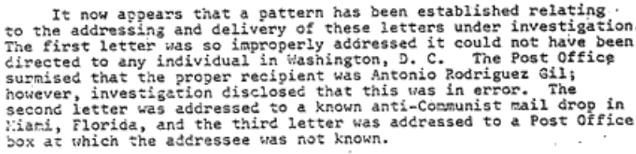
    (HSCA Report Volume 3 page 431)

    Even Secret Service inspector Thomas Kelley admitted the letters were apparently “meant to be intercepted“.

    The links with the 1963 letters and William Harvey (a person of extreme interest in the assassination) are most notable. 

    The 1963 forged letters

    “Oswald’s” letter to the Russian Embassy on November 9, 1963

    This uncharacteristically typed letter, purportedly written by Oswald, was intercepted by the FBI (as they did with all mail going to the embassy). This letter incriminated Oswald and foreign confederates and was corroborative of the Mexico City charade. It denigrates the “notorious FBI” and refers to Kostikov as “comrade Kostin.”

    The Warren Commission accepted this letter as authentic and explained it as an awkward appeal by Oswald for help from the Soviet Embassy. In fact, the content and the timing of the letter suggest that it was part of the same stratagem designed by those behind the Mexico City set-up.

    The fact that this letter was sent to Tovarich Nikolai Reznichenko at the embassy was a source of concern, even if the Oswalds corresponded with him several times in 1963. An FBI report (HSCA Record 180-10110-10104) clearly refers to him as “the man in the Soviet Embassy (Washington’s) in charge of assassinations.” In 1970, researcher Paul Scott had described him as “one of the top members of the Soviet Secret Police (KGB) in the United States.” (Paul Scott article)

    Incriminatory letters from Cuba- 1963

    Five letters from Cuba, all postmarked shortly after the assassination, one of which was destined for Oswald, were part of the Castro false flag operation and were also used to incriminate Oswald with unidentified Cuban agents, and Fidel Castro himself. These letters were addressed to recipients (Oswald, RFK, The Voice of America–a CIA propaganda asset), which guaranteed their interception or their being simply handed over to intelligence agencies.

    They also corroborate the Mexico City fabrication, which very few people would have known about at this time. The FBI dismissed these letters as a hoax, which they were. But they were a hoax with a purpose: to blame JFK’s murder on the Russians and the Cubans. Their content and timing revealed the same tactics being used by the planners.

    Letters from Cuba to Oswald—proof of pre-knowledge of the assassination

    In JFK: The Cuba Files, Cuban G2 officer Fabian Escalante presents a thorough analysis of five bizarre letters that were written before the assassination in order to position Oswald as a Castro asset. It is difficult to sidestep them the way the FBI did. The FBI argued that they were all typed from the same typewriter, yet supposedly sent by different people. This indicated to them that it was a hoax, perhaps perpetrated by Cubans wanting to encourage a U.S. invasion.

    However, the content of the letters and timeline proves something far more sinister, according to Cuban intelligence. The following is how John Simkin summarizes the evidence:

    The G-2 had a letter, signed by Jorge that had been sent from Havana to Lee Harvey Oswald on 14th November, 1963. It had been found when a fire broke out on 23rd November in a sorting office. After the fire, an employee who was checking the mail in order to offer, where possible, apologies to the addressees of destroyed mail, and to forward the rest, found an envelope addressed to Lee Harvey Oswald. It is franked on the day Oswald was arrested and the writer refers to Oswald’s travels to Mexico, Houston and Florida …, which would have been impossible to know about at that time!

    It incriminates Oswald in the following passage: “I am informing you that the matter you talked to me about the last time that I was in Mexico would be a perfect plan and would weaken the politics of that braggart Kennedy, although much discretion is needed because you know that there are counter-revolutionaries over there who are working for the CIA.”

    Escalante informed the House Select Committee on Assassinations about this letter. When he did this, he discovered that they had four similar letters that had been sent to Oswald. Four of the letters were postmarked “Havana”. It could not be determined where the fifth letter was posted. Four of the letters were signed: Jorge, Pedro Charles, Miguel Galvan Lopez and Mario del Rosario Molina. Two of the letters (Charles & Jorge) are dated before the assassination (10th and 14th November). A third, by Lopez, is dated 27th November, 1963. The other two are undated.

    Cuba is linked to the assassination in all the letters. In two of them, an alleged Cuban agent is clearly implicated in having planned the crime. However, the content of the letters, written before the assassination, suggested that the authors were either “a person linked to Oswald or involved in the conspiracy to execute the crime.”

    This included knowledge about Oswald’s links to Dallas, Houston, Miami and Mexico City. The text of the Jorge letter “shows a weak grasp of the Spanish language on the part of its author. It would thus seem to have been written in English and then translated.”

    Escalante adds: “It is proven that Oswald was not maintaining correspondence, or any other kind of relations, with anyone in Cuba. Furthermore, those letters arrived at their destination at a precise moment and with a conveniently incriminating message, including that sent to his postal address in Dallas, Texas …. The existence of the letters in 1963 was not publicized or duly investigated, and the FBI argued before the Warren Commission to reject them.”

    Escalante argues: “The letters were fabricated before the assassination occurred and by somebody who was aware of the development of the plot, who could ensure that they arrived at the opportune moment and who had a clandestine base in Cuba from which to undertake the action. Considering the history of the last 40 years, we suppose that only the CIA had such capabilities in Cuba.”

    The first letter addressed to Oswald includes: “close the business,” “money I gave you,” “recommend much to the chief,” “I told him (Castro) you could put out a candle at fifty meters,” “when you come to Habana.” Letter four specifies $7000 given to Oswald, which is close to what a Phillips-connected false witness claimed he saw being given to Oswald in Mexico City in the Cuban embassy. It also states that a Cuban agent named Pedro Charles “became a close friend of former Marine and expert shooter Lee H. Oswald in Mexico.”

    Black Ops: ZRRIFLE and Black Letters

    File 178-10004-10148 (released in 2025), from the Rockefeller Commission, discusses the use of this type of psy-war propaganda. This strongly indicates what all the letters discussed in this article are: Black Letters, i.e., forged incriminatory letters designed to create a phony paper trail to set up a foe:

    Partial file content:
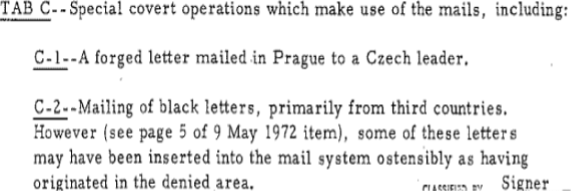
    The Pepe Letters are too similar to the six 1963 incriminatory letters for this to all be happenstance. The tone, wording, and content, as well as the designed-to-be-intercepted expedition of all nine letters, incrimination targets, nature of the recipients, and the timing, can only be interpreted one way. These were Black Letters. They are the workings of specialized strategists who began plotting by November 1962 or earlier against JFK. They used psych-ops techniques, such as black letters. The letters supplemented other tactics that were in tune with the following part of Harvey’s ZRRIFLE: It also contemplates the need for false documentation within CIA files to protect the operation from exposure: “Cover: planning should include provision for blaming Czechs or Sovs in case of blow” and “Should have phony 201 in RI to backstop this, documentation therein forged and backdated. Should look like a CE [Counterespionage] file.”

    Case Linkage

    The assassination and the “Pepe” plot are not the only cases that should have been compared for clues that would help profile the plotters. On their own, they already provide compelling evidence of central coordination. Oswald’s opening of a Fair Play for Cuba Committee branch in New Orleans is already considered very suspicious by many in the research community. The Menendez links to the FPCC should set off alarm bells for all. This author’s chronicle of other potential patsies that were linked to this dying outfit–deemed to be Castro’s network in the U.S. by the House Committee on Un-American Activities–exceeded several in number. The newly found Menendez link is the topping on the cake.

    Conclusion

    At this point, the reader is encouraged to read the letters discussed in this article and peruse the other sources that can be found in the bibliography. If one concludes that the 1962 and 63 incidents are linked, then there is most likely a conspiracy involving central planning by those capable of implementing such tactics. Just as importantly, these events should be added to the growing body of evidence around CIA officers William Harvey and David Phillips, making them persons of even greater interest. Already suspected by some government investigation insiders, the proximity of Harvey to the Pepe Letters and Phillips’ links to Mexico City and the FPCC should not go unexplored. These letters have been for too long unexplored, but they are powerful evidence of a pre-existing plot against JFK.


    Acknowledgements

    I would like to thank Bill Simpich and Doug Campbell, who were the first to see the significance of the Pepe Letters. They, along with Dave Boylan, have provided valuable input to me regarding this still-developing story.

    References

    The PEPE Letters at Kennedysandking (all nine black letters are in the appendices) 25 January 2025

    Exposing the FPCC, Parts 1, 2 and 3 at Kennedysandking.com,

    The Three Failed Plots to Kill JFK at Kennedysandking.com, 18 November 2016

    The CIA and Mafia’s “Cuban American Mechanism” and the JFK Assassination at Kennedysandking.com, 12 April 2018

    Oswald’s Last Letter: The Scorching Hot Potato at Kennedysandking.com, 17 December 2019

    Paul Bleau: “On the Trail of the Plotters” (Conference at UK Dealey Plaza)

    Doug Campbell Lancer presentation 2020

    Bill Simpich Education Forum 2025 My Summary of the Pepe Letters 

    The Following Files are at the Mary Ferrell Foundation:

    104-10012-10022 Kostikov

    104-10308-10249 PLOTS TO ASSASSINATE THE PRESIDENT OF THE U.S- Menendez, Gajate, FPCC

    104-10506-10037 SURFACING OF LETTER DATED 27 NOV 1963 RE POSSIBLE PLOT TO ASSASSINATE PRESIDENT KENNEDY- 1976 distancing of Menedez

    104-10308-10001 100-300-12 PLOTS TO ASSASSINATE THE PRES OF THE US

    104-10506-10008 ROUTING SHEET AND DISPATCH: BERNARDO MORALES; THREATENING LETTER RE PRESIDENT KENNEDY

    104-10506-10016 TRANSMITTAL SLIP AND MEMO: INFORMATION CONCERNING POSSIBLE PLOT TO ASSASSINATE PRESIDENT KENNEDY- William Harvey sender

    104-10308-10272 Lt. Ramos: friendly with Fidel

    104-10506-10003 GAJATE PUIG AS INTERMEDIARY

    178-10004-10148 Description of how CIA uses Covert Black letters

    104-10506-10015 This sheet confirms Gajate is an AMOT contact : ROUTING SHEET AND GREEN LIST NAME CHECK REQUESTS/RESULTS

    180-10108-10017: ANTONIO GUILLERMO ROGRIGUEZ JONES.

    124-10279-10069: No Title Hugo Trejo

    HSCA Report, Volume III, Starting on Page 399: Analysis of the Pepe Letters

  • The Missile Crisis Plot to Kill JFK

    The Missile Crisis Plot to Kill JFK

    Paul Bleau examines a phony trail of psy war Black Letters both before and after the JFK murder, linking the plot to Cuba.  It turns out that every credible examination, including Cuban G2, concluded they were phony, designed to produce a false trail.

    The Missile Crisis Plot to Kill JFK

    By Paul Bleau

    Introduction

    Comparative Case Analysis (‘CCA’), also known as ‘Similar Fact Analysis’, is a technique used in criminal intelligence analysis to identify similarities and support decision making (Dominik Sacha et al, 2017, originally published at The Eurographics Association).

    Cases can be linked in CCA through any of the following:

    a) Modus Operandi (or tactics, techniques, procedures)
    b) Signatures and patterns
    c) Forensic evidence
    d) Intelligence

    CCA is also a perpetrator profiling technique. By comparing seemingly similar cases, crime scenes, tactics, language, weapons, injuries, people of interest, and backdrops, templates can be defined and suspects identified.

    CCA was never performed for the JFK assassination.

    By comparing elements of what occurred in and around the murder of JFK and a November 1962 plot involving the use of incriminating letters purportedly sent from Havana by a Jose Pepe Menendez almost one year before the successful attempt, we will present compelling evidence of not only a conspiracy, but key parts of an m.o. and the identification of persons of interest.

    Ask yourself the question: If it can be established that there is a clear connection between two plots to kill JFK, the successful one and another that occurred a year earlier, can one solve the murder by solving the preliminary plot?

    Readers will be able to find all letters referred to by clicking here.

    Summary

    Near the end of November 1962, when the tensions around JFK’s handling of the Missile Crisis were at their highest and military hawks were opposed to their Commander in Chief, three letters from Cuba were intercepted. These letters, all bearing the signature Pepe, were fabrications designed to provide a paper trail that would frame potential patsies in the murder of JFK as leftists who were in league with Cuban agents.

    As we will see later, their interception was made easy by design: The intended recipients could easily be portrayed as pro-Castro and were not even connected to the addresses on the letters. Those who picked up the letters in their place were CIA-friendly and certain to pass the information on to their intelligence contacts who were part of the JMWAVE network, controlled by CIA officer William Harvey. The FBI and the Secret Service considered these letters to be serious. They suspected that their interception was intended, and called the alleged sender of the letter, Pxepe Menendez, a suspect. This case was never solved and was closed on November 21, 1963, one day before the assassination.

    In October 1963, Oswald and/or an imposter contacted Valeriy Kostikov, a KGB officer in the Russian Embassy in Mexico City, whom the CIA believed was in charge of executive action in the Western Hemisphere. After Kennedy was killed, at least three assets answering to CIA officer David Phillips offered false testimonies to link Oswald to Cuban agents.

    Between the Mexico City incident and the assassination six weeks later, Oswald was linked to Kostikov and the Cubans in six incriminatory letters that were strikingly similar to the Pepe Letters in terms of style, content, phrasing, and propaganda strategy.

    It is the similarity between the 1962 and 1963 false flag operation templates that renders the Pepe Letters affair so significant.

    The Pepe Letters

    In the process of reviewing the recent Latin American intel files at the Mary Ferrell Foundation, a series of them pertained to a prior plot that involved the use of incriminating letters to set up a patsy who would be blamed for the assassination of JFK and made to look as if he were a Cuban asset.

    The first letter I analyzed was very telling.

    1. It was sent from Cuba to “Bernardo Morales” at a post office box in Miami owned by an anti-Castro propaganda unit called Radio Libertad, La Voz Anti-Communista de America. The alleged sender was Jose Menendez, and the letter was signed Pepe. Morales was unknown to those who handled the letter and who eventually forwarded it to a CIA contact linked to the JMWAVE station in Miami.
    2. The sender’s full name is Jose Menendez Ramos. He was nicknamed Pepe. Menendez and his wife Carrie Hernandez had been described by an informant as members of the Tampa FPCC. Menendez got a “top Job” in the Cuban Government after his return. He and his wife were said to be extremely pro-Castro.
    3. Olga Duque de Heredia de Lopez and Aida Mayo Coetara, Miami Representatives for Radio Libertad (linked to anti-Castro DRE operatives), handled the mail. Lopez handed the letter to Cesar Gajate, whom she described as an anti-Communist fighter. Mayo is the wife of Humberto Lopez Perez, the director of Radio Libertad in Venezuela.
    4. Gajate was an AMOT contact. AMOT is a cryptonym for a network of Cubans trained by David Morales at JMWAVE during 1960-61. He passed on the information to his contact (likely CIA officer Tony Sforza or David Morales, who answered to William Harvey).
    5. This was an elaborate hoax to push the “Cubans plan to kill JFK” narrative. One of the people pushing it – CIA’s Bill Finch, worked with Bill Harvey.
    6. The information was sent to the Secret Service, the FBI, and the Department of State on Dec. 8, and later to the INS by Rufus Horn of Task Force W and is signed by him as Liaison and in lieu of William Harvey.
    7. The INS identified a Morales who entered the U.S. using a fake visa.
    8. Radio Libertad was CIA-sponsored (which was also the case for Voice of America) and operated out of Venezuela. It had an antenna office in Miami.
    9. The letter is postmarked November 29, 1962, a month after JFK’s peaceful resolution of the Missile Crisis.
    10. It reveals a network of conspirators based in Miami, Washington, and Cuba.
    11. It lamely suggests that by sending the letter to the right-wing Radio Libertad, it would not be intercepted.
    12. It crudely links “Fidel” to a plot to kill JFK.
    13. It does not mince words and is self-incriminating: “if we are able to kill President Kennedy,” “It would be a great success, super extraordinary, for Fidel,” “Marxist-Leninists 90 miles from the U.S.,” “paralyze imperialism completely,” “terrorize capitalism”, “get in contact with your Friends”, “You are an artist”: all very similar to the 1963 letters we will discuss later.

    The second letter, which was postmarked November 14, was sent to Antonio Rodriguez–a student at Georgetown’s foreign service school and the son of a Venezuelan diplomat–who was a chauffeur for Colonel Hugo Trejo. Trejo was a suspected intelligence contact from Venezuela and a Venezuelan military officer and politician who led the first attempt at a military rebellion against the president of Venezuela, Marcos Pérez Jiménez. Improperly addressed, Trejo advised the FBI about the letter.

    Trejo said that the letter arrived at a Venezuelan Delegation office in Washington. The Secret Service, tipped off by an informant suspecting an assassination plot involving Trejo, questioned members of the delegation, including Trejo, Rodriguez, and others, about the letter.

    “Antonio Rodriguez Jones’ address was crossed out in red ink and emerged from the Dead Letter Section with the address Antonio Rodriguez Gil, “2335 Ashmead Place NW, Washington, DC.   The Secret Service eventually found “this was in error”. 

    This address was the base for the office of the Venezuelan delegation of the Inter-American Defense Board, an OAS institution, where Antonio Rodriguez Gil was a chauffeur.  

    The ostensible reason for the operation against foreign service student Antonio Rodriguez Jones was because his father was Antonio Rodriguez Echazabal, also a diplomat by trade.   He was Cuba’s ambassador to Haiti as recently as 1959 before he defected in place in Haiti.   He identified as anti-Communist but was not involved with any anti-Castro opposition group. In November 1962, Echazabal was living in Washington, DC and planning to defect to the United States.   Echazabal was believed to secretly be a communist.   When Echazabal was arrested and deported in August 1963, the “Cuban plot against the President” file was ostensibly closed, but new files kept going inside it.” (Bill Simpich email to Paul Bleau, Sept 6, 2025)

    The letter refers to the assassination Cuba-linked plot in a similar fashion to the first Pepe letter discussed above, and was deemed to have been written by the same sender (Menendez) following FBI handwriting analysis.

    Intelligence forces attempted to link Rodriguez to an alleged Cuban Terrorist named Pino Machado:

    Who or what was the seed of the “Cuban plot? Perhaps Pino Machado, who was yet another diplomat, and formerly the alternate ambassador to Carlos Lechuga at the United Nations.  The Secret Service believed Pino Machado would be near JFK at an April 1961 UN event, and his profile was described as dangerous because he might be armed and had a history of violence.   

    His crimes?  A member of the July 26th Movement and imprisoned by Batista for sabotage activities until his fall.   The anti-Castroites had accused Pino Machado of being involved in JFK’s death since the very beginning.  

    The FBI’s Chief of National Intelligence, Ray Wannall, noted here that a “Secret Service informant” (#3-11-48) claimed on 11/27/63 that Pino Machado was involved in “terrorism” in Washington, DC, back in April 1961. And that if there was an “international plot”, then Pino Machado was the “intellectual director” of Oswald’s activities in Mexico City.  His subordinate Lambert Anderson had been monitoring both Oswald and the FPCC for months before 11/22/63.   

    Wannall accused Pino Machado of being in Mexico City in 1963, being involved in a plot to assassinate an anti-Castro leader at JFK’s dinner in Miami on 11/18/63, and the assassination of JFK himself.  All of this bogus information–and much more over the months–was passed on to Miami Secret Service officer Ernest Aragon and his boss, John Marshall.  JM/Wave’s Ted Shackley and Harvey had been studying Aragon as early as November 1962.  By early December 1963, Aragon knew that a Pedro Charles letter was a fake. This was allegedly sent after the JFK murder from Cuba to Oswald, discussing the “affair” and Oswald’s marksmanship. Unfortunately, the man (FBI informant) I call “the other Ernest Aragon/it may have been an alias” working for the Cuban Revolutionary Council, who also served as Secret Service informant 3-11-14, turned it over to Bill Finch of the Miami CIA’s security division (who worked for William Harvey). This offers some understanding as to why Aragon reported security lapses and Marshall twice told the HSCA that he was concerned that the Secret Service might be involved in the assassination of JFK.” (Bill Simpich email to Paul Bleau, Sept 7, 2025)

    The third Pepe letter was sent to: SEÑOR MINISTRO DE REPÚBLICA DE GUATEMALA in Guatemala. It does not refer to the assassination plot. It does attempt to link Cuba to clandestine revolutionary activities in the country. It made its way to the CIA.

    The FBI suspected subterfuge around the flagrant errors in addressing all three letters.

    (HSCA Report Volume 3 page 431)

    Even Secret Service inspector Thomas Kelley admitted the letters were apparently “meant to be intercepted“.

    The links with the 1963 letters and William Harvey (a person of extreme interest in the assassination) are most notable. 

    The 1963 forged letters

    “Oswald’s” letter to the Russian Embassy on November 9, 1963

    This uncharacteristically typed letter, purportedly written by Oswald, was intercepted by the FBI (as they did with all mail going to the embassy). This letter incriminated Oswald and foreign confederates and was corroborative of the Mexico City charade. It denigrates the “notorious FBI” and refers to Kostikov as “comrade Kostin.”

    The Warren Commission accepted this letter as authentic and explained it as an awkward appeal by Oswald for help from the Soviet Embassy. In fact, the content and the timing of the letter suggest that it was part of the same stratagem designed by those behind the Mexico City set-up.

    The fact that this letter was sent to Tovarich Nikolai Reznichenko at the embassy was a source of concern, even if the Oswalds corresponded with him several times in 1963. An FBI report (HSCA Record 180-10110-10104) clearly refers to him as “the man in the Soviet Embassy (Washington’s) in charge of assassinations.” In 1970, researcher Paul Scott had described him as “one of the top members of the Soviet Secret Police (KGB) in the United States.” (Paul Scott article)

    Incriminatory letters from Cuba- 1963

    Five letters from Cuba, all postmarked shortly after the assassination, one of which was destined for Oswald, were part of the Castro false flag operation and were also used to incriminate Oswald with unidentified Cuban agents, and Fidel Castro himself. These letters were addressed to recipients (Oswald, RFK, The Voice of America–a CIA propaganda asset), which guaranteed their interception or their being simply handed over to intelligence agencies.

    They also corroborate the Mexico City fabrication, which very few people would have known about at this time. The FBI dismissed these letters as a hoax, which they were. But they were a hoax with a purpose: to blame JFK’s murder on the Russians and the Cubans. Their content and timing revealed the same tactics being used by the planners.

    Letters from Cuba to Oswald—proof of pre-knowledge of the assassination

    In JFK: The Cuba Files, Cuban G2 officer Fabian Escalante presents a thorough analysis of five bizarre letters that were written before the assassination in order to position Oswald as a Castro asset. It is difficult to sidestep them the way the FBI did. The FBI argued that they were all typed from the same typewriter, yet supposedly sent by different people. This indicated to them that it was a hoax, perhaps perpetrated by Cubans wanting to encourage a U.S. invasion.

    However, the content of the letters and timeline proves something far more sinister, according to Cuban intelligence. The following is how John Simkin summarizes the evidence:

    The G-2 had a letter, signed by Jorge that had been sent from Havana to Lee Harvey Oswald on 14th November, 1963. It had been found when a fire broke out on 23rd November in a sorting office. After the fire, an employee who was checking the mail in order to offer, where possible, apologies to the addressees of destroyed mail, and to forward the rest, found an envelope addressed to Lee Harvey Oswald. It is franked on the day Oswald was arrested and the writer refers to Oswald’s travels to Mexico, Houston and Florida …, which would have been impossible to know about at that time!

    It incriminates Oswald in the following passage: “I am informing you that the matter you talked to me about the last time that I was in Mexico would be a perfect plan and would weaken the politics of that braggart Kennedy, although much discretion is needed because you know that there are counter-revolutionaries over there who are working for the CIA.”

    Escalante informed the House Select Committee on Assassinations about this letter. When he did this, he discovered that they had four similar letters that had been sent to Oswald. Four of the letters were postmarked “Havana”. It could not be determined where the fifth letter was posted. Four of the letters were signed: Jorge, Pedro Charles, Miguel Galvan Lopez and Mario del Rosario Molina. Two of the letters (Charles & Jorge) are dated before the assassination (10th and 14th November). A third, by Lopez, is dated 27th November, 1963. The other two are undated.

    Cuba is linked to the assassination in all the letters. In two of them, an alleged Cuban agent is clearly implicated in having planned the crime. However, the content of the letters, written before the assassination, suggested that the authors were either “a person linked to Oswald or involved in the conspiracy to execute the crime.”

    This included knowledge about Oswald’s links to Dallas, Houston, Miami and Mexico City. The text of the Jorge letter “shows a weak grasp of the Spanish language on the part of its author. It would thus seem to have been written in English and then translated.”

    Escalante adds: “It is proven that Oswald was not maintaining correspondence, or any other kind of relations, with anyone in Cuba. Furthermore, those letters arrived at their destination at a precise moment and with a conveniently incriminating message, including that sent to his postal address in Dallas, Texas …. The existence of the letters in 1963 was not publicized or duly investigated, and the FBI argued before the Warren Commission to reject them.”

    Escalante argues: “The letters were fabricated before the assassination occurred and by somebody who was aware of the development of the plot, who could ensure that they arrived at the opportune moment and who had a clandestine base in Cuba from which to undertake the action. Considering the history of the last 40 years, we suppose that only the CIA had such capabilities in Cuba.”

    The first letter addressed to Oswald includes: “close the business,” “money I gave you,” “recommend much to the chief,” “I told him (Castro) you could put out a candle at fifty meters,” “when you come to Habana.” Letter four specifies $7000 given to Oswald, which is close to what a Phillips-connected false witness claimed he saw being given to Oswald in Mexico City in the Cuban embassy. It also states that a Cuban agent named Pedro Charles “became a close friend of former Marine and expert shooter Lee H. Oswald in Mexico.”

    Black Ops: ZRRIFLE and Black Letters

    File 178-10004-10148 (released in 2025), from the Rockefeller Commission, discusses the use of this type of psy-war propaganda. This strongly indicates what all the letters discussed in this article are: Black Letters, i.e., forged incriminatory letters designed to create a phony paper trail to set up a foe:

    Partial file content:
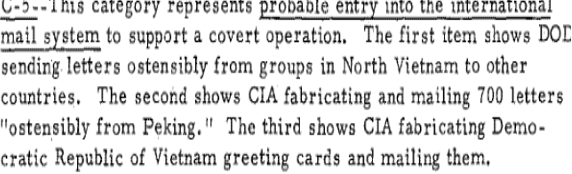
    The Pepe Letters are too similar to the six 1963 incriminatory letters for this to all be happenstance. The tone, wording, and content, as well as the designed-to-be-intercepted expedition of all nine letters, incrimination targets, nature of the recipients, and the timing, can only be interpreted one way. These were Black Letters. They are the workings of specialized strategists who began plotting by November 1962 or earlier against JFK. They used psych-ops techniques, such as black letters. The letters supplemented other tactics that were in tune with the following part of Harvey’s ZRRIFLE: It also contemplates the need for false documentation within CIA files to protect the operation from exposure: “Cover: planning should include provision for blaming Czechs or Sovs in case of blow” and “Should have phony 201 in RI to backstop this, documentation therein forged and backdated. Should look like a CE [Counterespionage] file.”

    Case Linkage

    The assassination and the “Pepe” plot are not the only cases that should have been compared for clues that would help profile the plotters. On their own, they already provide compelling evidence of central coordination. Oswald’s opening of a Fair Play for Cuba Committee branch in New Orleans is already considered very suspicious by many in the research community. The Menendez links to the FPCC should set off alarm bells for all. This author’s chronicle of other potential patsies that were linked to this dying outfit–deemed to be Castro’s network in the U.S. by the House Committee on Un-American Activities–exceeded several in number. The newly found Menendez link is the topping on the cake.

    Conclusion

    At this point, the reader is encouraged to read the letters discussed in this article and peruse the other sources that can be found in the bibliography. If one concludes that the 1962 and 63 incidents are linked, then there is most likely a conspiracy involving central planning by those capable of implementing such tactics. Just as importantly, these events should be added to the growing body of evidence around CIA officers William Harvey and David Phillips, making them persons of even greater interest. Already suspected by some government investigation insiders, the proximity of Harvey to the Pepe Letters and Phillips’ links to Mexico City and the FPCC should not go unexplored. These letters have been for too long unexplored, but they are powerful evidence of a pre-existing plot against JFK.


    Acknowledgements

    I would like to thank Bill Simpich and Doug Campbell, who were the first to see the significance of the Pepe Letters. They, along with Dave Boylan, have provided valuable input to me regarding this still-developing story.

    References

    The PEPE Letters at Kennedysandking (all nine black letters are in the appendices) 25 January 2025

    Exposing the FPCC, Parts 1, 2 and 3 at Kennedysandking.com,

    The Three Failed Plots to Kill JFK at Kennedysandking.com, 18 November 2016

    The CIA and Mafia’s “Cuban American Mechanism” and the JFK Assassination at Kennedysandking.com, 12 April 2018

    Oswald’s Last Letter: The Scorching Hot Potato at Kennedysandking.com, 17 December 2019

    Paul Bleau: “On the Trail of the Plotters” (Conference at UK Dealey Plaza)

    Doug Campbell Lancer presentation 2020

    Bill Simpich Education Forum 2025 My Summary of the Pepe Letters 

    The Following Files are at the Mary Ferrell Foundation:

    104-10012-10022 Kostikov

    104-10308-10249 PLOTS TO ASSASSINATE THE PRESIDENT OF THE U.S- Menendez, Gajate, FPCC

    104-10506-10037 SURFACING OF LETTER DATED 27 NOV 1963 RE POSSIBLE PLOT TO ASSASSINATE PRESIDENT KENNEDY- 1976 distancing of Menedez

    104-10308-10001 100-300-12 PLOTS TO ASSASSINATE THE PRES OF THE US

    104-10506-10008 ROUTING SHEET AND DISPATCH: BERNARDO MORALES; THREATENING LETTER RE PRESIDENT KENNEDY

    104-10506-10016 TRANSMITTAL SLIP AND MEMO: INFORMATION CONCERNING POSSIBLE PLOT TO ASSASSINATE PRESIDENT KENNEDY- William Harvey sender

    104-10308-10272 Lt. Ramos: friendly with Fidel

    104-10506-10003 GAJATE PUIG AS INTERMEDIARY

    178-10004-10148 Description of how CIA uses Covert Black letters

    104-10506-10015 This sheet confirms Gajate is an AMOT contact : ROUTING SHEET AND GREEN LIST NAME CHECK REQUESTS/RESULTS

    180-10108-10017: ANTONIO GUILLERMO ROGRIGUEZ JONES.

    124-10279-10069: No Title Hugo Trejo

    HSCA Report, Volume III, Starting on Page 399: Analysis of the Pepe Letters

  • Review of James Douglass’s New Book – Pt 3

    Jim DiEugenio concludes his three-part review of James Douglass’s important new book with a discussion of the final and culminating murder of the sixties: the assassination of Robert Kennedy.

    Martyrs to the Unspeakable – Pt. 3

    By James W. Douglass


    Because James Douglass wrote an entire volume about the presidency and the assassination of John Kennedy, it is that case which gets the least attention in Martyrs to the Unspeakable. Which is a justifiable decision.

    But, having said that, Douglass still does deal with JFK. He brings up the case first in its relation to our current troubles: That is, President Kennedy’s dispute with David Ben Gurion and Israel. (p. 10) This important issue is finally getting the attention it deserves through writers like Rick Stirling, Ken McCarthy, and Monica Wiesak. Douglass shows that, quite early, Kennedy was aware of the need for America to come to the aid of the Palestinians who had been impacted by the Nakba. He addressed the problem in 1951. (p. 10). Later on, the author shows that Kennedy never stopped supporting that cause. He was trying to pass a UN resolution to grant relief on November 20, 1963– one which Israel vociferously objected to. (pp. 64-67)

    As Kennedy was about to enter the White House, he was alerted by the outgoing Secretary of State, Christian Herter, that there were rumors that Israel might be trying to build an atomic bomb. The problem mushroomed as Douglass notes, because “No American president was more concerned with the danger of nuclear proliferation than John Fitzgerald Kennedy.” (p. 11). The conflict between Kennedy and Prime Minister Ben Gurion began at their first, and only, head of state, face-to-face meeting at the Waldorf Astoria in New York in late May of 1961. At this meeting, Kennedy expressed his curiosity about the size of the atomic reactor at the Dimona site, but Ben Gurion insisted that it was only for desalination. Which, of course, was false.

    Kennedy’s interest was in not starting an atomic arms race in the Middle East. (p. 14). Specifically, he thought the possibility existed that if Israel developed a bomb, the Russians would aid Egypt in doing the same. As Douglass notes, this canard by Ben Gurion would mushroom two years later into a direct confrontation, which would result in Ben Gurion’s resignation.

    Douglass notes an important conversation that JFK had with Amos Elon, an American reporter for Haaretz. As early as 1961, Kennedy was realizing that the American/Israeli relationship was more useful to Tel Aviv than Washington. And he specifically said, “We sometimes find ourselves in difficulty due to our close relations with Israel.” The president said that the important thing was that the Israelis get along with the Arabs. And if that meant Israel adopting a neutralist stance, he would consider it. As long as there would be an Israeli/Arab settlement. (pp. 16-17)

    Douglass now goes to another complicating factor in the Middle East equation. This was Kennedy’s attempt to forge a relationship with Gamal Abdel Nasser of Egypt. Before his meeting with Ben Gurion, Kennedy wrote to Nasser about a peaceful settlement to the Arab/Israeli conflict and also a viable solution to the Palestinian refugee problem, based on repatriation or compensation. (p. 17) This, as JFK knew, was very important to Nasser.

    Ben Gurion was worried about Kennedy’s aim of regular inspection at Dimona. He even encouraged the prominent Jewish lobbyist Abe Feinberg to discourage Kennedy from insisting on this. But Feinberg reported back that Kennedy would not be thwarted. Therefore, as related by former Mossad chief Rafael Eitan, the Israelis built a phony control center over the real one at Dimona, “with fake control panels and computer-lined gauges.” The goal was to make it look like a desalination plant. To top it off, none of the American inspectors spoke Hebrew, which made it easier to conceal the camouflage. (p. 20)

    This all escalated until May of 1963 when Kennedy insisted on scheduling full, unfettered and biannual inspections. And if these were denied, he was threatening to pull funding for Israel. After an exchange of four letters, Ben Gurion resigned. This allowed a delay to take place while a new prime minister was chosen. Two months later, the same ultimatum was issued to Levi Eshkol. Eshkol stalled on Kennedy’s request before agreeing to it. But Kennedy’s assassination then occurred, and, as in many other areas, Lyndon Johnson curtailed, stopped and then reversed Kennedy’s policy on both Dimona and the Palestinian refugee dilemma.

    In fact, as Douglass writes later, there is evidence that CIA counter-intelligence chief James Angleton actually helped Israel produce its first bomb. Angleton ran the Israeli desk at the CIA. He helped by referring an English scientist named Wilfred Mann to the Israelis. But Angleton denied ever being involved with shipping fissionable materials. In other words, he wanted no part of the NUMEC scandal out of the Pittsburgh area. (p. 58; click here for that story https://consortiumnews.com/2020/08/05/25-years-of-cn-how-israel-stole-the-bomb-sept-11-2016/)

    II

    Bobby Kennedy did not forget his brother’s devotion to nuclear non-proliferation. He noted it prominently in his maiden speech in the Senate. In that speech, he specifically mentioned how Israel was a problem in this regard. Although they were little noted in the USA, the comments were noted prominently in Israel. Mainly because of RFK’s support of the IAEA, the International Atomic Energy Agency, which did inspections of nuclear plants. (p. 61) These types of professionals would likely have unearthed the Israeli ruse about Dimona. Tel Aviv wanted no part of that.

    From here, Douglass shifts the focus to Sirhan Bishara Sirhan. Specifically to the lengthy—150 hours– hypnotic sessions sponsored by the legal team of William Pepper and Laurie Dusek. The late Harvard psychologist, Dr. Daniel Brown, concluded that Sirhan was one of the most susceptible hypnosis subjects he had ever encountered. Brown concluded that he was “…the perfect candidate.”(p. 69)

    Sirhan had two disturbing events happen to him in rather close proximity to each other. The first was the death of his sister, who died of leukemia when he was 21. The second event was when he fell off a horse at Granja Vista Del Rio Horse Farm. Sirhan was treated at the Corona Community Hospital emergency room by a Dr. Nelson. He was discharged four hours later. But according to his brother, he was gone for two weeks. (Lisa Pease, A Lie Too Big to Fail, p. 434). Yet he only received four stitches over one eye. Both his mother and a friend tried to find out where he was. (Douglass, p. 73)

    With Sirhan under hypnosis, Brown discovered that he was in a ward with no windows and with about seven other patients, all with head injuries. Doctors would approach him each day with clipboards, taking urine samples, and asking him how he felt. When he did return, those close to him detected a personality change; he was more reserved and argumentative. (Douglass, p. 74) But further, you only visit a doctor once to get four stitches removed. So why did Sirhan then visit a doctor 13 more times over the next year, from 1966 to December of 1967? (Pease, p. 435)

    III

    From here, Douglass goes into the RFK career and his murder. In my view, this was a real highlight of the book. For the Bobby Kennedy of 1968 was probably the most radical candidate for president since Henry Wallace. Douglass goes into RFK’s disputes with President Johnson on civil rights and Vietnam. For example, Marian Wright of the NAACP wanted to attract political attention to Mississippi, since so many African/American children were suffering from hunger. Bobby Kennedy did go down as part of a small sub-committee on poverty. He was greatly impacted by what he saw and wanted Johnson to declare a state of emergency–which he would not. From there, he went to Indian reservations, Appalachia and New York City ghettoes. He wanted to see firsthand what Michael Harrington called the Other America. (Douglass, p. 88)

    When LBJ would not act on this issue, even after the riots of the summer of 1967, RFK decided that the man who could act was King. He told Marian Wright to tell King to bring the poor to Washington. So while in Atlanta, she did just that. And as she later said, “Out of that, the Poor People’s Campaign was born.” And King decided that this was then going to be the prime focus of his career. (Douglass, p. 91)

    But, as Douglass points out, it was not just this joint opposition to poverty that was worrisome to the Powers That Be. It was also their mutual opposition to the Vietnam War. Kennedy had made a speech against that war in the Senate on March 3, 1967. Almost exactly one month later, on April 4th, King delivered his polemic at Riverside Church in New York.

    Most people in this field are aware of President Kennedy’s conversation with Charles de Gaulle about the Vietnam War. What most people do not know is that the French president had a very similar conversation with Bobby Kennedy about the same subject. And Douglass describes it in detail in this book. (pp. 392-94) RFK took a European tour in late January and early February of 1967.

    He had two important topics he wished to discuss with some of the leaders he met: atomic weapons and the Vietnam War. He quickly found out that each one of the emissaries he met with thought Johnson’s war policy in Vietnam was so misguided as to be termed mad. When RFK met with de Gaulle, they talked for over one hour. And the exclusive subject was Vietnam. The president reminded Bobby of the advice he had given his brother, namely that the USA should not go into Vietnam. He then said that by directly entering that conflict, America’s special place in the world—one of respect and admiration—had been torn to tatters:

    The United States is in the process of destroying a country and a people. America says it is fighting Communism. But by what right does it fight Communism in another people’s country and against their will…. History is the force at work in Vietnam. The United States will not prevail against it. (p. 394)

    When they walked to the door, with the 6’4” de Gaulle hovering over the 5’10” Kennedy, the French president gave the senator some sage advice:

    Do not become embroiled in this difficulty in Vietnam. Then you can survive its outcome. Those who are involved will be badly hurt, because your country will tear itself apart over it. A great leader will be needed to put it back together and lead it to its destiny…. You must be that leader. (ibid)

    How could anyone not be impacted by someone like this? De Gaulle was the man who risked his own life, many times, to get France out of Algeria. Something JFK had advised France to do back in 1957. Douglass had done us all a favor in describing this little-known meeting.

    IV

    Kennedy’s visit to France had some big blowback when he got back to the USA. There was an article in Newsweek saying that he had received a “peace feeler” from Hanoi while in Paris. The senator did not understand what the report was about, and he told his press secretary that. (p. 409)

    What had happened is that on the same day that he had met with de Gaulle, he had a meeting with the Far East desk officer in the French Foreign Office. Kennedy was accompanied by a translator from the American embassy. The desk officer said that North Vietnam was willing to enter negotiations in return for an unconditional bombing halt. The senator did not think this was very important. But the translator did. He cabled his superiors in Washington about the story. And that is how it got in Newsweek. And from there it spread to the MSM, including TV.

    President Johnson was quite offended by this story, as he took almost everything RFK did as a personal affront. He thought that Bobby had leaked the story in order to promote himself as a peacemaker. But it was even worse than that. Because Johnson–under the influence of his Vietnam overall commander, William Westmoreland—thought that he was on the verge of winning in Indochina.

    When RFK got word of this MSM story, he wanted to straighten things out with the president. So he went to see Johnson. This was a mistake. Instantly, LBJ accused him of leaking the story. Kennedy replied with, “I didn’t leak it. I didn’t even know there was a peace feeler. I think the leak came from somebody in your State Department” (Douglass, p. 410)

    Johnson took this reply badly. He said it was not his State Department. It was Bobby’s. Meaning that it was still filled with Kennedy loyalists.

    Kennedy tried to change the subject. He offered him what his plan would be to settle in Vietnam: stop the bombing, go to the negotiating table, do a staged cease-fire and create a coalition government governed by an international commission to hold elections as a final solution.

    About a year from Tet, Johnson was not in a state of mind to listen to any peace agreement. He made no bones about it either. He began with “There’s not a chance in hell I’ll do that.” Then it got worse:

    I’m going to destroy you in six months. We’re going to win in Vietnam by the summer. By July or August the war will be over. You and every one of your dove friends will be dead politically in six months. You guys will be destroyed.

    What is really kind of bizarre about this is that it appears that Johnson believed it. He really thought that General Westmoreland was giving him the right info and predicting the correct outcome. RFK had finally gotten a glimpse into Johnson’s real psyche about the most divisive conflict since the Civil War. He appropriately walked out. He now understood de Gaulle’s advice. There was only one way to end the war. Even if it meant the end of him.

    V

    I would like to close with two sterling episodes from the book.

    The first is another conversation I had never seen before. This was between Bobby Kennedy and Giorgi Bolshakov in May of 1961. (pp. 469-70) Bobby called him in and told the Russian spy that his brother thought there could be a lot more cooperation between their two countries. But Jack was taking over from a former general, namely Eisenhower, as president. Therefore, he was stuck with people like Lyman Lemnitzer as chair of the Joint Chiefs and Allen Dulles as Director of the CIA.

    Now recall, this was after RFK’s duty on the Taylor Commission investigating the Bay of Pigs. He understood how that debacle had occurred. He knew the CIA had deceived the president, and the Joint Chiefs had approved the operation. So he now delivered the punchline: His brother had made a mistake in not firing Dulles and Lemnitzer right away!

    Again, I had never seen this quote before. If you ever wondered where Bobby Kennedy’s later radicalism came from, here it is. He would have gotten rid of Lemnitzer and Dulles on day one. He then expanded on this point:

    These men make outdated recommendations and suggestions which are out of keeping with the president’s new course. My brother has been compelled to go by their mistaken judgments in decision making. Cuba has changed all our foreign policy concepts. For us, the events in the Bay of Pigs are not a flop, but the best lesson we have ever learned. So we are no longer going to repeat our past mistakes. (Douglass, p. 469)

    RFK knew that this attitude by his brother would put a target on the president’s back: “They can put him away any moment. Therefore, he must tread carefully in certain matters and never push his way through.” This remarkable discussion—four hours’ worth– went on until nightfall. When RFK gave Bolshakov a lift home–at or after 10 PM, the Russian could barely sleep. The next morning, he cabled his summary to Moscow. This is what began the secret communications between JFK and Khrushchev. So intricately described in JFK and the Unspeakable.

    If anyone has any knowledge of something similar to this happening since, I would like to hear it. I know nothing like it occurred during the Truman or Eisenhower administrations. It might have been possible under Gorbachev, but Reagan blew that opportunity. Thus paving the way for him to be deposed.

    VI

    As most of us know, the so-called Bobby Kennedy open and shut murder case was not open and shut. But there were signals at the start that the game was going to be rigged. For instance, as Roger LaJaunesse of the local FBI told Bill Turner, both he and the regular command of the LAPD were shoved aside almost immediately. The LAPD Chief of Detectives, Robert Houghton, installed an elite team of his own officers to run that investigation. It was called Special Unit Senator. And the two men who were in charge were Lt. Manny Pena and Sgt. Hank Hernandez. Both of them had ties to the CIA. And they did their best to keep that angle out of the trial and to censor any exculpatory material to the defense.

    But it was actually even worse than that. Thomas Noguchi was the man who performed the autopsy on the senator. He wrote a 62-page report on his findings. The late pathologist Cyril Wecht once called it the finest piece of medico-legal reportage he had ever read. For whatever reason, Noguchi was the last person to testify for the prosecution. In his testimony, both his report and some photographs were admitted into evidence. As Noguchi was beginning to describe the damage to Robert Kennedy’s skull that was revealed during his examination, the lead defense lawyer objected. Grant Cooper said the following:

    Pardon me, Your Honor. Is all of this detail necessary? I would object on the ground of immateriality. I hardly think that this testimony of the doctor is necessary in dealing with the cause of the man’s death. I am not suggesting, Your Honor please…this witness may certainly testify to the cause of death, but I don’t think it is necessary to go into details. I think he can express an opinion that death was due to a gunshot wound. (p. 377)

    This is astonishing. Because it is Noguchi’s findings that exculpate Sirhan as the killer of Robert Kennedy. And here was Sirhan’s defense attorney handing the prosecution their guilty verdict on a silver platter. As anyone who has read some of the better books on the RFK case should know, all the projectiles that entered the senator were from behind, at upward angles, and at very close range. The wound that Noguchi was about to describe was at contact range, about 3 inches away. (Douglass, p. 388) Which means the gun was so close to the head that expelled particles had nowhere to escape into the air. So they created a tattoo ring on the rear of Kennedy’s skull. (Douglass, p. 387) Sirhan was never behind the senator, and no one ever said that his gun arm was aimed upward or that he was in point contact with the rear of Kennedy’s head.

    So why would Grant Cooper object to having the best witness he could have testify to those particular elements of the crime scene?

    The answer is simple: Johnny Rosselli. Cooper was serving as attorney for a cohort of Rosselli’s in the Friars Club case right before he took on the RFK case. Maurice Friedman was a Las Vegas frontman for the mob’s casino ownership. Both Friedman and Rosselli ran a card cheating ring at the club, which was frequented by some high rollers from the entertainment industry, like Phil Silvers. Because of the sophisticated cheating apparatus, Friedman won hundreds of thousands of dollars. Rosselli got a cut since it was on his mob turf. (Douglass, pp. 400-401)

    But on July 20, 1967, the FBI raided the club. The ring was exposed, and Rosselli and Friedman were indicted. They were worried about being convicted, so they bribed a court reporter for the grand jury minutes in their case. A copy of Phil Silvers’ grand jury testimony was found on Cooper’s desk during the trial. At first, Cooper lied and said he had no idea where it came from. (Douglass, p. 404)

    Cooper eventually came clean about what had happened. And it was clear he was facing an indictment. But the inter-agency task force on the Sirhan case was told that this decision would not be made until after the RFK trial. Well, after his less-than-zealous performance for Sirhan, Cooper ended up not being indicted. Defended by a member of the Warren Commission, Joseph Ball, Cooper got off with a slap on the wrist. And a mild one at that. He was fined a thousand dollars. (Click here for the decision https://caselaw.findlaw.com/court/ca-supreme-court/1827338.html)

    It is quite difficult not to see this in tandem with his horrendous performance in defense of Sirhan. Where he actually stipulated to the prosecution’s evidence.

    Jim Douglass has done a fine job in describing and then defining the epochal impact of the four high-level murders of the sixties. They were not the result of aimless violence by disturbed assassins. They were all cleverly worked out plots, and the net result was a large diversion of American history. Which does not get into textbooks. This book is a worthy successor to JFK and the Unspeakable.

    The book is available here. Editor’s note: An advance copy was provided for this review. The prior link may also be used for preordering, with an expected release date of Oct 28.

    Click here to read part 1.

  • Review of James Douglass’s New Book – Pt 3

    Jim DiEugenio concludes his three-part review of James Douglass’s important new book with a discussion of the final and culminating murder of the sixties: the assassination of Robert Kennedy.

    Martyrs to the Unspeakable – Pt. 3

    By James W. Douglass


    Because James Douglass wrote an entire volume about the presidency and the assassination of John Kennedy, it is that case which gets the least attention in Martyrs to the Unspeakable. Which is a justifiable decision.

    But, having said that, Douglass still does deal with JFK. He brings up the case first in its relation to our current troubles: That is, President Kennedy’s dispute with David Ben Gurion and Israel. (p. 10) This important issue is finally getting the attention it deserves through writers like Rick Stirling, Ken McCarthy, and Monica Wiesak. Douglass shows that, quite early, Kennedy was aware of the need for America to come to the aid of the Palestinians who had been impacted by the Nakba. He addressed the problem in 1951. (p. 10). Later on, the author shows that Kennedy never stopped supporting that cause. He was trying to pass a UN resolution to grant relief on November 20, 1963– one which Israel vociferously objected to. (pp. 64-67)

    As Kennedy was about to enter the White House, he was alerted by the outgoing Secretary of State, Christian Herter, that there were rumors that Israel might be trying to build an atomic bomb. The problem mushroomed as Douglass notes, because “No American president was more concerned with the danger of nuclear proliferation than John Fitzgerald Kennedy.” (p. 11). The conflict between Kennedy and Prime Minister Ben Gurion began at their first, and only, head of state, face-to-face meeting at the Waldorf Astoria in New York in late May of 1961. At this meeting, Kennedy expressed his curiosity about the size of the atomic reactor at the Dimona site, but Ben Gurion insisted that it was only for desalination. Which, of course, was false.

    Kennedy’s interest was in not starting an atomic arms race in the Middle East. (p. 14). Specifically, he thought the possibility existed that if Israel developed a bomb, the Russians would aid Egypt in doing the same. As Douglass notes, this canard by Ben Gurion would mushroom two years later into a direct confrontation, which would result in Ben Gurion’s resignation.

    Douglass notes an important conversation that JFK had with Amos Elon, an American reporter for Haaretz. As early as 1961, Kennedy was realizing that the American/Israeli relationship was more useful to Tel Aviv than Washington. And he specifically said, “We sometimes find ourselves in difficulty due to our close relations with Israel.” The president said that the important thing was that the Israelis get along with the Arabs. And if that meant Israel adopting a neutralist stance, he would consider it. As long as there would be an Israeli/Arab settlement. (pp. 16-17)

    Douglass now goes to another complicating factor in the Middle East equation. This was Kennedy’s attempt to forge a relationship with Gamal Abdel Nasser of Egypt. Before his meeting with Ben Gurion, Kennedy wrote to Nasser about a peaceful settlement to the Arab/Israeli conflict and also a viable solution to the Palestinian refugee problem, based on repatriation or compensation. (p. 17) This, as JFK knew, was very important to Nasser.

    Ben Gurion was worried about Kennedy’s aim of regular inspection at Dimona. He even encouraged the prominent Jewish lobbyist Abe Feinberg to discourage Kennedy from insisting on this. But Feinberg reported back that Kennedy would not be thwarted. Therefore, as related by former Mossad chief Rafael Eitan, the Israelis built a phony control center over the real one at Dimona, “with fake control panels and computer-lined gauges.” The goal was to make it look like a desalination plant. To top it off, none of the American inspectors spoke Hebrew, which made it easier to conceal the camouflage. (p. 20)

    This all escalated until May of 1963 when Kennedy insisted on scheduling full, unfettered and biannual inspections. And if these were denied, he was threatening to pull funding for Israel. After an exchange of four letters, Ben Gurion resigned. This allowed a delay to take place while a new prime minister was chosen. Two months later, the same ultimatum was issued to Levi Eshkol. Eshkol stalled on Kennedy’s request before agreeing to it. But Kennedy’s assassination then occurred, and, as in many other areas, Lyndon Johnson curtailed, stopped and then reversed Kennedy’s policy on both Dimona and the Palestinian refugee dilemma.

    In fact, as Douglass writes later, there is evidence that CIA counter-intelligence chief James Angleton actually helped Israel produce its first bomb. Angleton ran the Israeli desk at the CIA. He helped by referring an English scientist named Wilfred Mann to the Israelis. But Angleton denied ever being involved with shipping fissionable materials. In other words, he wanted no part of the NUMEC scandal out of the Pittsburgh area. (p. 58; click here for that story https://consortiumnews.com/2020/08/05/25-years-of-cn-how-israel-stole-the-bomb-sept-11-2016/)

    II

    Bobby Kennedy did not forget his brother’s devotion to nuclear non-proliferation. He noted it prominently in his maiden speech in the Senate. In that speech, he specifically mentioned how Israel was a problem in this regard. Although they were little noted in the USA, the comments were noted prominently in Israel. Mainly because of RFK’s support of the IAEA, the International Atomic Energy Agency, which did inspections of nuclear plants. (p. 61) These types of professionals would likely have unearthed the Israeli ruse about Dimona. Tel Aviv wanted no part of that.

    From here, Douglass shifts the focus to Sirhan Bishara Sirhan. Specifically to the lengthy—150 hours– hypnotic sessions sponsored by the legal team of William Pepper and Laurie Dusek. The late Harvard psychologist, Dr. Daniel Brown, concluded that Sirhan was one of the most susceptible hypnosis subjects he had ever encountered. Brown concluded that he was “…the perfect candidate.”(p. 69)

    Sirhan had two disturbing events happen to him in rather close proximity to each other. The first was the death of his sister, who died of leukemia when he was 21. The second event was when he fell off a horse at Granja Vista Del Rio Horse Farm. Sirhan was treated at the Corona Community Hospital emergency room by a Dr. Nelson. He was discharged four hours later. But according to his brother, he was gone for two weeks. (Lisa Pease, A Lie Too Big to Fail, p. 434). Yet he only received four stitches over one eye. Both his mother and a friend tried to find out where he was. (Douglass, p. 73)

    With Sirhan under hypnosis, Brown discovered that he was in a ward with no windows and with about seven other patients, all with head injuries. Doctors would approach him each day with clipboards, taking urine samples, and asking him how he felt. When he did return, those close to him detected a personality change; he was more reserved and argumentative. (Douglass, p. 74) But further, you only visit a doctor once to get four stitches removed. So why did Sirhan then visit a doctor 13 more times over the next year, from 1966 to December of 1967? (Pease, p. 435)

    III

    From here, Douglass goes into the RFK career and his murder. In my view, this was a real highlight of the book. For the Bobby Kennedy of 1968 was probably the most radical candidate for president since Henry Wallace. Douglass goes into RFK’s disputes with President Johnson on civil rights and Vietnam. For example, Marian Wright of the NAACP wanted to attract political attention to Mississippi, since so many African/American children were suffering from hunger. Bobby Kennedy did go down as part of a small sub-committee on poverty. He was greatly impacted by what he saw and wanted Johnson to declare a state of emergency–which he would not. From there, he went to Indian reservations, Appalachia and New York City ghettoes. He wanted to see firsthand what Michael Harrington called the Other America. (Douglass, p. 88)

    When LBJ would not act on this issue, even after the riots of the summer of 1967, RFK decided that the man who could act was King. He told Marian Wright to tell King to bring the poor to Washington. So while in Atlanta, she did just that. And as she later said, “Out of that, the Poor People’s Campaign was born.” And King decided that this was then going to be the prime focus of his career. (Douglass, p. 91)

    But, as Douglass points out, it was not just this joint opposition to poverty that was worrisome to the Powers That Be. It was also their mutual opposition to the Vietnam War. Kennedy had made a speech against that war in the Senate on March 3, 1967. Almost exactly one month later, on April 4th, King delivered his polemic at Riverside Church in New York.

    Most people in this field are aware of President Kennedy’s conversation with Charles de Gaulle about the Vietnam War. What most people do not know is that the French president had a very similar conversation with Bobby Kennedy about the same subject. And Douglass describes it in detail in this book. (pp. 392-94) RFK took a European tour in late January and early February of 1967.

    He had two important topics he wished to discuss with some of the leaders he met: atomic weapons and the Vietnam War. He quickly found out that each one of the emissaries he met with thought Johnson’s war policy in Vietnam was so misguided as to be termed mad. When RFK met with de Gaulle, they talked for over one hour. And the exclusive subject was Vietnam. The president reminded Bobby of the advice he had given his brother, namely that the USA should not go into Vietnam. He then said that by directly entering that conflict, America’s special place in the world—one of respect and admiration—had been torn to tatters:

    The United States is in the process of destroying a country and a people. America says it is fighting Communism. But by what right does it fight Communism in another people’s country and against their will…. History is the force at work in Vietnam. The United States will not prevail against it. (p. 394)

    When they walked to the door, with the 6’4” de Gaulle hovering over the 5’10” Kennedy, the French president gave the senator some sage advice:

    Do not become embroiled in this difficulty in Vietnam. Then you can survive its outcome. Those who are involved will be badly hurt, because your country will tear itself apart over it. A great leader will be needed to put it back together and lead it to its destiny…. You must be that leader. (ibid)

    How could anyone not be impacted by someone like this? De Gaulle was the man who risked his own life, many times, to get France out of Algeria. Something JFK had advised France to do back in 1957. Douglass had done us all a favor in describing this little-known meeting.

    IV

    Kennedy’s visit to France had some big blowback when he got back to the USA. There was an article in Newsweek saying that he had received a “peace feeler” from Hanoi while in Paris. The senator did not understand what the report was about, and he told his press secretary that. (p. 409)

    What had happened is that on the same day that he had met with de Gaulle, he had a meeting with the Far East desk officer in the French Foreign Office. Kennedy was accompanied by a translator from the American embassy. The desk officer said that North Vietnam was willing to enter negotiations in return for an unconditional bombing halt. The senator did not think this was very important. But the translator did. He cabled his superiors in Washington about the story. And that is how it got in Newsweek. And from there it spread to the MSM, including TV.

    President Johnson was quite offended by this story, as he took almost everything RFK did as a personal affront. He thought that Bobby had leaked the story in order to promote himself as a peacemaker. But it was even worse than that. Because Johnson–under the influence of his Vietnam overall commander, William Westmoreland—thought that he was on the verge of winning in Indochina.

    When RFK got word of this MSM story, he wanted to straighten things out with the president. So he went to see Johnson. This was a mistake. Instantly, LBJ accused him of leaking the story. Kennedy replied with, “I didn’t leak it. I didn’t even know there was a peace feeler. I think the leak came from somebody in your State Department” (Douglass, p. 410)

    Johnson took this reply badly. He said it was not his State Department. It was Bobby’s. Meaning that it was still filled with Kennedy loyalists.

    Kennedy tried to change the subject. He offered him what his plan would be to settle in Vietnam: stop the bombing, go to the negotiating table, do a staged cease-fire and create a coalition government governed by an international commission to hold elections as a final solution.

    About a year from Tet, Johnson was not in a state of mind to listen to any peace agreement. He made no bones about it either. He began with “There’s not a chance in hell I’ll do that.” Then it got worse:

    I’m going to destroy you in six months. We’re going to win in Vietnam by the summer. By July or August the war will be over. You and every one of your dove friends will be dead politically in six months. You guys will be destroyed.

    What is really kind of bizarre about this is that it appears that Johnson believed it. He really thought that General Westmoreland was giving him the right info and predicting the correct outcome. RFK had finally gotten a glimpse into Johnson’s real psyche about the most divisive conflict since the Civil War. He appropriately walked out. He now understood de Gaulle’s advice. There was only one way to end the war. Even if it meant the end of him.

    V

    I would like to close with two sterling episodes from the book.

    The first is another conversation I had never seen before. This was between Bobby Kennedy and Giorgi Bolshakov in May of 1961. (pp. 469-70) Bobby called him in and told the Russian spy that his brother thought there could be a lot more cooperation between their two countries. But Jack was taking over from a former general, namely Eisenhower, as president. Therefore, he was stuck with people like Lyman Lemnitzer as chair of the Joint Chiefs and Allen Dulles as Director of the CIA.

    Now recall, this was after RFK’s duty on the Taylor Commission investigating the Bay of Pigs. He understood how that debacle had occurred. He knew the CIA had deceived the president, and the Joint Chiefs had approved the operation. So he now delivered the punchline: His brother had made a mistake in not firing Dulles and Lemnitzer right away!

    Again, I had never seen this quote before. If you ever wondered where Bobby Kennedy’s later radicalism came from, here it is. He would have gotten rid of Lemnitzer and Dulles on day one. He then expanded on this point:

    These men make outdated recommendations and suggestions which are out of keeping with the president’s new course. My brother has been compelled to go by their mistaken judgments in decision making. Cuba has changed all our foreign policy concepts. For us, the events in the Bay of Pigs are not a flop, but the best lesson we have ever learned. So we are no longer going to repeat our past mistakes. (Douglass, p. 469)

    RFK knew that this attitude by his brother would put a target on the president’s back: “They can put him away any moment. Therefore, he must tread carefully in certain matters and never push his way through.” This remarkable discussion—four hours’ worth– went on until nightfall. When RFK gave Bolshakov a lift home–at or after 10 PM, the Russian could barely sleep. The next morning, he cabled his summary to Moscow. This is what began the secret communications between JFK and Khrushchev. So intricately described in JFK and the Unspeakable.

    If anyone has any knowledge of something similar to this happening since, I would like to hear it. I know nothing like it occurred during the Truman or Eisenhower administrations. It might have been possible under Gorbachev, but Reagan blew that opportunity. Thus paving the way for him to be deposed.

    VI

    As most of us know, the so-called Bobby Kennedy open and shut murder case was not open and shut. But there were signals at the start that the game was going to be rigged. For instance, as Roger LaJaunesse of the local FBI told Bill Turner, both he and the regular command of the LAPD were shoved aside almost immediately. The LAPD Chief of Detectives, Robert Houghton, installed an elite team of his own officers to run that investigation. It was called Special Unit Senator. And the two men who were in charge were Lt. Manny Pena and Sgt. Hank Hernandez. Both of them had ties to the CIA. And they did their best to keep that angle out of the trial and to censor any exculpatory material to the defense.

    But it was actually even worse than that. Thomas Noguchi was the man who performed the autopsy on the senator. He wrote a 62-page report on his findings. The late pathologist Cyril Wecht once called it the finest piece of medico-legal reportage he had ever read. For whatever reason, Noguchi was the last person to testify for the prosecution. In his testimony, both his report and some photographs were admitted into evidence. As Noguchi was beginning to describe the damage to Robert Kennedy’s skull that was revealed during his examination, the lead defense lawyer objected. Grant Cooper said the following:

    Pardon me, Your Honor. Is all of this detail necessary? I would object on the ground of immateriality. I hardly think that this testimony of the doctor is necessary in dealing with the cause of the man’s death. I am not suggesting, Your Honor please…this witness may certainly testify to the cause of death, but I don’t think it is necessary to go into details. I think he can express an opinion that death was due to a gunshot wound. (p. 377)

    This is astonishing. Because it is Noguchi’s findings that exculpate Sirhan as the killer of Robert Kennedy. And here was Sirhan’s defense attorney handing the prosecution their guilty verdict on a silver platter. As anyone who has read some of the better books on the RFK case should know, all the projectiles that entered the senator were from behind, at upward angles, and at very close range. The wound that Noguchi was about to describe was at contact range, about 3 inches away. (Douglass, p. 388) Which means the gun was so close to the head that expelled particles had nowhere to escape into the air. So they created a tattoo ring on the rear of Kennedy’s skull. (Douglass, p. 387) Sirhan was never behind the senator, and no one ever said that his gun arm was aimed upward or that he was in point contact with the rear of Kennedy’s head.

    So why would Grant Cooper object to having the best witness he could have testify to those particular elements of the crime scene?

    The answer is simple: Johnny Rosselli. Cooper was serving as attorney for a cohort of Rosselli’s in the Friars Club case right before he took on the RFK case. Maurice Friedman was a Las Vegas frontman for the mob’s casino ownership. Both Friedman and Rosselli ran a card cheating ring at the club, which was frequented by some high rollers from the entertainment industry, like Phil Silvers. Because of the sophisticated cheating apparatus, Friedman won hundreds of thousands of dollars. Rosselli got a cut since it was on his mob turf. (Douglass, pp. 400-401)

    But on July 20, 1967, the FBI raided the club. The ring was exposed, and Rosselli and Friedman were indicted. They were worried about being convicted, so they bribed a court reporter for the grand jury minutes in their case. A copy of Phil Silvers’ grand jury testimony was found on Cooper’s desk during the trial. At first, Cooper lied and said he had no idea where it came from. (Douglass, p. 404)

    Cooper eventually came clean about what had happened. And it was clear he was facing an indictment. But the inter-agency task force on the Sirhan case was told that this decision would not be made until after the RFK trial. Well, after his less-than-zealous performance for Sirhan, Cooper ended up not being indicted. Defended by a member of the Warren Commission, Joseph Ball, Cooper got off with a slap on the wrist. And a mild one at that. He was fined a thousand dollars. (Click here for the decision https://caselaw.findlaw.com/court/ca-supreme-court/1827338.html)

    It is quite difficult not to see this in tandem with his horrendous performance in defense of Sirhan. Where he actually stipulated to the prosecution’s evidence.

    Jim Douglass has done a fine job in describing and then defining the epochal impact of the four high-level murders of the sixties. They were not the result of aimless violence by disturbed assassins. They were all cleverly worked out plots, and the net result was a large diversion of American history. Which does not get into textbooks. This book is a worthy successor to JFK and the Unspeakable.

    The book is available here. Editor’s note: An advance copy was provided for this review. The prior link may also be used for preordering, with an expected release date of Oct 28.

    Click here to read part 1.

  • Russian Ambassador Hands Over 350 Page File

    The Luna Committee is in receipt of a 350 page file from Moscow on the JFK case and Lee Harvey Oswald. They are translating it now. Read here.

  • Russian Ambassador Hands Over 350 Page File

    The Luna Committee is in receipt of a 350 page file from Moscow on the JFK case and Lee Harvey Oswald. They are translating it now. Read here.

  • Anna Luna and a Progress Report

    Congressowman Luna explains where her committee has gone and what still needs to be done. Read here.

  • Anna Luna and a Progress Report

    Congressowman Luna explains where her committee has gone and what still needs to be done. Read here.

  • Review of James Douglass’s New Book – Pt 2

    James Douglass, the only print journalist at the Jowers/King 1999 conspiracy trial now returns to that subject, plus the radicalization of Martin Luther King by 1968.

    Martyrs to the Unspeakable – Pt. 2

    By James W. Douglass


    James Douglass was the only American print journalist in attendance at the entire civil trial in Memphis on the King case in 1999. He was there as a correspondent for Probe Magazine. Court TV was originally going to cover that proceeding, but according to Douglass, they pulled out just a couple of days before. The Memphis Commercial Appeal’s reporter on the King case was not allowed to attend. So he waited each day for Douglass to emerge in order to get the rundown on what happened. The jury in that trial found for the plaintiffs, the King family, against defendant Loyd Jowers. They decided that the King murder was the result of a conspiracy in which local tavern owner Jowers took part. Jim’s report was first published in Probe, and then excerpted in the anthology The Assassinations.

    As with Malcolm X, J. Edgar Hoover was obsessed with the so-called rise of a Black Messiah. Therefore, he did everything he could to discredit King. The first charge was that King was really a secret communist who had infiltrators from Moscow amid his entourage. In fact, Stanley Levison was a private businessman who contributed to the CPUSA but had halted his contributions by late 1956. The FBI knew this, and they also knew that his evolving interest was in the civil rights movement. He was now going to turn his fundraising abilities to that cause. So the FBI tried to get him to return to the party as their informant. He turned them down. (p. 141) So Hoover tried another track: Levison was steering the civil rights movement for Moscow.

    The other target for Hoover was Jack O’Dell. Again, O’Dell was a former member of the CPUSA who went to work for King’s Southern Christian Leadership Conference (SCLC). Beginning in 1961, he was an associate editor for Freedomways, an African-American political journal. He was a good office organizer for the SCLC, especially out of New York.

    As many commentators–like the late Harris Wofford–have noted, Hoover used these accusations of communist influence to drive a wedge between the Kennedys and King. As Douglass notes, the constant harangue by Hoover to expose King as a pinko with communist influences in his camp was, at least, partly successful. President Kennedy told King that if Hoover could prove he had two communists working for him, “…he won’t hesitate to leak it. He’ll use it to wreck the civil rights bill.” (p. 155). Kennedy had fallen for what was at least partly disinformation on Hoover’s part, and he asked King to jettison both men. The president was very sensitive to what Hoover could do to both himself and King. He said in a private conference, “If they shoot you down, they’ll shoot us down too. So we’re asking you to be careful.” (p. 156) King resisted this request on Levison and left the decision up to him. They decided to keep the relationship on a private basis. In 1963, he asked O’Dell to resign, which he did. But King continued to consult with him occasionally.

    What makes this more interesting is that both men fully understood the pressure being brought to bear on all three men: both Kennedys and King. And they understood that whatever they could do for the SCLC, what the Kennedys could do was more important.

    II

    The problem was that the Kennedys had backed the March on Washington. Which turned out to be a smashing success. (pp. 160-61) This had been preceded by President Kennedy’s June 11, 1963, televised declaration on civil rights, the most powerful statement on the matter by any president since Lincoln. In other words, King’s actions, in tandem with the Kennedys, were becoming very potent on a national level. After a thorough study of the FBI files, writer Kenneth O’Reilly stated that the FBI’s,

    …decision to destroy King was not made until the March on Washington demonstrated that the civil rights movement had finally muscled its way onto the nation’s political agenda. (p. 163)

    Under even further pressure from Hoover, he got Robert Kennedy to approve a wiretap on the SCLC’s and King’s phones out of Atlanta. Why did RFK agree to do this? The deal was for thirty days. So “If the taps proved King innocent of Communist associations, then the FBI would have to leave him and Kennedy both alone.” (p. 164). The problem was, as RFK’s personal liaison with the FBI, Courtney Evans, noted:

    …That the assassination of President Kennedy followed these events reasonably close in point of time, and this disrupted the operation of the Office of the Attorney General. ((p. 165)

    If anything, that was an understatement. What happened after JFK’s murder is that Hoover ripped out Bobby Kennedy’s private line to his office. He knew that RFK would not be around very much longer. The rabid racist also knew that his neighbor, Lyndon Johnson, would now allow him much more freedom in his vendetta against King.

    On December 23, 1963, a nine-hour meeting was held at FBI HQ to plan an intensive campaign against King. The aim was to use any technique in order to discredit the man. This included planting a good-looking female in his office:

    We will at the proper time, when it can be done without embarrassment to the Bureau, expose King as an opportunist who is not a sincere person but is exploiting the racial situation for personal gain…. (p. 165)

    The Church Committee adduced testimony that the aim was plain and simple: character assassination. Quite literally, no holds were barred. It was as if King were a dangerous KGB agent. And because Hoover oversaw the Bureau as a monarch, no one dared raise any questions of legality or ethics. It was all made worse when King was named Time magazine’s Man of the Year at the end of 1963. Now, with no one’s permission, the Bureau began to install hidden microphones in the rooms King would stay at on the road. (p. 168). In the spring of 1964, Hoover also got the influential syndicated writer Joseph Alsop to write a communist smear column against King. This was followed a week later by a similar article in the New York Times. (p. 170)

    As he had been warned by President Kennedy, who was not around anymore, King immediately suspected Hoover was behind both pieces. At an airport press conference in San Francisco, he pretty much threw down the gauntlet:

    It would be encouraging to us if Mr. Hoover and the FBI would be as diligent in apprehending those responsible for bombing churches and killing little children, as they are in seeking out allegedly Communist infiltration in the civil rights movement. (p. 171)

    Hoover responded in kind. The tactic now shifted from the Levison/O’Dell angle—which proved to be pretty much a dry well—to the wiretaps and bugs in the hotels. Hoover began this practice at the Willard Hotel in Washington, DC in January of 1964. This campaign was ratcheted up even further when it was announced that King would be given the Nobel Peace Prize for 1964. In other words, one of the highest international honors was being bestowed on Hoover’s beta noire. Hoover retaliated in public against this by calling King “the most notorious liar in the country.” His assistant urged him to qualify that remark as being “off the record”, but Hoover would not. Hoover then doubled down and said King was “one of the lowest characters in the country” and he was being “controlled” by his communist advisors. (p. 173)

    III

    When King was alerted to this attack, he was on vacation in Bimini, preparing his Nobel Prize address. He replied with:

    I cannot conceive of Mr. Hoover making a statement like this without being under extreme pressure. He has apparently faltered under the awesome burden, complexities and responsibilities of his office. (ibid)

    That reply initiated the infamous blackmail tape and letter sent to the Atlanta SCLC HQ in late November of 1964. The entire letter was not found until 2014 by Yale historian Beverly Gage, and Douglass prints it in his book. (pp. 174-75) It is six paragraphs long. The letter is clearly complementary to the alleged taping. In the 4th paragraph, it says the following:

    No person can overcome facts, not even a fraud like yourself. Lend your sexually psychotic ear to the enclosure. You will find yourself and in all your dirt, filth, evil and moronic talk exposed on the record for all time. I repeat—no person can argue successfully against facts. You are finished. You will find on the record for all time your filthy, dirty, evil companions, male and females giving expression with you to your hideous abnormalities….It is all there on the record, your sexual orgies…This one is but a tiny sample….King you are done. (pp. 174-75)

    Toward the end, the letter states: “You are done. There is but one way out for you. You better take it before your filthy, abnormal, fraudulent self is bared to the nation.” (p. 175 ) The FBI mailed it from Miami about five days before Thanksgiving of 1964. But the package sat at the Atlanta headquarters for over a month. It was not opened until after King received his Nobel Prize in Oslo. And it was opened by King’s wife Coretta. She notified her husband, and he and his advisors immediately realized it was from the FBI.

    There has been an ongoing debate over two matters in the package. The letter gave King a deadline of 34 days to act. Some believe that, considering when the package was mailed, this would mean Christmas. Others say it was timed for the Nobel Peace Prize honor, which was about two weeks earlier. The second matter was the aim of the package. The SCLC maintained it was for King to take his own life. The FBI, in the person of William Sullivan, who oversaw the composition of the letter, said they wanted King to resign, as they were already grooming his successor, one Samuel Pierce. (p. 169)

    Whatever the timing, whatever the goal, King concluded correctly that the FBI was out to break him. Through their surveillance, the FBI knew he knew and told Attorney General Nicholas Katzenbach that “King was emotionally distraught and feared public exposure.” (p. 179)

    King decided to continue in his efforts, knowing that neither of the Kennedys was now in office and Hoover’s venom was virtually unfettered. He must have felt even more forlorn when Malcolm X was killed the next month. As some have noted, Malcolm was killed just two weeks before President Johnson sent the first combat troops to Vietnam.

    IV

    Johnson had escalated the war in Vietnam to heights that President Kennedy would have found appalling. By early 1967 there were nearly 400,000 American combat troops in theater. Johnson had activated the air campaign, Operation Rolling Thunder, to complement the combat troops. There ended up being more bomb tonnage dropped in Indochina than had been disposed of during World War II; by a factor of 3-1, the ratio was not even close. The problem was that the bombing campaign inevitably included civilians, since, unlike Germany, Vietnam did not have a highly concentrated industrial base.

    In January of 1967, King was looking at a Ramparts magazine photo/essay entitled “The Children of Vietnam”. Many of the pictures showed little children in a hideously burned state. The article was by attorney William Pepper. King then met with him, and Pepper showed him more photos. It moved King to now begin a sustained assault on Johnson’s prosecution of the war. His first speech was in Los Angeles on February 27th, called “The Casualties of the War in Vietnam”. This was followed up by the more famous address at New York’s Riverside Church on April 4, 1967. As Douglass appropriately notes, a year later, King was dead.

    There were those—like Ralph Bunche– who advised against King taking on the war. But King thought it was hypocritical to send African-American troops to fight in Vietnam for rights that some did not have at home; and to kill so many innocent civilians along the way.

    Another aspect that made King determined to speak out on Indochina was that he had done so in 1965, and then backtracked. At that time, he said that Johnson had a serious problem in this regard because “The war in Vietnam is accomplishing nothing.” (p. 351) About a month and a half later, in April of 1965, he told some journalists in Boston that the United States should end the war. On July 2, 1965, in Petersburg, Virginia, King said that the war must be halted and a negotiated settlement should be achieved. (p. 352). But the SCLC board members did not want King to continue in this vein.

    So King instead had a meeting with UN Ambassador Arthur Goldberg in September to voice his concerns and urge Johnson to negotiate a truce. King even suggested that it would be possible to bring the Chinese into the negotiations. Both Goldberg and Senator Thomas Dodd voiced opposition to these types of talks. (pp. 355-57) And Dodd went further by saying King had no knowledge to speak on matters so complex as Indochina, and further, he was undermining Johnson’s foreign policy. King thought Johnson had put Dodd up to this criticism.

    As others, Douglass sees King’s decision to return to the Vietnam issue, coupled with the stirrings of the Poor People’s March, as raising his targeting from character assassination to outright elimination. As per the latter, what King ultimately hoped to gain from the Washington demonstrations was the following:

    1. A full employment program
    2. Guaranteed Annual Income
    3. Funding for 500,000 annual units of low-cost housing (p. 310)

    King wanted to do in Washington what he did in Birmingham. Through peaceful civil disobedience, he would tie up the city and force its leaders to act on his proposals. But King was going to go even further and unite the two goals:

    After we get to DC and stay a few days we’ll call the peace movement in and let them go on the other side of the Potomac and try to close down the Pentagon, if that can he done. (p. 311)

    King was now talking about closing down both Congress and the Pentagon. The reader should recall that this is on FBI tapings. As Bernard LaFayette, a coordinator of the Poor People’s Campaign, later said, “You see, the Poor People’s Campaign was clearly economic rights. Now, it’s not low volume; it’s high volume.” (ibid). Or as Vincent Harding, the man who drafted King’s Riverside speech, later said: King was moving in “some radical directions that few of us had been prepared for.” He clearly suggested that this necessitated his assassination. (p. 314)

    V

    James Earl Ray escaped from prison in late April of 1967. After working as a dishwasher for a couple of months, he stashed enough money to buy an old car and crossed the border to Montreal, Canada. There, at the Neptune Tavern, he met a man he knew simply as Raul. Although Ray had been attacked for creating this character, a witness who testified at the 1999 King trial confirmed it. Seaman Sidney Carthew also met Raul at the same bar. And he saw him with Ray. (pp. 339-40)

    As Douglass describes it, Ray’s partnership with Raul ended up being a minor gun-running and drug-smuggling operation. It went from Canada to the USA, particularly California, and then to Mexico, and back to the southern part of the USA, ending with Ray being asked by Raul to go to Memphis and buy a rifle. But it was the wrong one. So Raul ordered him to go back and buy another one. As attorney Arthur Hanes testified at the King trial, it was that rifle which was dropped at the door of Canipe’s novelty shop a few minutes before the actual assassination. And that would be the weapon Ray was charged with in killing King. (p. 340) Even though that rifle was never calibrated for accuracy.

    Perhaps the most remarkable aspect of Ray’s journeys after his escape is his use of multiple identities, i.e., Eric Galt, Ramon George Sneyd, Paul Bridgeman and John Willard. As Philip Melanson originally noted, all four lived in a suburban area of Toronto; and within a five-mile radius of each other. But beyond that, three of the aliases—Galt, Bridgeman, Sneyd—approximated Ray’s general appearance, that is, in height, weight and hair color. Further, there is no evidence that Ray had been to Toronto before the assassination of King.

    What makes this even more startling is that Ray signed the Galt alias with the wrong middle name of ‘Starvo’, which came from a scrawl Eric used for ‘St. V’, which actually stood for St. Vincent. But here is the capper: “When Galt shortened it to the initial ‘S’ Ray… did the same.” (p. 341) As Douglass concludes, only someone with access to Galt’s security file at Union Carbide, where he worked, could have known about these nuances.

    Douglass now moves to the preparations made for the King’s murder. First, King’s normal all-African-American security team was removed the morning of his arrival. The replacement team of caucasian guards was then removed late in the afternoon, about an hour before the shooting. Two black officers from the fire station across the street were reassigned to different stations for that day. The tactical police units around the Lorriane Motel, where King stayed, were moved back earlier on April 4th. The first three negated any security, and the last made it easier for an escape. (pp. 343-44)

    Was it even more prepared for than that? The reason King returned to Memphis was because, in his first visit there, about a week earlier, there was a raucous disturbance in the demonstration. That disturbance was caused by the Invaders, an African American youth group modeled on the Black Panthers. (p. 448) A prominent member of that group was Marrell McCullough, who was later uncovered as a police informant and then worked a long career as a CIA officer.

    When King decided to return, the FBI then put out a story that on his original visit, he ignored the Lorraine, which was black owned. He had stayed at the Holiday Inn motel, which was white owned. Therefore, King was initially booked into an interior courtyard room at the Lorraine for his return. Someone, no one knows who, had that room switched to a street-level room. It would have been difficult to assassinate King in that first room. The room on the street made it easier. (pp. 448-49)

    On the day of the murder, Raul delivered a rifle to Loyd Jowers’ eatery, Jim’s Grill. The back door opened up to a bush area across from the Lorraine. There is a dispute as to where the shot that killed King originated. At least two credible witnesses say it did not come from the flophouse where Ray was booked at. It came from that bushy area, and Douglass agrees with that. But the point remains, those bushes were inexplicably cut down early the next morning. (p. 455)

    As the reader can see, there is good reason that the MSM did not cover the Jowers/King trial in 1999. Because they suspected that the King family would win out. Which they did. Jim Douglass does a good job presenting that evidence, which helped Bill Pepper win a judgment.

    Next: JFK and RFK are eliminated. Click here to read part 3.

  • Review of James Douglass’s New Book – Pt 2

    James Douglass, the only print journalist at the Jowers/King 1999 conspiracy trial now returns to that subject, plus the radicalization of Martin Luther King by 1968.

    Martyrs to the Unspeakable – Pt. 2

    By James W. Douglass


    James Douglass was the only American print journalist in attendance at the entire civil trial in Memphis on the King case in 1999. He was there as a correspondent for Probe Magazine. Court TV was originally going to cover that proceeding, but according to Douglass, they pulled out just a couple of days before. The Memphis Commercial Appeal’s reporter on the King case was not allowed to attend. So he waited each day for Douglass to emerge in order to get the rundown on what happened. The jury in that trial found for the plaintiffs, the King family, against defendant Loyd Jowers. They decided that the King murder was the result of a conspiracy in which local tavern owner Jowers took part. Jim’s report was first published in Probe, and then excerpted in the anthology The Assassinations.

    As with Malcolm X, J. Edgar Hoover was obsessed with the so-called rise of a Black Messiah. Therefore, he did everything he could to discredit King. The first charge was that King was really a secret communist who had infiltrators from Moscow amid his entourage. In fact, Stanley Levison was a private businessman who contributed to the CPUSA but had halted his contributions by late 1956. The FBI knew this, and they also knew that his evolving interest was in the civil rights movement. He was now going to turn his fundraising abilities to that cause. So the FBI tried to get him to return to the party as their informant. He turned them down. (p. 141) So Hoover tried another track: Levison was steering the civil rights movement for Moscow.

    The other target for Hoover was Jack O’Dell. Again, O’Dell was a former member of the CPUSA who went to work for King’s Southern Christian Leadership Conference (SCLC). Beginning in 1961, he was an associate editor for Freedomways, an African-American political journal. He was a good office organizer for the SCLC, especially out of New York.

    As many commentators–like the late Harris Wofford–have noted, Hoover used these accusations of communist influence to drive a wedge between the Kennedys and King. As Douglass notes, the constant harangue by Hoover to expose King as a pinko with communist influences in his camp was, at least, partly successful. President Kennedy told King that if Hoover could prove he had two communists working for him, “…he won’t hesitate to leak it. He’ll use it to wreck the civil rights bill.” (p. 155). Kennedy had fallen for what was at least partly disinformation on Hoover’s part, and he asked King to jettison both men. The president was very sensitive to what Hoover could do to both himself and King. He said in a private conference, “If they shoot you down, they’ll shoot us down too. So we’re asking you to be careful.” (p. 156) King resisted this request on Levison and left the decision up to him. They decided to keep the relationship on a private basis. In 1963, he asked O’Dell to resign, which he did. But King continued to consult with him occasionally.

    What makes this more interesting is that both men fully understood the pressure being brought to bear on all three men: both Kennedys and King. And they understood that whatever they could do for the SCLC, what the Kennedys could do was more important.

    II

    The problem was that the Kennedys had backed the March on Washington. Which turned out to be a smashing success. (pp. 160-61) This had been preceded by President Kennedy’s June 11, 1963, televised declaration on civil rights, the most powerful statement on the matter by any president since Lincoln. In other words, King’s actions, in tandem with the Kennedys, were becoming very potent on a national level. After a thorough study of the FBI files, writer Kenneth O’Reilly stated that the FBI’s,

    …decision to destroy King was not made until the March on Washington demonstrated that the civil rights movement had finally muscled its way onto the nation’s political agenda. (p. 163)

    Under even further pressure from Hoover, he got Robert Kennedy to approve a wiretap on the SCLC’s and King’s phones out of Atlanta. Why did RFK agree to do this? The deal was for thirty days. So “If the taps proved King innocent of Communist associations, then the FBI would have to leave him and Kennedy both alone.” (p. 164). The problem was, as RFK’s personal liaison with the FBI, Courtney Evans, noted:

    …That the assassination of President Kennedy followed these events reasonably close in point of time, and this disrupted the operation of the Office of the Attorney General. ((p. 165)

    If anything, that was an understatement. What happened after JFK’s murder is that Hoover ripped out Bobby Kennedy’s private line to his office. He knew that RFK would not be around very much longer. The rabid racist also knew that his neighbor, Lyndon Johnson, would now allow him much more freedom in his vendetta against King.

    On December 23, 1963, a nine-hour meeting was held at FBI HQ to plan an intensive campaign against King. The aim was to use any technique in order to discredit the man. This included planting a good-looking female in his office:

    We will at the proper time, when it can be done without embarrassment to the Bureau, expose King as an opportunist who is not a sincere person but is exploiting the racial situation for personal gain…. (p. 165)

    The Church Committee adduced testimony that the aim was plain and simple: character assassination. Quite literally, no holds were barred. It was as if King were a dangerous KGB agent. And because Hoover oversaw the Bureau as a monarch, no one dared raise any questions of legality or ethics. It was all made worse when King was named Time magazine’s Man of the Year at the end of 1963. Now, with no one’s permission, the Bureau began to install hidden microphones in the rooms King would stay at on the road. (p. 168). In the spring of 1964, Hoover also got the influential syndicated writer Joseph Alsop to write a communist smear column against King. This was followed a week later by a similar article in the New York Times. (p. 170)

    As he had been warned by President Kennedy, who was not around anymore, King immediately suspected Hoover was behind both pieces. At an airport press conference in San Francisco, he pretty much threw down the gauntlet:

    It would be encouraging to us if Mr. Hoover and the FBI would be as diligent in apprehending those responsible for bombing churches and killing little children, as they are in seeking out allegedly Communist infiltration in the civil rights movement. (p. 171)

    Hoover responded in kind. The tactic now shifted from the Levison/O’Dell angle—which proved to be pretty much a dry well—to the wiretaps and bugs in the hotels. Hoover began this practice at the Willard Hotel in Washington, DC in January of 1964. This campaign was ratcheted up even further when it was announced that King would be given the Nobel Peace Prize for 1964. In other words, one of the highest international honors was being bestowed on Hoover’s beta noire. Hoover retaliated in public against this by calling King “the most notorious liar in the country.” His assistant urged him to qualify that remark as being “off the record”, but Hoover would not. Hoover then doubled down and said King was “one of the lowest characters in the country” and he was being “controlled” by his communist advisors. (p. 173)

    III

    When King was alerted to this attack, he was on vacation in Bimini, preparing his Nobel Prize address. He replied with:

    I cannot conceive of Mr. Hoover making a statement like this without being under extreme pressure. He has apparently faltered under the awesome burden, complexities and responsibilities of his office. (ibid)

    That reply initiated the infamous blackmail tape and letter sent to the Atlanta SCLC HQ in late November of 1964. The entire letter was not found until 2014 by Yale historian Beverly Gage, and Douglass prints it in his book. (pp. 174-75) It is six paragraphs long. The letter is clearly complementary to the alleged taping. In the 4th paragraph, it says the following:

    No person can overcome facts, not even a fraud like yourself. Lend your sexually psychotic ear to the enclosure. You will find yourself and in all your dirt, filth, evil and moronic talk exposed on the record for all time. I repeat—no person can argue successfully against facts. You are finished. You will find on the record for all time your filthy, dirty, evil companions, male and females giving expression with you to your hideous abnormalities….It is all there on the record, your sexual orgies…This one is but a tiny sample….King you are done. (pp. 174-75)

    Toward the end, the letter states: “You are done. There is but one way out for you. You better take it before your filthy, abnormal, fraudulent self is bared to the nation.” (p. 175 ) The FBI mailed it from Miami about five days before Thanksgiving of 1964. But the package sat at the Atlanta headquarters for over a month. It was not opened until after King received his Nobel Prize in Oslo. And it was opened by King’s wife Coretta. She notified her husband, and he and his advisors immediately realized it was from the FBI.

    There has been an ongoing debate over two matters in the package. The letter gave King a deadline of 34 days to act. Some believe that, considering when the package was mailed, this would mean Christmas. Others say it was timed for the Nobel Peace Prize honor, which was about two weeks earlier. The second matter was the aim of the package. The SCLC maintained it was for King to take his own life. The FBI, in the person of William Sullivan, who oversaw the composition of the letter, said they wanted King to resign, as they were already grooming his successor, one Samuel Pierce. (p. 169)

    Whatever the timing, whatever the goal, King concluded correctly that the FBI was out to break him. Through their surveillance, the FBI knew he knew and told Attorney General Nicholas Katzenbach that “King was emotionally distraught and feared public exposure.” (p. 179)

    King decided to continue in his efforts, knowing that neither of the Kennedys was now in office and Hoover’s venom was virtually unfettered. He must have felt even more forlorn when Malcolm X was killed the next month. As some have noted, Malcolm was killed just two weeks before President Johnson sent the first combat troops to Vietnam.

    IV

    Johnson had escalated the war in Vietnam to heights that President Kennedy would have found appalling. By early 1967 there were nearly 400,000 American combat troops in theater. Johnson had activated the air campaign, Operation Rolling Thunder, to complement the combat troops. There ended up being more bomb tonnage dropped in Indochina than had been disposed of during World War II; by a factor of 3-1, the ratio was not even close. The problem was that the bombing campaign inevitably included civilians, since, unlike Germany, Vietnam did not have a highly concentrated industrial base.

    In January of 1967, King was looking at a Ramparts magazine photo/essay entitled “The Children of Vietnam”. Many of the pictures showed little children in a hideously burned state. The article was by attorney William Pepper. King then met with him, and Pepper showed him more photos. It moved King to now begin a sustained assault on Johnson’s prosecution of the war. His first speech was in Los Angeles on February 27th, called “The Casualties of the War in Vietnam”. This was followed up by the more famous address at New York’s Riverside Church on April 4, 1967. As Douglass appropriately notes, a year later, King was dead.

    There were those—like Ralph Bunche– who advised against King taking on the war. But King thought it was hypocritical to send African-American troops to fight in Vietnam for rights that some did not have at home; and to kill so many innocent civilians along the way.

    Another aspect that made King determined to speak out on Indochina was that he had done so in 1965, and then backtracked. At that time, he said that Johnson had a serious problem in this regard because “The war in Vietnam is accomplishing nothing.” (p. 351) About a month and a half later, in April of 1965, he told some journalists in Boston that the United States should end the war. On July 2, 1965, in Petersburg, Virginia, King said that the war must be halted and a negotiated settlement should be achieved. (p. 352). But the SCLC board members did not want King to continue in this vein.

    So King instead had a meeting with UN Ambassador Arthur Goldberg in September to voice his concerns and urge Johnson to negotiate a truce. King even suggested that it would be possible to bring the Chinese into the negotiations. Both Goldberg and Senator Thomas Dodd voiced opposition to these types of talks. (pp. 355-57) And Dodd went further by saying King had no knowledge to speak on matters so complex as Indochina, and further, he was undermining Johnson’s foreign policy. King thought Johnson had put Dodd up to this criticism.

    As others, Douglass sees King’s decision to return to the Vietnam issue, coupled with the stirrings of the Poor People’s March, as raising his targeting from character assassination to outright elimination. As per the latter, what King ultimately hoped to gain from the Washington demonstrations was the following:

    1. A full employment program
    2. Guaranteed Annual Income
    3. Funding for 500,000 annual units of low-cost housing (p. 310)

    King wanted to do in Washington what he did in Birmingham. Through peaceful civil disobedience, he would tie up the city and force its leaders to act on his proposals. But King was going to go even further and unite the two goals:

    After we get to DC and stay a few days we’ll call the peace movement in and let them go on the other side of the Potomac and try to close down the Pentagon, if that can he done. (p. 311)

    King was now talking about closing down both Congress and the Pentagon. The reader should recall that this is on FBI tapings. As Bernard LaFayette, a coordinator of the Poor People’s Campaign, later said, “You see, the Poor People’s Campaign was clearly economic rights. Now, it’s not low volume; it’s high volume.” (ibid). Or as Vincent Harding, the man who drafted King’s Riverside speech, later said: King was moving in “some radical directions that few of us had been prepared for.” He clearly suggested that this necessitated his assassination. (p. 314)

    V

    James Earl Ray escaped from prison in late April of 1967. After working as a dishwasher for a couple of months, he stashed enough money to buy an old car and crossed the border to Montreal, Canada. There, at the Neptune Tavern, he met a man he knew simply as Raul. Although Ray had been attacked for creating this character, a witness who testified at the 1999 King trial confirmed it. Seaman Sidney Carthew also met Raul at the same bar. And he saw him with Ray. (pp. 339-40)

    As Douglass describes it, Ray’s partnership with Raul ended up being a minor gun-running and drug-smuggling operation. It went from Canada to the USA, particularly California, and then to Mexico, and back to the southern part of the USA, ending with Ray being asked by Raul to go to Memphis and buy a rifle. But it was the wrong one. So Raul ordered him to go back and buy another one. As attorney Arthur Hanes testified at the King trial, it was that rifle which was dropped at the door of Canipe’s novelty shop a few minutes before the actual assassination. And that would be the weapon Ray was charged with in killing King. (p. 340) Even though that rifle was never calibrated for accuracy.

    Perhaps the most remarkable aspect of Ray’s journeys after his escape is his use of multiple identities, i.e., Eric Galt, Ramon George Sneyd, Paul Bridgeman and John Willard. As Philip Melanson originally noted, all four lived in a suburban area of Toronto; and within a five-mile radius of each other. But beyond that, three of the aliases—Galt, Bridgeman, Sneyd—approximated Ray’s general appearance, that is, in height, weight and hair color. Further, there is no evidence that Ray had been to Toronto before the assassination of King.

    What makes this even more startling is that Ray signed the Galt alias with the wrong middle name of ‘Starvo’, which came from a scrawl Eric used for ‘St. V’, which actually stood for St. Vincent. But here is the capper: “When Galt shortened it to the initial ‘S’ Ray… did the same.” (p. 341) As Douglass concludes, only someone with access to Galt’s security file at Union Carbide, where he worked, could have known about these nuances.

    Douglass now moves to the preparations made for the King’s murder. First, King’s normal all-African-American security team was removed the morning of his arrival. The replacement team of caucasian guards was then removed late in the afternoon, about an hour before the shooting. Two black officers from the fire station across the street were reassigned to different stations for that day. The tactical police units around the Lorriane Motel, where King stayed, were moved back earlier on April 4th. The first three negated any security, and the last made it easier for an escape. (pp. 343-44)

    Was it even more prepared for than that? The reason King returned to Memphis was because, in his first visit there, about a week earlier, there was a raucous disturbance in the demonstration. That disturbance was caused by the Invaders, an African American youth group modeled on the Black Panthers. (p. 448) A prominent member of that group was Marrell McCullough, who was later uncovered as a police informant and then worked a long career as a CIA officer.

    When King decided to return, the FBI then put out a story that on his original visit, he ignored the Lorraine, which was black owned. He had stayed at the Holiday Inn motel, which was white owned. Therefore, King was initially booked into an interior courtyard room at the Lorraine for his return. Someone, no one knows who, had that room switched to a street-level room. It would have been difficult to assassinate King in that first room. The room on the street made it easier. (pp. 448-49)

    On the day of the murder, Raul delivered a rifle to Loyd Jowers’ eatery, Jim’s Grill. The back door opened up to a bush area across from the Lorraine. There is a dispute as to where the shot that killed King originated. At least two credible witnesses say it did not come from the flophouse where Ray was booked at. It came from that bushy area, and Douglass agrees with that. But the point remains, those bushes were inexplicably cut down early the next morning. (p. 455)

    As the reader can see, there is good reason that the MSM did not cover the Jowers/King trial in 1999. Because they suspected that the King family would win out. Which they did. Jim Douglass does a good job presenting that evidence, which helped Bill Pepper win a judgment.

    Next: JFK and RFK are eliminated. Click here to read part 3.